R ARIVANANTHAM
CHENNAI, APR 15
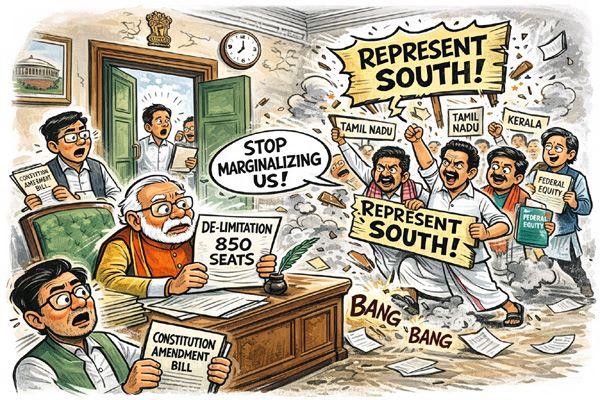
A high-stakes political confrontation is unfolding across India as the Centre’s proposed delimitation exercise—linked to the implementation of the women’s reservation law—triggers a sharp North–South divide, with southern leaders warning of a direct assault on federal balance and political representation.
- Bharatiya Janata Party moves to fast-track women’s quota with sweeping constitutional overhaul
- Southern CMs led by M. K. Stalin warn of “massive agitation” over representation fears
- A. Revanth Reddy flags “injustice” to SCs, STs, women if southern seats shrink
- K. T. Rama Rao cautions of nationwide agitation if South’s voice is diluted
- Shashi Tharoor pitches “degressive proportionality” to balance population with federal equity
- Debate widens: From North–South divide to migrant education, NEP gaps and inclusive governance
At the heart of the storm is the Bharatiya Janata Party-led government’s plan to expand the Lok Sabha from 543 to 850 seats, alongside enabling 33% reservation for women ahead of the 2029 general elections. The move, to be introduced through a Constitutional amendment during a special Parliament session, has ignited fierce resistance from opposition-ruled southern states.
“Final Warning”: Stalin Draws the Battle Lines
Tamil Nadu Chief Minister M. K. Stalin has emerged as the most vocal critic, convening an emergency meeting of DMK MPs and issuing a stern political message.
Read Also:
“Delimitation or domination?”: Stalin’s fiery warning puts Centre on notice
“If anything is done that harms Tamil Nadu, or that disproportionately enhances the political power of northern states, we in Tamil Nadu will not remain silent… Tamil Nadu will register its protest with full force… we will organise a massive agitation,” he warned.
Raising concerns over lack of transparency, Stalin said: “We do not even know how this delimitation exercise is going to be carried out. No explanation has been provided so far… When such secrecy surrounds this process, it only strengthens the suspicion that a grave danger lies beneath.”
In a direct message to Prime Minister Narendra Modi, he added: “If you imagine that you can wrong Tamil Nadu and move on as usual, you are mistaken… this is the final warning.”
Telangana Joins Chorus: “Injustice to the South”
Echoing similar concerns, Telangana Chief Minister A. Revanth Reddy cautioned that delimitation without proportional safeguards could harm vulnerable sections.
Dear Shri @narendramodi Ji
I am writing this open letter to you in response to the latest proposal to increase Lok Sabha seats to 850.#LokSabhaDelimitation pic.twitter.com/4M566g78kU
— Revanth Reddy (@revanth_anumula) April 14, 2026
“Women, SCs and STs in southern states would face injustice if there is no adequate increase in seats,” he said, advocating a pro-rata or hybrid model.
Reddy underlined the imbalance: “If there is an increase of 30 seats in a northern state… will Dalits, STs and women in southern states not lose if the seats decrease?”
Meanwhile, K. T. Rama Rao warned that any attempt to dilute southern representation “will not remain just a political issue but could trigger a widespread public agitation.”
Centre’s Push: “Nothing Controversial”
Defending the move, Union Minister Kiren Rijiju asserted: “There is nothing controversial… The issue of women’s reservation cannot be made a political matter… The Prime Minister has made a very simple and clear appeal to rise above party politics.”
The Centre argues that delimitation is essential to operationalise the Nari Shakti Vandan Adhiniyam (2023) and ensure equitable representation based on updated population data.
The Core Conflict: Population vs Performance
The proposed exercise has revived a long-standing fault line:
- Northern states with higher population growth stand to gain more seats
- Southern states like Tamil Nadu and Kerala, which controlled population growth, fear losing relative influence
Congress leader Shashi Tharoor offered a middle path, suggesting: “It would be dangerous for our federalism if smaller states felt their prosperity and human development were being punished with relative disenfranchisement.”
He proposed adopting the European model of “degressive proportionality”, where:
- Larger states get more seats
- Smaller states retain meaningful representation
“We need a compromise between strict democratic representation and ensuring smaller political entities have a meaningful voice,” Tharoor said, urging wider consultations.
Beyond Politics: Migrants, NEP and Education Inequality
While the delimitation debate dominates headlines, a parallel issue is gaining traction—educational access for migrant communities.
India’s National Education Policy 2020 emphasises multilingual education and mother tongue learning. Yet, in several urban centres, civic-run schools teaching Tamil, Odia, Sindhi, Marathi and Telugu have been shut due to low enrolment.
This contradiction is stark:
- Policy promises linguistic inclusion
- Ground reality reflects institutional withdrawal
Migrants—who form a crucial urban workforce—now face limited access to education in their native languages, raising questions about inclusive governance.
Global Contrast: Lessons from Asia
Countries like Singapore and Malaysia offer a contrasting model:
- Mother tongue education is actively preserved
- Classes continue even with fewer than 10 students
- Linguistic diversity is treated as a national asset
The comparison raises a critical question for Gujarat and other “model states”:
If smaller nations can sustain linguistic inclusivity, why can’t India’s urban systems?
Political Takeaway: Continuity vs Course Correction
The delimitation debate is no longer just about seat numbers—it is about:
- Federal balance
- Regional equity
- Inclusive development
What Lies Ahead:
- BJP likely to push reforms with parliamentary strength
- Opposition to intensify mobilisation across southern states
- Migrant and youth issues may reshape future political narratives
Bottom Line
India stands at a constitutional crossroads. The challenge is not merely to expand Parliament, but to ensure that expansion does not shrink the voice of any region or community.
As M. K. Stalin declared, the battle is not just political—it is existential for federalism. And as voices from the South grow louder, the Centre faces a crucial test:
Can it deliver reform with consensus—or risk deepening the divide?