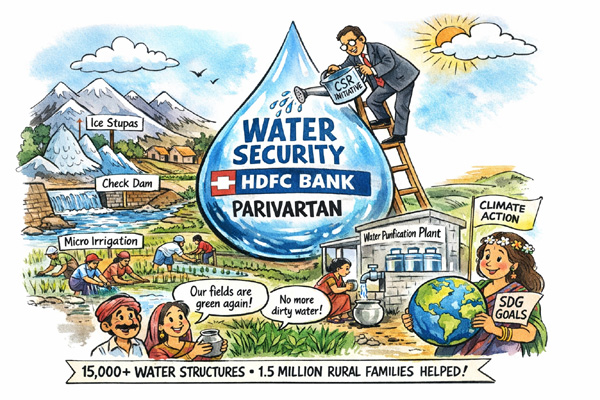
- Over 15,000 water structures revive villages, secure livelihoods across 28 states
- From Himalayan ice stupas to drought-zone check dams, CSR redefines water resilience
- 15 lakh households gain water security; safe drinking water reaches 950+ villages
- Integrated farming, irrigation and community ownership drive sustainable impact
- Decade-long mission aligns with climate action and clean water global goals
NE ENVIRONMENT BUREAU
MUMBAI, APR 16
In a sweeping, ground-level transformation of rural India’s water landscape, HDFC Bank under its flagship CSR initiative Parivartan has built and restored over 15,289 water structures, touching more than 10,430 villages and supporting nearly 15 lakh households.
What sets this initiative apart is not just scale, but its depth—spanning geographies as diverse as the Himalayan highlands, where innovative ice stupas conserve glacial water, to parched districts where check dams and farm ponds are reviving agriculture and livelihoods.
Engineering water security, one village at a time
The programme’s footprint includes a wide array of decentralised water assets—farm ponds, check dams, rainwater harvesting systems, and jal minars—ensuring both irrigation and drinking water access.
In central tribal belts, lift irrigation systems and recharge wells are expanding cultivation possibilities, while over 950 villages now have access to safe drinking water through advanced purification systems using UV, RO, and multi-stage filtration technologies.
Beyond infrastructure: Farming futures reimagined
Recognising that water alone cannot transform rural economies, Parivartan integrates agricultural support—micro-irrigation, shade net farming, bio-input centres and multi-layer cultivation.
This convergence has led to increased irrigation coverage, reduced dependence on erratic rainfall, and improved crop yields, enabling small farmers to move from subsistence to sustainability.
Equally critical is capacity building. Water user groups are trained in water budgeting and efficient utilisation, ensuring long-term viability of assets.
Community at the core
Unlike conventional top-down CSR models, Parivartan embeds community ownership at every stage. Participatory Village Action Plans—developed with women’s self-help groups and water associations—guide interventions, ensuring they reflect local priorities.
Technology further sharpens impact, with GIS-based planning enabling precise site selection, while convergence with schemes like MGNREGA amplifies scale and efficiency.
Voices of impact
Nusrat Pathan, Head – CSR, HDFC Bank: “At HDFC Bank Parivartan, we have worked to meet communities where they are, whether that means building ice stupas in the mountains or installing purification plants in villages that have never had clean tap water.”
“Through ‘Parivartan’, our work spans watershed development, rainwater harvesting, the construction and rejuvenation of water bodies, last-mile irrigation infrastructure, and the promotion of climate-smart agricultural practices.”
“Over 15,000 water structures and safe drinking water for nearly a thousand villages is a milestone, but the real measure is in the fields that now yield a second crop and the children who no longer fall ill from contaminated water.”
“We remain committed to building a water-secure India.”
A decade of purpose, a future of sustainability
Over the past decade, Parivartan has evolved into a holistic rural development engine. In FY 2024–25, Natural Resource Management was formalised as a core pillar—integrating water conservation, afforestation, soil health and solar energy.
Aligned with global benchmarks like Sustainable Development Goal 6 (Clean Water and Sanitation) and SDG 13 (Climate Action), the initiative places water security at the heart of climate resilience.
With a CSR outlay of ₹1,068.03 crore in FY 2024–25 and a cumulative impact on over 10.56 crore lives, Parivartan stands as one of India’s most comprehensive corporate-led social transformation programmes.