NE POLITICAL BUREAU
NEW DELHI, APR 17
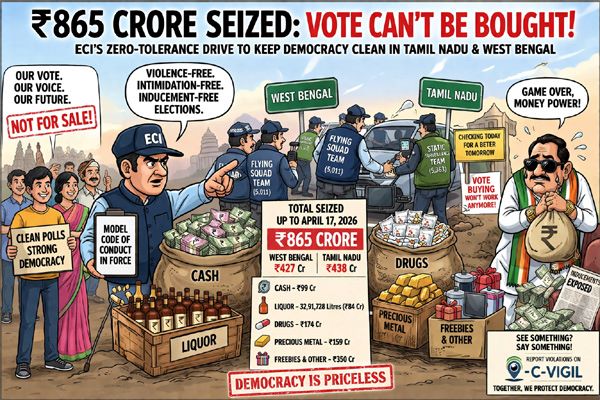
In a stark indicator of the scale at which inducements can influence electoral processes, the Election Commission of India has reported seizures exceeding ₹865 crore across Tamil Nadu and West Bengal since the announcement of the 2026 Assembly elections—underscoring an aggressive crackdown on money power and illegal incentives during polls.
The Election Commission had announced the poll schedule on March 15, 2026, covering key states including Tamil Nadu and West Bengal, while directing strict enforcement of the Model Code of Conduct (MCC).
“The Commission has directed the State/UT governments to ensure strict compliance with the Model Code of Conduct (MCC).”
To ensure clean elections, the Commission has intensified coordination with top bureaucratic and enforcement machinery.
“It may be recalled that the Commission has held multiple review meetings with the Chief Secretaries, CEOs, DGPs, and senior officers… and directed them to ensure violence-free, intimidation-free and inducement free elections.”
On the ground, enforcement has scaled up significantly. Over 5,011 Flying Squad Teams (FSTs)—2,728 in West Bengal and 2,283 in Tamil Nadu—have been deployed to respond to complaints within 100 minutes. Additionally, 5,363 Static Surveillance Teams (SSTs) are conducting surprise checks across strategic locations.
Since the activation of the Election Seizure Management System (ESMS) on February 26, 2026, the data till April 17 paints a revealing picture:
- West Bengal: ₹427 crore seized, including cash, liquor, drugs, precious metals, and freebies
- Tamil Nadu: ₹438 crore seized across similar categories
- Total: ₹865 crore
The seizures include ₹99 crore in cash, over 32.9 lakh litres of liquor, ₹174 crore worth of drugs, and ₹350 crore in freebies and other inducements—highlighting the multi-pronged nature of election-related violations.
At the same time, the Commission has sought to strike a balance between strict enforcement and public convenience.
“The Commission has also stressed that the enforcement authorities should ensure that ordinary citizens are not inconvenienced or harassed during the checking and inspection for the enforcement of these directives.”
To address concerns, District Grievance Committees have been established, while citizens and political parties are encouraged to actively report violations through the C-Vigil platform—making electoral vigilance increasingly participatory and technology-driven.
While the seizures reflect robust enforcement, they also raise broader questions about the persistence of inducement-driven practices in elections. As polling dates approach, the spotlight remains firmly on ensuring that democratic choice is shaped by free will—not financial influence.