

NE FEATURES BUREAU
AHMEDABAD, MAY 29
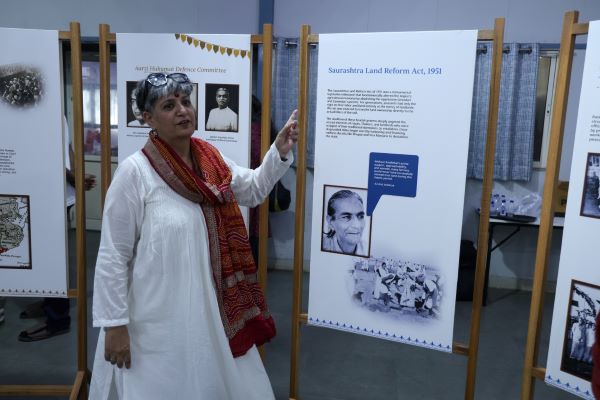
History stepped out of dusty archives and into public conversation on Friday as an exhibition dedicated to the life and legacy of veteran statesman Rasiklal U. Parikh opened at the Ahmedabad Management Association (AMA), attracting scholars, students, civic leaders and history enthusiasts eager to revisit a defining chapter in Gujarat’s political evolution.
- Exhibition marks the 116th birth anniversary of legendary statesman Rasiklal U. Parikh
- Rare archival material highlights his role in freedom struggle, land reforms and state-building
- Research-led initiative developed by a Nirma University design student draws scholars, civic leaders and citizens
- Exhibition explores Parikh’s contributions to Saurashtra, Gujarat and the Constituent Assembly of India
- Organisers envision the project as a travelling public archive to preserve Gujarat’s political heritage
Titled “A Visionary Statesman: The Public Life of Rasiklal U. Parikh,” the exhibition offers a compelling journey through the life of a freedom fighter, administrator and institution-builder whose contributions helped shape post-Independence Saurashtra and Gujarat.
More than a commemorative event, the exhibition seeks to rekindle public memory of a leader whose role in governance, land reforms and democratic institution-building has often remained overlooked in mainstream historical narratives.
A Statesman Who Helped Shape Modern Gujarat
Born on May 29, 1910, in Limbdi, Rasiklal U. Parikh emerged as one of the key architects of governance in western India during the formative years following Independence.
A participant in both the Salt Satyagraha and the Quit India Movement, Parikh endured imprisonment during the freedom struggle before going on to play a pivotal role in public administration.
He served as Home Minister and later Chief Minister of Saurashtra State and subsequently handled important portfolios including revenue, land, home and industry in the Bombay and Gujarat governments. As a member of the Constituent Assembly of India, he contributed to the shaping of independent India’s democratic foundations.
Five Chapters of a Remarkable Public Life
Spread across five thematic sections, the exhibition chronicles Parikh’s extraordinary journey from freedom fighter to nation-builder.
Visitors are taken through key milestones including:
- The integration of princely states into the Indian Union
- The Junagadh annexation and formation of the Aarzi Hukumat
- The implementation of the landmark Saurashtra Land Reform Act
- Institution-building challenges in newly independent India
- His intellectual pursuits, personal struggles and enduring public legacy
Archival photographs, historical documents, interpretive panels and rare narratives offer visitors a deeper understanding of governance during a transformative period in Indian history.
A Young Researcher’s Mission to Preserve History
What makes the project particularly noteworthy is that it has been conceptualised and developed by Raj Patel, an intern from the Institute of Design at Nirma University, as part of his graduation project.
Supported by members of the Parikh family and archival researchers, the initiative adopts a research-driven approach to public history, making historical knowledge accessible to contemporary audiences.
Unlike traditional memorial exhibitions, the project encourages visitors to engage critically with questions of governance, leadership and public service.
“A Travelling Public Archive for Future Generations”
Speaking about the initiative, Parikh’s granddaughter Gauri Wagenaar said:
“The exhibition emerged from a long-standing desire to reclaim and preserve an important yet increasingly overlooked chapter of Gujarat’s political history. The initiative is envisioned not merely as a memorial project, but as a travelling public archive that would continue to engage audiences across Gujarat over the coming months.”
Her remarks underscore the broader objective of transforming the exhibition into a living repository of historical memory that can inspire future generations.
Reflections from Scholars and Civic Leaders
The inauguration ceremony witnessed the participation of historians, academics, civic leaders and invited guests who shared personal recollections and reflections on Parikh’s public life.
Many speakers highlighted his commitment to ethical governance, institution-building and public service, describing him as a leader whose contributions remain deeply relevant in contemporary times.
For younger visitors, the exhibition offers a rare opportunity to understand how visionary leadership helped lay the foundations of modern Gujarat and democratic India.
A Legacy Worth Remembering
At a time when public discourse often focuses on contemporary politics, the exhibition serves as a timely reminder of the individuals who shaped the nation through courage, sacrifice and administrative foresight.
By bringing Rasiklal U. Parikh’s story back into the public domain, the exhibition not only honours a distinguished statesman but also encourages reflection on the values of public service, integrity and nation-building that continue to resonate today.