- Union Minister Dr. Jitendra Singh launches DST-funded Central Instrumentation Facility and three strategic research clusters to accelerate translational science
- Nearly 70 industries join as founding partners in a landmark industry-academia alliance aimed at converting cutting-edge research into national capability
- Advanced Materials, Clean Energy and Healthcare & MedTech clusters to drive indigenous technologies, commercialisation and future-ready innovation ecosystems
- Shared scientific infrastructure, startup incubation and interdisciplinary collaboration positioned as catalysts for India’s semiconductor, quantum and AI ambitions
- Minister calls for science that delivers societal impact, urging researchers to move beyond publications towards deployable solutions for Viksit Bharat 2047
NE SCIENCE & TECHNOLOGY BUREAU
GANDHINAGAR, JUNE 11
In a major push towards building a globally competitive research and innovation ecosystem, Union Minister of State (Independent Charge) for Science & Technology and Earth Sciences Dr. Jitendra Singh inaugurated the Department of Science & Technology (DST)-funded Central Instrumentation Facility (CIF) and three flagship research clusters at IIT Gandhinagar, calling for a paradigm shift from academic publications to real-world technological solutions that power India’s journey towards Viksit Bharat 2047.
The newly launched Advanced Materials Research Cluster (AMRC), Energy Research Cluster (ERC) and Healthcare & MedTech Research Cluster (HMRC) are designed to bridge the gap between laboratory discoveries and industrial deployment, fostering innovation that directly addresses national priorities in materials self-reliance, clean energy and affordable healthcare.
Highlighting the growing confidence of industry in academic research, Dr. Jitendra Singh announced that around 70 industries have joined the initiative as founding partners, creating one of the country’s most significant industry-academia collaborative platforms for translational research and technology commercialisation.
Addressing the programme “Advancing Research & Innovation Towards Viksit Bharat with the Inauguration of Major Research Initiatives,” the Minister stressed that scientific excellence must ultimately translate into societal and economic value.
“The true value of scientific research lies not merely in publications, but in its ability to create tangible societal and economic impact. India requires a robust ecosystem where discoveries move seamlessly from laboratories to deployment through effective collaboration between academia, industry and government.”
Describing the newly inaugurated clusters as embodiments of translational research, the Minister observed that India’s strategic challenges require sustained scientific efforts extending well beyond academic output.
“India’s critical challenges in materials self-reliance, clean energy and affordable healthcare require sustained efforts beyond research publications. The newly launched clusters embody a translational research approach where scientific discovery is carried through pilot development, validation and technology transfer.”
Dr. Jitendra Singh also underlined the government’s commitment to democratising research opportunities through the Anusandhan National Research Foundation (ANRF), ensuring that financial and technical support reaches institutions across the country rather than remaining confined to traditional centres of excellence.
He emphasised that India’s research ecosystem must harness its multidisciplinary strengths by integrating science, humanities and social sciences to solve complex national challenges through holistic approaches.
Calling the present era “a decade of science and technology,” the Minister noted that initiatives such as the National Quantum Mission and IndiaAI Mission are positioning India as a key player in frontier technologies while opening new avenues for researchers and institutions.
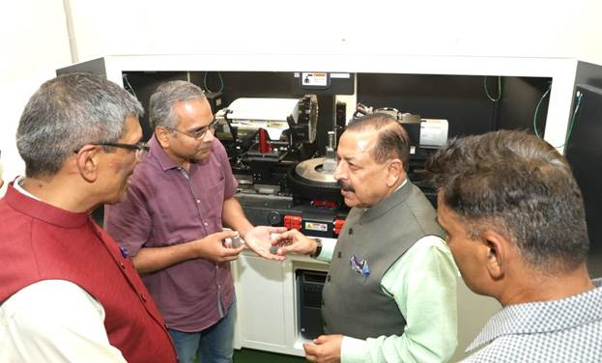
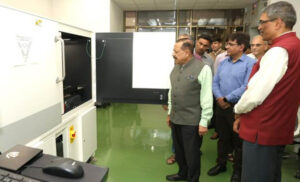
The inauguration of the Central Instrumentation Facility marks another strategic milestone. Equipped with advanced shared scientific infrastructure, the facility will provide researchers, startups and industries access to sophisticated equipment that would otherwise remain beyond the reach of individual institutions, strengthening national priorities including India’s semiconductor ecosystem.
During his visit, Dr. Jitendra Singh toured the IIT Gandhinagar Research Park, interacting with startups and faculty-led technology demonstrations that showcase innovations with commercial and societal potential. Established with support from the Department of Science and Technology, the Research Park currently hosts more than 20 companies and over 30 startups, creating a vibrant ecosystem for research commercialisation and entrepreneurship.
Advocating deeper industry engagement, the Minister stressed that collaboration should begin at the conceptualisation stage of research rather than after project completion, enabling smoother technology transfer and greater alignment with societal and industrial needs.
Referring to the recently announced ₹1 lakh crore Research, Development and Innovation (RDI) initiative, he said it reflects the Government’s commitment to strengthening private-sector participation in research while encouraging institutions to leverage partnerships with industry and philanthropic organisations.
The Minister also interacted with representatives of NAMTECH, appreciating their efforts to develop future-ready talent through industry-integrated learning models aligned with emerging technology sectors.
During the programme, Dr. Jitendra Singh released a publication highlighting IIT Gandhinagar’s Top 25 Research Achievements of 2025, commending the institute’s interdisciplinary culture and emphasis on sustainable development, creative learning and solution-driven research.
Concluding his address, the Minister expressed confidence that the newly launched research clusters, shared scientific infrastructure and industry-linked innovation ecosystem would significantly strengthen India’s scientific capabilities.
“India’s path to becoming a developed nation will be built through institutions where research meets industry and innovation translates into national capability.”
The launch represents a decisive step towards creating a future where laboratories, startups, industries and policymakers work in unison—transforming scientific discoveries into technologies that enhance national competitiveness, economic growth and societal well-being.