- MoUs, urban infrastructure and energy security take centre stage as Vadodara hosts the fourth edition of the Vibrant Gujarat Regional Conference
- Manohar Lal Khattar says reliable power, modern cities and policy stability are the strongest pillars for attracting long-term investments
- Chief Minister Bhupendra Patel highlights ₹13.30 lakh crore investment intent generated through 9,499 MoUs across the first three regional conferences
- Conference showcases Gujarat’s integrated growth model with high-speed rail, clean mobility, MSMEs, start-ups and smart urban infrastructure driving the next investment cycle
NE BUSINESS BUREAU
VADODARA, JUNE 29
Positioning Gujarat at the forefront of India’s next wave of industrial expansion, the fourth edition of the Vibrant Gujarat Regional Conference (VGRC) in Vadodara underscored how reliable energy, world-class infrastructure and policy continuity are strengthening the state’s appeal as one of the country’s most competitive investment destinations.
The conference, a precursor to the Vibrant Gujarat Global Summit, brought together policymakers, industry leaders, investors, entrepreneurs and international delegates to chart the next phase of Central Gujarat’s economic transformation. Several Memoranda of Understanding (MoUs) were signed between the Gujarat Government and leading companies, aimed at converting the region’s industrial strengths into sustainable economic growth.
Launching the conference, Chief Minister Bhupendra Patel described the VGRC as a new model of balanced regional development, stating that Gujarat has consistently advanced the vision of inclusive growth envisioned by Prime Minister Narendra Modi.
Highlighting the outcomes of the previous regional conferences held in Mehsana, Rajkot and Surat, Patel said they had together generated 9,499 MoUs involving proposed investments worth nearly ₹13.30 lakh crore, creating a strong pipeline for industrial expansion and employment generation.
Addressing the gathering, Union Minister for Power and Housing & Urban Affairs Manohar Lal Khattar said investor confidence is built not merely on incentives but on dependable governance and robust infrastructure.
“Reliable power supply, modern infrastructure, capable cities, skilled human resources and stable policies are the strongest foundations for winning investor confidence.”
He said Gujarat’s consistent policy framework and efficient governance over the past two decades have positioned the state among the world’s preferred investment destinations.
Calling the regional conference an innovative governance model, Khattar observed that it has evolved beyond a conventional investment event.
“It is much more than an event; it is a model of participatory governance.”
He noted that by facilitating direct interaction among government, industries, MSMEs, start-ups and local entrepreneurs, the platform is making policy formulation more inclusive while improving implementation efficiency. He expressed confidence that the regional engagements would significantly strengthen preparations for the Vibrant Gujarat Global Summit 2027 in Ahmedabad.
Emphasising the role of energy security in industrial competitiveness, Khattar said industries flourish when supported by reliable electricity, seamless logistics, quality infrastructure and efficient urban services.
“Dependable power is the foundation of a strong economy, and Gujarat continues to lead the nation in this regard.”
He noted that India successfully met a record peak electricity demand of nearly 271 GW this year and has already planned capacity to meet demand of 300 GW, driven by the rapid growth of data centres, electric mobility and Artificial Intelligence. He added that the vision of “One Nation, One Grid, One Frequency” continues to strengthen India’s energy resilience despite global geopolitical uncertainties.
The Union Minister also stressed that urban infrastructure has become a decisive factor in investment decisions, with investors evaluating housing, mobility, water supply, sanitation, digital governance and civic amenities alongside industrial infrastructure.
Highlighting inclusive economic development, he said the PM SVANidhi Scheme has extended institutional credit to over 7.6 million street vendors, while more than 4 million beneficiaries have established strong credit histories through timely repayments. Nearly 800,000 beneficiaries have subsequently graduated to higher-value credit under the Pradhan Mantri Mudra Yojana.
On the sidelines of the conference, a panel discussion on “High-Speed Rail Corridor as a Catalyst for Economic Growth and Regional Development” explored the transformative role of connectivity in industrial development.
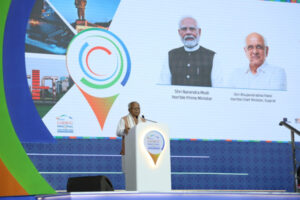
Khattar observed: “Connectivity is not merely about linking two cities or facilitating the movement of people, but is intrinsically linked to economic growth and regional development.”
He added that economic corridors stimulate industrial investment, generate employment and reshape regional economies.
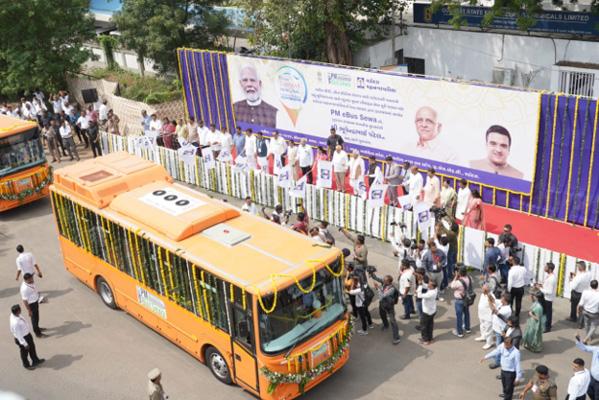
Reinforcing Gujarat’s clean mobility agenda, Chief Minister Bhupendra Patel and Deputy Chief Minister Harsh Sanghvi flagged off 30 air-conditioned electric buses under the PM e-Bus Service in the presence of Union Minister Manohar Lal Khattar, signalling another step towards sustainable urban transport and greener cities.
With strategic investments, next-generation infrastructure, clean energy initiatives and collaborative policymaking converging on a single platform, the Vadodara conference reaffirmed Gujarat’s position as one of India’s most dynamic engines of economic growth.