NE POLITICAL BUREAU
NEW DELHI, JUNE 29
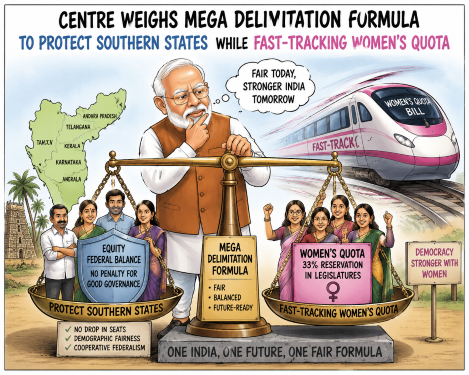
In what could emerge as one of the most consequential constitutional reforms since Independence, the Centre is working on a fresh political blueprint that seeks to simultaneously strengthen Mahila Shakti in India’s democratic institutions and address the long-standing apprehensions of the southern states over parliamentary delimitation.
Highly placed sources indicated that the government is examining multiple formulations to increase the number of Lok Sabha seats by nearly 50 per cent, enabling the implementation of the women’s reservation law ahead of the 2029 General Elections while ensuring that states which successfully controlled population growth do not suffer a decline in political representation.
- Government explores up to 50% increase in Lok Sabha seats to preserve federal balance and unlock 33% reservation for women before the 2029 general elections
- Fresh Constitution Amendment draft seeks to retain the existing inter-state seat ratio based on the 1971 Census, addressing concerns of Tamil Nadu, Kerala, Karnataka, Andhra Pradesh and Telangana
- Lok Sabha strength could rise from 543 to nearly 850, with corresponding expansion in State Assemblies and Union Territory legislatures
- Proposal aims to prevent population-control success from translating into diminished parliamentary representation for southern India
- Women’s reserved constituencies to rotate across states and Union Territories after delimitation exercise
- Government expected to move the Bill only after securing the crucial two-thirds majority in Parliament
The move assumes significance as Tamil Nadu, Kerala, Karnataka, Andhra Pradesh and Telangana have consistently voiced concerns that a purely population-based delimitation exercise could reduce their relative share of seats in the Lok Sabha despite their achievements in population stabilisation, literacy, healthcare and social development.
The fresh draft of the Constitution Amendment Bill, now under consideration after an earlier version failed to secure the constitutionally mandated two-thirds majority in the Lok Sabha on April 17, reportedly seeks to preserve the existing inter-state seat distribution based on the 1971 Census, while redrawing constituencies internally using the 2011 Census figures. The ongoing national Census is yet to be completed and its final population figures are not available.
Sources stressed that retaining the current inter-state ratio is only one of several options under active consideration and that no final decision has yet been taken.
The proposal is designed to strike a delicate constitutional balance—expanding representation without upsetting the federal compact that has governed parliamentary seat allocation for decades.
At present, the Nari Shakti Vandan Adhiniyam, which provides 33 per cent reservation for women in the Lok Sabha and State Legislative Assemblies, cannot come into force before 2034, as its implementation is linked to the delimitation process after the next Census.
To make the landmark legislation operational before the 2029 Lok Sabha elections, the government is now considering amendments that would delink implementation from the existing timeline while undertaking a simultaneous expansion of parliamentary and Assembly constituencies.
According to the current proposal, the strength of the Lok Sabha could rise from 543 seats to as many as 850, significantly increasing women’s representation without reducing the political weight of any region.
The Constitution Amendment Bill introduced earlier this year also proposes a proportionate increase in the number of seats in State Legislative Assemblies and Union Territory legislatures to accommodate the one-third reservation for women.
The Bill further provides that: “The seats reserved for women in Lok Sabha and legislative Assemblies shall be allotted by rotation to different constituencies in a state or Union territory.”
Government sources said the legislation will be introduced only after the ruling coalition is confident of securing the required numbers in Parliament. The NDA currently commands around 300 members in the Lok Sabha, with three vacancies, while a Constitution Amendment requires the support of at least two-thirds of the House, translating to around 360 votes under the present strength.
Political observers say the emerging formula reflects the government’s attempt to reconcile two competing national priorities—expanding women’s participation in legislative bodies and preserving the federal equilibrium between India’s rapidly growing northern states and the demographically stabilised southern region.
If the proposed framework is eventually adopted, it could pave the way for the largest expansion of parliamentary representation since Independence while ensuring that Mahila Shakti occupies nearly one-third of India’s legislative institutions without triggering an inter-state political imbalance.