- Defence Acquisition Council clears capital procurement proposals to bolster the Army, Navy and Air Force with next-generation indigenous combat capabilities
- Anti-drone warfare, advanced missile systems, kamikaze drones, tank protection and maritime surveillance dominate one of the biggest defence modernisation approvals of the year
- Indian Navy to strengthen sea-denial, unmanned operations and electric propulsion testing, while the Air Force gains persistent high-altitude surveillance capabilities
- Capital acquisitions aim to enhance operational readiness, survivability and technological superiority across multiple domains of warfare
- Strategic approvals reinforce India’s vision of building a self-reliant, technology-driven and future-ready military force
NE DEFENCE BUREAU
NEW DELHI, JULY 3
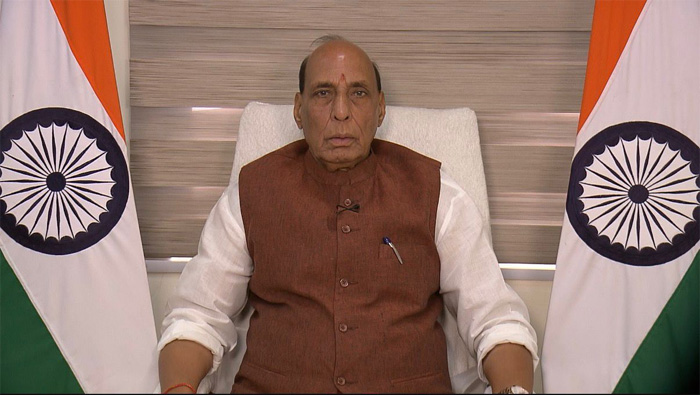
In a decisive move to strengthen India’s military preparedness amid an evolving global security landscape, the Defence Acquisition Council (DAC), chaired by Defence Minister Rajnath Singh, on Thursday accorded Acceptance of Necessity (AoN)—the in-principle administrative approval—for capital acquisition proposals worth approximately ₹52,000 crore, paving the way for the induction of a new generation of advanced weapon systems for the Indian Army, Navy and Air Force.
The approvals are aimed at significantly enhancing the operational capabilities, survivability and technological edge of the three Services while reinforcing India’s drive towards indigenous defence manufacturing and self-reliance.
For the Indian Army, the DAC approved the procurement of the AKASH TARANG Anti-Unmanned Aerial Vehicle (UAV) Electronic Warfare System, Man Portable Anti-Tank Guided Missile (MPATGM) Systems, Medium Range Surface-to-Air Missile (MRSAM) Weapon System, Very Short Range Air Defence System (V-SHORADS), Active Protection System for Tanks, and Jet-Based Kamikaze Drone System.
The AKASH TARANG system is designed to provide robust protection against hostile drones and unmanned aerial threats, while the MPATGM will significantly enhance the Infantry’s capability to neutralise enemy armoured and mechanised formations.
The MRSAM Weapon System will strengthen medium-range air defence against a wide spectrum of stand-off aerial threats, while the multi-spectral V-SHORADS will improve resilience against sophisticated countermeasures and boost low-level air defence capabilities.
To improve battlefield survivability, the Active Protection System will enhance the defensive shield of tanks against incoming threats, while the Jet-Based Kamikaze Drone System will provide enhanced electronic warfare capabilities with greater precision, lethality, survivability and cost-effectiveness.
For the Indian Navy, the DAC approved the acquisition of the Multi Influence Ground Mine (MIGM), Naval Shipborne Unmanned Aerial System (NSUAS) and the establishment of a Land Based Testing Facility (LBTF) for Electric Propulsion Systems.
The MIGM is expected to strengthen the Navy’s sea-denial capability by restricting adversary movement, while the sensor-equipped NSUAS will significantly enhance maritime surveillance, reconnaissance and situational awareness. The proposed LBTF will facilitate comprehensive testing of motors and electric propulsion systems for future naval platforms.
For the Indian Air Force, the Council approved the procurement of the Fixed-Wing High Altitude Pseudo Satellite (FW-HAPS) along with other capability enhancement proposals.
The FW-HAPS platform will provide persistent Intelligence, Surveillance and Reconnaissance (ISR), remote sensing and telecommunication capabilities from high altitudes, considerably improving the Air Force’s operational reach, real-time intelligence gathering and network-centric warfare capabilities.
The latest approvals reflect the Government’s continued emphasis on equipping the Armed Forces with cutting-edge technologies capable of addressing emerging threats across land, sea, air and electronic warfare domains. The acquisitions are also expected to provide a further boost to India’s indigenous defence manufacturing ecosystem while accelerating the country’s journey towards becoming a globally competitive defence production hub under the vision of Aatmanirbhar Bharat.