- Ahmedabad records an intense spell of nearly 177 mm rain in two hours, triggering widespread waterlogging, traffic paralysis and emergency response
- South Gujarat remains the epicentre of the rain fury as Valsad, Navsari, Surat and Tapi face red-alert conditions and extremely heavy rainfall
- CM Bhupendra Patel reviews situation at State Emergency Operation Centre; PM Modi and HM Amit Shah assure full Central support
- Additional NDRF and SDRF teams ordered into action; district collectors, in-charge ministers, secretaries and local administrations mobilised
- Schools and colleges in Ahmedabad to remain closed on July 24 as IMD warns of heavy to very heavy rain
- Rail traffic between Gholvad and Umargam Road suspended after water reaches danger mark; multiple Gujarat–Mumbai services cancelled or diverted
NE NEWS SERVICE
AHMEDABAD, JULY 23
Gujarat’s monsoon fury on Thursday transformed rain from a seasonal blessing into a statewide test of preparedness, resilience and emergency coordination—with Ahmedabad witnessing an extraordinary burst of rain, South Gujarat facing flood-like conditions and the State Government activating its administrative, civic and disaster-response machinery on a war footing.
The deluge disrupted normal life across several parts of the State, inundating roads, choking traffic, affecting connectivity and forcing precautionary decisions on education and rail services. The most intense impact was reported from South Gujarat, particularly Valsad, Navsari, Surat and Tapi, where the administration remained on high alert amid exceptionally heavy rainfall and rising water levels in rivers and low-lying areas.
In Ahmedabad, an intense spell reportedly dumped around 177 mm of rain in just two hours, causing severe waterlogging, stranded vehicles and widespread traffic disruption. The extreme spell prompted authorities to declare a holiday for schools and colleges in the city on Friday, July 24, as a precautionary measure.
CM reviews crisis at SEOC; PM, HM assure full central support
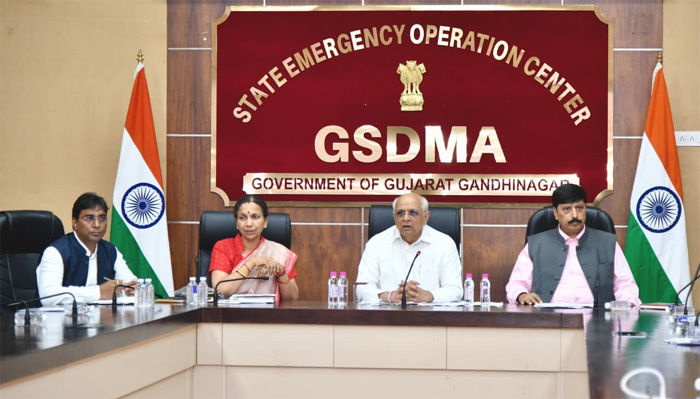
Chief Minister Bhupendra Patel reviewed the statewide situation at the State Emergency Operation Centre in Gandhinagar, with particular focus on Surat, Valsad, Navsari and Tapi.
The Chief Minister spoke directly with the Collectors of the affected districts to take stock of rainfall, flood conditions, rescue and evacuation operations and the status of rivers. Prime Minister Narendra Modi and Union Home Minister Amit Shah also spoke to the Chief Minister and assured full support from the Centre for rescue, relief, evacuation and safety operations.
The State Government has directed that rescue and evacuation of people stranded by flooding and residents of low-lying areas must receive the highest priority.
Additional NDRF and SDRF teams have been ordered to support local administrations. Deputy Chief Minister Harsh Sanghavi, Tribal Development Minister Naresh Patel and senior officials Remya Mohan and Alok Pandey have been assigned responsibilities to assist district administrations in rain-affected areas. In-charge secretaries have also been directed to reach districts where red alerts have been issued.
South Gujarat takes the brunt
The State Emergency machinery remained particularly focused on South Gujarat, where Valsad, Navsari, Surat and Tapi were under red-alert conditions amid extremely heavy rainfall.
Relief Commissioner Gaurav Makwana briefed the review meeting on the preparedness of the administration and said that the southern districts had been facing severe weather conditions, with Valsad, especially Umargam taluka, receiving exceptionally heavy rainfall.
The rain also raised concerns over river levels, low-lying settlements, road connectivity and the safety of people living in vulnerable areas.
The administration has been directed to maintain close surveillance over vulnerable locations and ensure that rescue and evacuation resources remain available at short notice.
In Valsad district, following heavy rainfall, people trapped in floodwaters were rescued from danger through a helicopter rescue operation by the district administration, which has set an exemplary standard for alertness and service in this emergency situation.
3,400+ dumpers, 1,100 JCBs kept ready to reopen roads
The State Government has also prepared a major post-flood road-restoration response.
The Roads and Buildings Department has kept more than 3,400 dumpers and over 1,100 JCB machines, besides other essential materials, ready to restore roads affected by overtopping, approach erosion and washouts once floodwaters recede.
The preparedness is aimed at ensuring that the disruption of road connectivity does not continue after the rain intensity declines.
The Chief Minister also reviewed the status of electricity supply, drinking-water distribution, State Transport services and road connectivity in the affected districts.
The Health Department has been instructed to remain ready with sanitation measures, disease-prevention arrangements and adequate stocks of essential medicines to prevent post-flood outbreaks.
Ahmedabad: 177 mm in two hours; schools, colleges to remain shut
Ahmedabad experienced one of the most intense spells of the day, with nearly 177 mm of rain reported in two hours, leaving several roads and underpasses waterlogged and disrupting traffic movement.
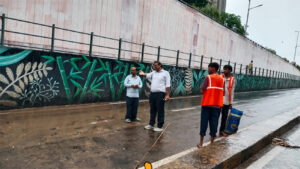
Amid heavy rainfall across the city, Ahmedabad Municipal Commissioner Banchhanidhi Pani, along with DyMCs, conducted on-ground inspections of waterlogging-affected areas to assess the situation and review drainage operations.
In view of the IMD warning of heavy to very heavy rainfall, all schools and colleges in Ahmedabad were ordered to remain closed on Friday, July 24, as a precautionary step to protect students and staff.
The decision reflects the administration’s attempt to reduce unnecessary movement at a time when several roads and low-lying areas may remain vulnerable to water accumulation.
IMD, SDMA alertS: Heavy rain threat continues
The weather system continued to keep Gujarat on alert, with warnings of heavy rainfall across several districts.
An emergency alert circulated through the government’s SACHET alert system warned of the possibility of heavy rainfall at isolated places in Bharuch, Chhota Udepur, Dahod, Narmada, Navsari, Panchmahal, Surat, Tapi, Dang, Vadodara and Valsad, with residents advised to follow SDMA guidelines.
The IMD’s Ahmedabad centre has also maintained active weather-warning and rainfall-monitoring systems for Gujarat and adjoining regions.
With the possibility of continuing heavy rain, authorities have urged residents to avoid unnecessary travel through flooded roads, underpasses and vulnerable areas.
Dam and river monitoring intensified
The heavy rainfall has also put water infrastructure and river systems under close watch.
At Ukai Dam, the Surat Municipal Corporation’s monitoring data showed the reservoir level at 313.61 feet at 8 a.m. on July 23, against a full reservoir level of 345 feet, with estimated inflow of 11,002 cusecs and outflow of 800 cusecs at that time.
The State administration has been monitoring river levels and flood conditions as intense rain in catchment areas can rapidly alter downstream conditions.
NDRF, SDRF and central response machinery on alert
The Centre has been closely monitoring the monsoon situation through the Ministry of Home Affairs’ Integrated Control Room, working with the IMD, Central Water Commission and INCOIS to provide early warnings to State and District Emergency Operation Centres.
The NDRF has also remained an important component of Gujarat’s disaster-response architecture. In earlier large-scale Gujarat flood operations, NDRF teams were deployed across multiple districts and carried out rescue and evacuation missions on a large scale.
The State Government has now directed the deployment of additional NDRF and SDRF teams to support rescue, relief and evacuation operations in the current rain-affected districts.
The wider national disaster-response mechanism has also been activated to monitor the monsoon situation and coordinate assistance to affected States.
Western Railway: Gujarat–Mumbai connectivity hit
The rain fury also disrupted one of Gujarat’s busiest railway corridors.
According to a railway release, Western Railway temporarily suspended train operations between Gholvad and Umargam Road after water levels at Railway Bridge No. 203 reached the danger mark. The precautionary suspension affected several important services linking Mumbai, Ahmedabad and Gandhinagar.
Fully cancelled on July 23
The following trains were cancelled:
- 22953/22954 Mumbai Central–Ahmedabad–Mumbai Central Gujarat Superfast Express
- 20901/20902 Mumbai Central–Gandhinagar Capital–Mumbai Central Vande Bharat Express
- 22961/22962 Mumbai Central–Ahmedabad–Mumbai Central Vande Bharat Express
- 12009/12010 Mumbai Central–Ahmedabad–Mumbai Central Shatabdi Express
- 12933/12934 Bandra Terminus–Ahmedabad–Bandra Terminus Karnavati Express
- 12931/12932 Mumbai Central–Ahmedabad–Mumbai Central AC Double Decker Express
- 22927/22928 Bandra Terminus–Ahmedabad–Bandra Terminus Lokshakti Express
- 19034 Ahmedabad–Valsad Gujarat Queen Express
- 20960 Vadnagar–Valsad Superfast Express
- 22904 Bhuj–Bandra Terminus AC Express
- 09088 Ahmedabad–Mumbai Central Special
- 12902 Ahmedabad–Dadar Gujarat Mail
- 19418 Ahmedabad–Borivali Express
- 22956 Bhuj–Bandra Terminus Kutch Express
- 20908 Bhuj–Dadar Sayaji Express
Diverted services
The 22919 MGR Chennai Central–Ahmedabad Humsafar Express was diverted via Daund–Ankai–Manmad–Jalgaon–Paldhi–Surat.
The 22185 Ahmedabad–Pune Express was diverted via Surat–Paldhi–Jalgaon–Manmad.
The 12298 Pune–Ahmedabad Duronto Express was diverted via Jalgaon–Paldhi–Udhna–Surat.
Passengers have been advised to check the latest status of their trains before commencing their journey.
Cancellation of trains on July 24
1. 12901 Dadar – Ahmedabad Gujarat Mail
2. 12934/33 Ahmedabad – Mumbai Central – Ahmedabad karnavati
3. 12932/31 Ahmedabad – Mumbai Central – Ahmedabad Double Decker
4. 22962/61 Ahmedabad – Mumbai Central – Ahmedabad Vande Bharat
5. 82902/901 Ahmedabad – Mumbai Central – Ahmedabad Tejas Express
Air services: Weather watch continues
The heavy rain and overcast conditions also raised concerns over possible flight delays and operational disruptions at Ahmedabad airport.
As of the latest available airport-weather information, Ahmedabad was experiencing overcast conditions and heavy rain forecasts for July 23, making weather-related delays possible. Passengers were advised to check airline and airport updates before travelling.
No verified statewide figure for mass flight cancellations was available in the official sources reviewed for this report.
Local bodies fight waterlogging on the ground
The rain placed urban drainage systems under enormous pressure.
In Ahmedabad, multiple roads and underpasses experienced waterlogging, while civic teams worked to clear waterlogged stretches and restore traffic movement. Public reports indicated disruption at several underpasses and major corridors during the intense spell.
The challenge for local bodies was two-fold: manage the immediate crisis while ensuring that emergency vehicles, rescue teams, ambulances and essential services could continue to move.
Across affected districts, district administrations and local bodies were coordinating with disaster-response agencies to monitor vulnerable areas, evacuate residents where necessary and restore essential services.
The human cost: Damage assessment underway
The rain caused widespread disruption to normal life, including waterlogging, traffic paralysis, road and rail connectivity problems and damage risks to property and infrastructure.
However, a consolidated official statewide figure for deaths, injuries and total property loss as of 9 p.m. on July 23 was not available in the verified official material reviewed.
District-level assessments are expected to provide a clearer picture of the impact as water recedes and field teams complete damage surveys.
The 9 p.m. picture: Gujarat remains on high alert
By 9 p.m., the State’s response had moved into a crucial phase.
The immediate priorities remained:
Rescue before relief.
Evacuation before assessment.
Connectivity before normalisation.
Health preparedness before the waters recede.
And above all, preventing a weather emergency from turning into a humanitarian crisis.
The State Government’s multi-layered response—combining the Chief Minister’s direct monitoring, district-level coordination, local-body action, NDRF-SDRF deployment, IMD warnings and Central Government support—has placed Gujarat’s disaster-management system under intense operational pressure.
The next 24 hours will be critical.
Because in a state where one intense spell can turn roads into rivers, raise river levels, disrupt railways and bring cities to a standstill, the real test of monsoon preparedness begins not when the rain falls—but when every warning is converted into timely action.