NE RURAL DEVELOPMENT BUREAU
NEW DELHI, JULY 27
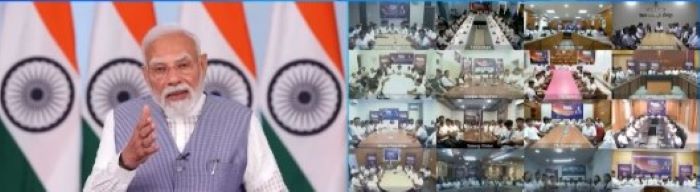
The map may still place India’s border villages at the farthest edge. Development is moving them to the centre. That was the powerful message emerging from Prime Minister Narendra Modi’s virtual interaction with young participants of the Viksit Vibrant Village Programme 2026, whose journeys to remote border settlements in Himachal Pradesh, Uttarakhand and Ladakh revealed a new reality—one in which distance no longer necessarily means deprivation.
More than 5,000 MYBharat Volunteers from 245 districts joined the interaction and shared stories of villages transformed by better roads, electricity, drinking water, healthcare, internet connectivity and digital payments.
- PM Modi hails MYBharat volunteers for taking the spirit of Ek Bharat, Shreshtha Bharat to India’s border villages
- 5,000-plus young Indians from 245 districts witness the transformation of remote frontiers
- Roads, electricity, water, healthcare and digital connectivity redraw the development map
- PM urges citizens to spend at least 5% of travel budgets on local products to strengthen rural livelihoods
But the most striking transformation was perhaps in perception.
Young Indians who travelled to the country’s remote frontiers expecting isolation and hardship returned with stories of resilient communities, confident women, vibrant local economies and technology reaching even the highest inhabited regions.
The old map is changing
For Nikita Pravin Solanki, the journey to Dhar Chango Nichla village in Kinnaur was her first independent trip.
The welcome she received from villagers changed her understanding of rural India. Her interactions with the woman Pradhan, Panchayat representatives, farmers, senior citizens and children revealed the expanding role of women in village development.
The roads were good. Electricity was regular. Drinking-water connections had reached homes. Digital connectivity was available.
The experience, she said, challenged her earlier assumptions about life in a remote border village.
“Solo travelling is a way of discovering the world while discovering yourself,” Modi said.
‘The last are now first’
Sunil Kumar Kela from Rajasthan found an immediate connection with the people of Dhar Chango Uprela village in Himachal Pradesh.
Both came from border regions. Their landscapes were different. Their spirit was not.
His concerns about roads, accommodation, electricity and mobile connectivity disappeared after he saw solar-energy installations, improved infrastructure and roads reaching even the homestay where he stayed.
The Prime Minister said young people from border regions across Rajasthan, Kashmir, Himachal Pradesh and the North-East shared a common outlook.
“Those who were last in priority earlier are now the first,” Modi said.
Strangers arrive. One family returns.
Bhavya Shri from Andhra Pradesh travelled to Harsil Valley in Uttarakhand with apprehensions about the unfamiliar climate, food and culture.
They soon disappeared.
The hospitality of local residents and officials, and her interaction with Indo-Tibetan Border Police personnel, gave her a deeper understanding of life in the frontier regions.
Participants from different States, languages and cultures, she said, arrived as strangers but returned as one family.
Modi said their journey had brought alive the spirit of Ek Bharat, Shreshtha Bharat.
“The manner in which all of you have lived the spirit of Ek Bharat, Shreshtha Bharat will inspire many more young people,” he said.
From sea level to 17,000 feet
For Sayantika Mistry from the Andaman and Nicobar Islands, the journey to Maan village in Ladakh was a leap from sea level to nearly 17,000 feet.
She suffered acute mountain sickness. The MYBharat team and ITBP personnel came to her aid.
The experience showed her not only the harsh realities of high-altitude life but also the care and resilience of communities living there.
Her family had expected poor connectivity. Instead, she found reliable internet, Wi-Fi, QR-code payments and UPI facilities.
Encouraging her to document the experience, Modi said: “When you share joy, it multiplies.”
Digital india at 14,500 feet
Ashish Soni from Uttar Pradesh video-called his parents from nearly 14,000 feet.
They were astonished.
For him, the experience became a symbol of a country where digital connectivity was no longer confined to metros and cities.
QR-code payments at around 14,500 feet, he said, showed that Digital India had become a source of trust across the country.
His interactions with women’s self-help groups also highlighted entrepreneurship through homestays, digital platforms and sea buckthorn-based products.
The Border Roads Organisation-built Chicham Bridge, he said, was opening new possibilities for connectivity, tourism and economic activity.
The new travel mantra: buy local
Modi said technology had reached every corner of the country. The next challenge was to ensure that local communities benefited from the economic activity generated by travel and tourism.
He urged citizens to support local producers.
“Wherever you travel, spend at least five per cent of your travel budget on buying products from local people,” he said.
The interaction underlined the changing role of India’s border villages in the national development story.
They are no longer merely remote settlements requiring attention.
They are becoming centres of tourism, entrepreneurship, connectivity, community resilience and national integration.
The frontier is no longer the periphery. It is where the new India is beginning to take shape.