NE LEGAL BUREAU
NEW DELHI/CHENNAI, AUG 3
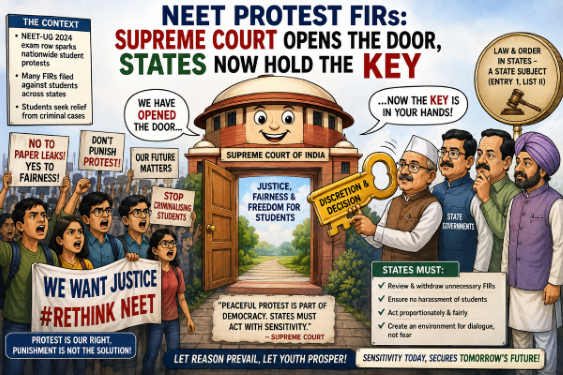
In a potentially far-reaching message for students who take to the streets to defend their academic future, the Supreme Court has drawn a bright legal line: peaceful protest cannot become a lifelong criminal stigma, but neither can a student’s identity as a protester become a shield for grave criminal conduct.
- Top court says cases against student protesters can be closed if they have no antecedents involving grave and heinous offences
- ‘Criminal antecedents’ narrowly confined to serious crimes; protection does not extend to genuine criminal conduct
- Kerala orders no further action in protest FIRs; Maharashtra moves to withdraw cases with court permission
- Tamil Nadu renews its abolition call, with CM stressing Centre must respect students’ sentiments
- Police excess allegations remain under scrutiny as SC seeks balance between protest rights and public order
The Supreme Court on Monday clarified that Delhi and other state governments are at liberty, in accordance with law, to close or withdraw FIRs registered against students who participated in protests over the NEET paper-leak controversy, provided the individuals do not have criminal antecedents involving grave and heinous offences.
A Bench headed by Chief Justice of India Surya Kant, along with Justices Joymalya Bagchi and V Mohana, made it clear that the expression “criminal antecedents” in the court’s earlier directions must be understood narrowly to mean grave and heinous offences.
The ruling comes against the backdrop of protests across several States following the NEET controversy and allegations of excessive police force against demonstrators.
SC’s message: Protest is not a crime, but crime cannot hide behind protest
At the outset of the hearing, Solicitor General Tushar Mehta told the Bench that the Union government was serious about its commitment not to pursue FIRs against protesting students except those having criminal antecedents.
Mehta said FIRs involving more than 2,700 persons with antecedents involving grave and heinous offences would not be withdrawn.
The clarification is significant because the Supreme Court’s earlier interim directions had already restrained authorities from taking coercive action against eligible protesting students, while making an exception for those with criminal antecedents. The Court had also directed the release of detained protesters under 18 who had no criminal records.
The larger legal principle emerging from the proceedings is one of balance: the State cannot criminalise peaceful dissent merely because an agitation is inconvenient, while legitimate law-enforcement action cannot be erased merely because the accused participated in a student movement.
The Court had earlier underlined that police excess or a “lathi charge” cannot be justified merely because there is an agitation and stressed that the right to peaceful protest was “absolutely guaranteed.”
Police excess claims add another layer
During Monday’s hearing, senior advocate Gopal Sankaranarayanan alleged that even lawyers’ children were subjected to violence during the protests.
“The videos are very shocking. We have given 300 videos to the court,” he submitted.
He urged accountability for alleged police excess, saying: “Ideally, we have identified un-uniformed individuals committing such police excess.”
He further sought directions to senior police authorities, questioning the alleged use of pellet guns and other force during the agitation.
The allegations come in the wake of the July 20 Delhi protest, when clashes broke out between demonstrators and security personnel as protesters attempted to move towards Parliament. Police used lathis and tear gas to disperse the crowd.
The Supreme Court has already sought preservation of CCTV footage, drone recordings, body-camera footage, wireless communication records, PCR logs and other electronic evidence relating to protests in affected States. It has also said allegations concerning injuries to both protesters and police personnel warrant a fair and independent examination.
The matter has now been posted for August 18.
Kerala, Maharashtra move towards case withdrawal
The Supreme Court’s clarification comes as State governments adopt varying approaches to the protest cases.
In Kerala, the government has already announced that cases registered in connection with protests held across the State in solidarity with the NEET agitation in Delhi would be withdrawn. Home Minister Ramesh Chennithala directed police not to pursue the FIRs, saying the demonstrations were peaceful and concerned an issue of national importance.
The Kerala development followed political pressure for withdrawal of the cases. Opposition leader Pinarayi Vijayan had urged the State government to withdraw cases against protesters and had claimed that nearly 5,000 people had been booked in connection with solidarity demonstrations.
In Maharashtra, Chief Minister Devendra Fadnavis directed the Home Department to withdraw cases registered against students who participated in NEET paper-leak protests across the State, including demonstrations in Mumbai, Pune, Nagpur and Chhatrapati Sambhajinagar. The withdrawal process is to be initiated with the permission of the concerned courts.
These developments underline the practical importance of Monday’s Supreme Court clarification: States have the legal room to reconsider protest FIRs, but the process must remain within the framework of law and judicial oversight wherever required.
Tamil Nadu: Abolish NEET, not merely close cases
Tamil Nadu presents a somewhat different dimension to the nationwide controversy.
The State has long maintained a fundamental opposition to NEET itself rather than merely seeking procedural reform. With protests intensifying across Tamil Nadu in July, students, teachers, youth organisations and political groups joined demonstrations demanding abolition of the examination and action over alleged irregularities.
Tamil Nadu Chief Minister Joseph Vijay has reiterated the State’s demand for abolition of NEET and criticised the arrest of opposition leaders during the Delhi agitation, urging the Centre to respect the sentiments of students.
Tamil Nadu therefore enters the developing legal landscape from a distinct policy position: its core demand is not simply that protesters should escape criminal cases, but that the examination itself should be scrapped.
The State has also witnessed its own demonstrations and detentions. In Chennai, rapper and activist Arivu was briefly detained during a protest demanding abolition of NEET and was later released.
The Supreme Court’s latest intervention could consequently have particular resonance in Tamil Nadu, where the NEET question has for years been intertwined with arguments over social justice, rural students, government-school students and equal access to medical education.
The legal message now before India
The emerging nationwide picture is therefore not a simple protester-versus-State binary.
It is a three-way legal and policy test:
peaceful dissent must remain protected; genuine police excess must face scrutiny; and serious criminal conduct must remain prosecutable.
That balance is precisely why the Supreme Court’s narrowing of “criminal antecedents” to grave and heinous offences matters. It prevents a broad criminal-history label from automatically defeating protection for students who participated in a protest, while preserving the State’s ability to proceed against those accused of genuinely serious offences.
As Kerala moves towards withdrawal, Maharashtra begins the process and Tamil Nadu continues to press its fundamental anti-NEET case, the Supreme Court’s August 18 hearing could provide another important chapter in the evolving jurisprudence of student protest, State power and the constitutional right to dissent.
The NEET controversy may have begun as an examination crisis. It has now become a much larger question for Indian democracy:
When students protest over the system that determines their future, should the law leave them with a criminal record—or with the constitutional space to be heard.