
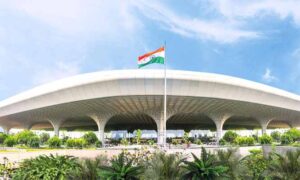
- Safety concerns surrounding the 60-year-old Terminal 1 trigger phased redevelopment after years of temporary mitigation
- Only around 5 million of Mumbai airport’s 55 million annual passengers will be temporarily deoperationalised
- T1 capacity to rise 33% to 20 million passengers annually after redevelopment, with historical airline slots to be restored
- Navi Mumbai International Airport offers airlines an alternative, including 100% landing-fee discount for new international flights
- Arun Bansal says Mumbai and Navi Mumbai airports are “complementary airports” serving the aviation needs of the commercial capital region
NE AVIATION BUREAU
MUMBAI, OCT 3
Mumbai’s aviation infrastructure is set for a major reset without shutting down the city’s airport ecosystem, with Adani Airports announcing a phased redevelopment of the North Section of Terminal 1B at Mumbai International Airport from January 2027.
The redevelopment of the ageing terminal has been driven by safety concerns surrounding the approximately 60-year-old infrastructure, but Adani Airports Holdings Limited (AAHL)-operated Mumbai International Airport Limited (MIAL) said the phased approach would ensure that 91% of Mumbai airport’s passenger traffic remains unaffected during the transition.
Of the airport’s approximately 55 million passengers per annum (mppa), only around 5 million passengers, or 9%, will be temporarily deoperationalised.
The move also marks a significant shift in Mumbai’s aviation architecture, with Mumbai Airport and the newly operational Navi Mumbai International Airport being positioned as complementary facilities serving the wider Mumbai Metropolitan Region.
Phased redevelopment to minimise disruption
The North Section of Terminal 1B, accounting for around one-third of Terminal 1’s current capacity, will be demolished in the first phase.
Arun Bansal, CEO, Adani Airport Holdings Limited, said the decision had been structured to balance the need to modernise ageing infrastructure with the imperative of keeping the country’s commercial capital connected.
“91% of Mumbai Airport’s passenger traffic will remain unaffected even as we undertake redevelopment of the age-old infrastructure that was in urgent need of repairs.”
He said only the North Section of Terminal 1B was being demolished in Phase 1 to minimise passenger inconvenience and operational disruption.
“The transition to Navi Mumbai Airport is temporary and does not represent a permanent shift of Mumbai Airport traffic,” Bansal said.
Airlines have been offered the option of temporarily relocating their operations to Navi Mumbai International Airport at their discretion, with AAHL promising assistance to facilitate the transition.
T1 capacity to rise 33%
The redevelopment, scheduled to begin in January 2027, is expected to increase Terminal 1’s annual handling capacity by 33% — from the current 15 mppa to 20 mppa.
The redeveloped terminal will also restore all historical slots and provide additional slots for airlines, according to the airport operator.
The capacity expansion comes against the backdrop of Mumbai’s constrained aviation infrastructure and growing demand for air travel.
For airlines, the redevelopment therefore represents both a temporary operational adjustment and a longer-term capacity opportunity.
Bansal said extensive consultations with airlines on the future of Terminal 1 had been underway since 2020.
“Extensive consultations with airlines on the future of Terminal 1 have been ongoing since 2020, and the proposed redevelopment was also presented before AERA and subsequently incorporated into the approved tariff framework.”
While acknowledging concerns raised by some airlines, he said passenger safety had to remain the overriding consideration.
“Passenger safety must remain paramount, and any further delay in commencing this process could adversely impact the safety and convenience of millions of travellers.”
Navi Mumbai emerges as the pressure valve
The redevelopment has become possible on this scale because Mumbai now has another major airport option.
Navi Mumbai International Airport (NMI) is being positioned as the temporary operational alternative for airlines whose services are affected by the phased redevelopment of T1.
AAHL said Navi Mumbai Airport has the infrastructure and capacity to handle additional passenger traffic transitioning from Mumbai Airport.
To encourage airline movement, Navi Mumbai Airport is offering a 100% discount on landing fees for new international flights.
The airport also plans to offer cash vouchers to international passengers to offset the difference in User Development Fee (UDF) between Navi Mumbai and Mumbai airports.
The incentives could help airlines and passengers navigate the transition while maintaining connectivity to the Mumbai metropolitan region.
‘Complementary airports’ for one aviation market
The redevelopment also underscores the emergence of a two-airport aviation system for India’s commercial capital.
Bansal said Navi Mumbai’s availability makes it possible to undertake the Mumbai Terminal 1 redevelopment in phases rather than shutting the entire terminal and causing greater disruption.
“Its availability makes it possible to undertake the redevelopment of T1 of Mumbai Airport in phases, instead of shutting down the entire terminal and causing greater disruption to passengers and airlines.”
He described Mumbai Airport and Navi Mumbai Airport as “complementary airports”, together addressing the severely constrained aviation infrastructure requirements of India’s commercial capital region.
The proposition is significant for the region’s long-term aviation planning. Rather than treating Navi Mumbai merely as an overflow facility, the two airports are increasingly being positioned as components of a larger metropolitan aviation network.
Safety first, capacity next
Terminal 1 had been identified as a safety-related concern for several years, with temporary mitigation measures continuing in the absence of a viable alternative for airlines and passengers.
The fire incident at Terminal 1 in April this year further highlighted the concerns surrounding continued operations, according to the airport operator.
With Navi Mumbai International Airport now available as an alternative, AAHL said the conditions are finally in place to proceed with the long-deferred redevelopment.
The immediate challenge will be managing the transition without unnecessary disruption to passengers and airlines.
The longer-term payoff, however, is substantial: a modernised Terminal 1 with 20 mppa capacity, restoration of historical slots, additional airline slots and a two-airport system capable of supporting Mumbai’s expanding aviation requirements.
For India’s financial capital, the message is clear: Mumbai Airport is not shutting down — it is being rebuilt while keeping the city flying.