
NE EDUCATION BUREAU
CHENNAI, AUG 3
What if the next career breakthrough for a young person is not hidden inside a conventional degree—but waiting inside a factory floor, design studio, CAD workstation or footwear innovation lab? As Tamil Nadu emerges as one of India’s most promising footwear manufacturing destinations, the Central Footwear Training Institute (CFTI), Chennai, is opening a new skills-driven gateway for students seeking employment-oriented education with a direct connection to industry.
- CFTI Chennai opens NCVET-approved career pathways as Tamil Nadu’s footwear manufacturing boom creates a massive talent demand
- ₹15,075-crore industry investments expected to generate 1.76 lakh shop-floor jobs and 3,900-plus supervisory and managerial opportunities
- From Class 10 to graduation, seven programmes offer specialised routes into footwear manufacturing, design, technology and management
- 70% practical workshop training puts hands-on industry skills at the heart of CFTI’s revamped curriculum
- Specialised Sports Shoe Manufacturing course responds to fast-growing athletic and lifestyle footwear market
- Nearly seven decades of training and 2.66 lakh candidates make CFTI a launchpad for India’s footwear workforce
CFTI Chennai, an autonomous institution under the Ministry of Micro, Small and Medium Enterprises (MSME), Government of India, has commenced admissions to seven NCVET-approved career-oriented programmes, offering students multiple entry points into footwear manufacturing, design, product development, advanced technology, quality assurance, production and management.
The opportunity is particularly compelling because the industry itself is expanding.
Footwear manufacturing investments across Tamil Nadu are expected to exceed ₹15,075 crore, with companies setting up or expanding facilities across Ulundurpet, Vellore, Perambalur, Karur, Tindivanam, Ranipet, Ambur, Coimbatore, Tiruchirappalli, Jayankondam and other industrial clusters.
The projected demand: around 1.76 lakh shop-floor employees and more than 3,900 supervisory and middle-management professionals over the next two to three years.
For young people looking for a career that combines skills, technology, creativity and employment, the numbers tell a compelling story.
From Class 10 to graduation: A course for every career aspiration
Addressing a press conference at the Press Information Bureau, Chennai, CFTI Director K. Murali invited students who have completed Class 10, Class 12, diploma or graduation to explore the Institute’s industry-oriented programmes.
The courses have been upgraded to NCVET-approved programmes, replacing the earlier NSQF-based programmes.
The seven offerings provide multiple pathways:
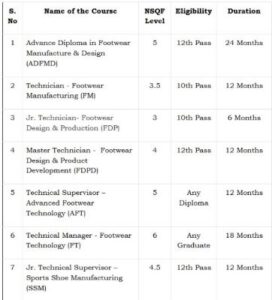
The range is significant: a student need not wait for a conventional three- or four-year degree to enter a technology-intensive manufacturing career.
70% practical: learning that walks straight into industry
The biggest attraction of the revamped programmes is their emphasis on hands-on learning.
CFTI has structured the curriculum around 70% practical workshop training and 30% classroom instruction, seeking to ensure that students graduate with the practical competencies expected on a modern manufacturing floor.
The programmes cover areas including footwear manufacturing, footwear design, product development, advanced footwear technology, production management, quality assurance, CAD and industrial engineering.
For students who are more comfortable learning by doing rather than simply memorising, this approach could provide a significant advantage.
The specialised one-year Sports Shoe Manufacturing programme is another distinctive offering, targeting the rapidly expanding sports, fitness, athleisure and performance-footwear segments.
69 years, 2.66 lakh trained: A legacy meets a new industry wave
Established in 1957, CFTI Chennai has spent nearly seven decades focusing exclusively on footwear technology education, skill development, research and entrepreneurship.
Over the years, the Institute has trained more than 2.66 lakh candidates, including international trainees. Many alumni have gone on to work with footwear manufacturing companies in India and overseas.
That legacy now meets a radically changing industry.
Modern footwear manufacturing increasingly involves computer-aided design, product development, automation, quality systems, industrial engineering, production planning and advanced materials.
CFTI’s curriculum is being positioned to reflect these changes and prepare young people for roles extending far beyond conventional factory-floor employment.
Tamil Nadu’s footwear boom needs a skilled workforce
The timing of the admissions drive is significant.
Tamil Nadu is witnessing a major expansion of its footwear manufacturing ecosystem, with new industrial clusters and large investments expected to create employment at multiple levels.
The projected requirement of 1.76 lakh shop-floor employees could translate into opportunities for technicians and skilled operators, while the additional requirement of 3,900-plus supervisory and middle-management professionals opens a pathway for diploma holders and graduates seeking specialised technical careers.
This is where vocational education can become a powerful bridge between education and employment.
For students, the message is straightforward: the growth of an industry is meaningful only when they are equipped to participate in it.
‘Meet the changing requirements of the footwear industry’
Murali highlighted CFTI’s long-standing role in developing specialised talent for the sector and the transformation of its curriculum.
He said the Institute’s new NCVET-approved courses have been designed to “meet the changing requirements of the footwear industry”, with practical training forming the dominant component.
He also invited students from different educational backgrounds to take advantage of the programmes as Tamil Nadu’s footwear manufacturing ecosystem expands.
The opportunity extends beyond employment. With entrepreneurship, design and product development embedded in the CFTI ecosystem, students can potentially move from being job seekers to job creators.
And that may be the most important message for today’s youth: a career-oriented course is not necessarily a shortcut—it can be a direct route to a specialised future.
With Tamil Nadu’s footwear sector expanding, CFTI’s seven new-age programmes could help ensure that the State’s next industrial success story is powered not merely by machines and investments, but by young, skilled and future-ready talent.