R ARIVANANTHAM
CHENNAI, AUG 5
Tamil Nadu’s first Budget under Chief Minister C Joseph Vijay has attempted something more consequential than distributing benefits: it has sought to sketch a new social contract between welfare today and wealth tomorrow. But behind the glittering announcements lies the question that will define the credibility of the new government—can Tamil Nadu simultaneously fulfil its expansive electoral commitments, create millions of new opportunities and repair its finances without forcing the next generation to pay for today’s promises?
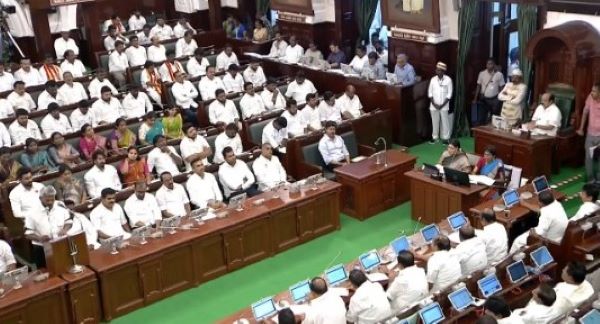
Finance Minister N Marie Wilson, presenting the Revised Budget Estimates for 2026-27 in the Assembly on Wednesday, unveiled a roadmap combining AI and deep-tech ambitions, youth skilling, student support, women-centric welfare, farmer relief, government employee protection, healthcare expansion, infrastructure and fiscal consolidation.
At its most audacious, the Budget aims to help propel Tamil Nadu towards a $1.5-trillion economy by 2036. The government’s broader Vetri Tamizhagam – Vision Document envisages programmes across 10 major focus areas and says they will be operationalised over one-, three- and five-year horizons.
But the numbers reveal the tightrope. The State’s overall outstanding liability is estimated at ₹10,98,768 crore, while its liability-to-GSDP ratio is projected at 27.01%. The revised fiscal deficit is estimated at ₹1,21,819 crore, although the government says it remains within the limits of the Tamil Nadu Fiscal Responsibility Act.
That makes the 2026-27 Budget less a conventional annual statement and more a test of whether Tamil Nadu can convert a political mandate into a financially sustainable development model.
1. ‘Vetri’ vision: From welfare State to $1.5-trillion economy
The government’s stated destination is ambitious: transform Tamil Nadu into a poverty-free, prosperous State offering equal opportunity, while targeting a $1.5-trillion economy by 2036.
The Budget speech says the government is guided by the principles of inclusive growth, social justice, equality, women’s safety, poverty eradication, a drug-free Tamil Nadu and corruption-free, transparent administration.
The scale of the blueprint is visible in the Vetri Tamizhagam Vision Document, which brings together 436 schemes and projects under 10 pillars. These include women’s welfare, youth, farmers and agricultural labourers, education, healthcare, infrastructure and governance.
For political accountability, however, one distinction matters: 436 schemes are not 436 completed poll promises. The Budget does not publish a single independently audited number of electoral promises fulfilled.
What has been implemented or ordered?
The government’s clearest major poll-linked achievement cited in the Budget is the ₹5,932-crore agricultural loan waiver benefiting 14.43 lakh farmers, with the speech stating that the waiver has been credited to all eligible beneficiaries.
Other measures already undertaken since assuming office—such as procurement and tender reforms, expansion of digital governance and the new government health insurance scheme—are significant governance actions, but should not automatically be counted as manifesto promises unless mapped against the published manifesto.
What is proposed/newly budgeted?
The Budget now places several high-profile promises and new commitments on the implementation track, including:
- ₹2,000 crore Vetri Laptop Scheme for college students;
- 8-gram gold coin and silk saree as ‘Annan’s Seer’ for eligible women at marriage, with ₹812 crore allocated;
- gold ring for every newborn delivered in a government hospital;
- expansion of the breakfast scheme to Classes VI-VIII;
- large-scale youth skilling and internships;
- AI skilling and employment initiatives;
- new farmer, livestock and fisheries support;
- upgraded government employee health insurance;
- and a technology-led governance architecture.
The government’s challenge is therefore not merely how many promises it can announce, but how many it can fund, deliver and sustain.
2. Youth bonanza: 13 lakh to be skilled, 5.32 lakh to get bicycles
If the Budget has one unmistakable political and economic target, it is Tamil Nadu’s youth.
The proposed Vetri Skill Training Scheme will provide industry-aligned training to 12 lakh college students and one lakh unemployed youth during the current year. Internship opportunities will initially be offered to 20,000 young people, with stipends for eligible graduates and vocationally trained candidates. The allocation is ₹150 crore.
The AI Industry Development Programme goes further, targeting five lakh youth by 2031 across engineering colleges, polytechnics and ITIs, with curriculum development involving academic and industry partners including IIT Madras.
For school-going Gen-Z, approximately 5.32 lakh Class XI students in government and aided schools will receive modern bicycles with helmets and water bottles, backed by ₹277 crore. School education gets ₹44,527 crore.
The sporting side is equally expansive: 10 Olympic Centres of Excellence, ₹22 crore assistance for 500 high-performing athletes and ₹42 crore for rural sports, besides one hour of structured sports and physical activity after school hours.
Youth Welfare and Sports Development receives ₹1,051 crore.
3. Students: Laptop, hostel, breakfast—and a digital future
The ₹2,000-crore Vetri Laptop Scheme is arguably the most visible student-centric announcement. It positions the laptop not as a giveaway but as a learning, skilling and employability tool.
The government also proposes 200 integrated student hostels providing one lakh modern beds across educational hubs under the TN-SUDAR programme. The project is estimated at ₹3,200 crore, with a State capital construction grant of ₹640 crore over two years.
The expanded Perunthalaivar Kamarajar Breakfast Scheme will cover Classes VI-VIII in government and aided schools, benefiting an additional 15.14 lakh students across 15,414 schools, with ₹710 crore allocated.
The State is also extending its TN SPARK AI, robotics and online-tools programme from 5,000 government schools to another 2,600 schools, creating a three-tier learning structure from Classes VI to XII.
The message is clear: the Budget is trying to turn students from welfare recipients into the human capital of Tamil Nadu’s next economic cycle.
4. Women: Gold, sarees, land ownership and economic dignity
The Budget has retained the political visibility of women’s welfare while adding some structural elements.
The 8-gram gold coin and silk saree ‘Annan’s Seer’ scheme receives ₹812 crore.
For marginalised women, Mannin Magal Thittam aims to turn Adi Dravidar and Tribal women agricultural labourers into landowners, coupled with training in modern farming technologies, with ₹20 crore allocated.
The Budget also creates institutional support for transgender persons through skills, bank-linked self-employment assistance and ‘Aran’ shelter homes in five districts, besides short-stay homes in 15 districts.
Yet one conspicuous electoral promise is missing from the Revised Budget: the widely publicised ₹2,500 monthly assistance for women. That omission will inevitably keep the Opposition’s accountability argument alive.
5. Farmers: ₹5,932-crore loan waiver meets the next test of farm economics
For agriculture, the biggest headline is not a promise but a claimed delivery: ₹5,932 crore in agricultural loan waivers for 14.43 lakh farmers. The Budget says eligible beneficiaries have already received the benefit.
The government has also sanctioned a ₹134-crore Kuruvai Package after inadequate monsoon rainfall and low Mettur storage affected the irrigation calendar.
Livestock farmers are promised a new ₹31-crore Kaalnadaigal Kaappom insurance scheme, while 25 veterinary hospitals will be upgraded to polyclinics, 210 dispensaries to hospitals and 143 mobile veterinary units will be created.
For fishermen, lean-period assistance rises from ₹6,000 to ₹7,000 per family, benefiting 1.93 lakh traditional fishing families, with ₹135 crore allocated.
Water security is also being pushed up the agenda, with the Cauvery-Vaigai-Gundar river-linking project commencing this year with ₹150 crore, alongside ₹50 crore for DPRs for three other river-linking projects.
The next question is whether the government can move from relief economics to productivity economics—better prices, irrigation, mechanisation, insurance, storage, processing and export-led farm incomes.
6. Government employees: Better health cover, but bigger expectations
Government employees and pensioners have received a significant health-care upgrade.
The New Health Insurance Scheme 2026 raises basic insurance coverage from ₹5 lakh to ₹7.5 lakh, specified illness coverage from ₹10 lakh to ₹12 lakh, and the corpus for rare and specified illnesses from ₹10 lakh to ₹15 lakh for employees.
The scheme covers 2,992 medical procedures and 46 specified illnesses through 1,535 empanelled hospitals and government institutions. The allocation is ₹838 crore.
Pensions and other retirement benefits receive a substantial ₹47,240 crore allocation.
But employee organisations will likely look beyond medical insurance—to recruitment, pay revision, pension architecture, vacancies and service conditions.
7. AI city, technology and industry: Arivagam could be the Budget’s biggest gamble
The proposed ‘Arivagam’ AI and innovation city could prove to be the most future-facing element of the Budget.
The project is envisaged as an integrated ecosystem encompassing AI research, education, skills, semiconductor testing, innovation incubators and industrial infrastructure. A ₹5-crore feasibility study has been provided.
It dovetails with the broader technology agenda. Tamil Nadu’s IT sector already generates more than ₹2.5 lakh crore in annual exports and provides direct and indirect employment to over 20 lakh people, according to the Budget speech.
The State plans to strengthen the Tamil Nadu AI Mission across AI, quantum technology and AVGC-XR, with applications in healthcare, agriculture, education, citizen services and governance.
For industry, the real opportunity lies in whether Arivagam can become more than a branded technology enclave—and instead generate startups, deep-tech patents, semiconductor capability, research capital and high-value employment.
8. Healthcare: From hospital-centric care to distributed care
The Budget allocates ₹23,357 crore to Health and Family Welfare.
It proposes a hub-and-spoke telemedicine system beginning with five specialist hubs and 200 spokes, eventually expanding to 1,000 hubs and spokes over five years.
Cancer care gets another structural push through five zonal cancer-care hospitals, while an additional ₹100 crore is being added for essential medicines, particularly for chronic diseases and cancer.
For an ageing State, this shift from centralised hospitals towards telemedicine, district-level care and preventive healthcare could be more consequential than headline allocations.
9. Industry and MSMEs: Policy stability becomes the real incentive
The government has promised a new Tamil Nadu Industrial Policy focusing on innovation, technology-led growth, sustainable development and exports.
For businesses, the Budget’s emphasis on procurement reform, digital taxation, easier registration and technology-driven governance may prove as important as direct subsidies.
The government says it has removed unnecessary certificates in public tenders, opened tender participation across departments and relaxed eligibility for low-value procurements to enable young entrepreneurs and small businesses to compete. It claims these measures have already generated significant savings.
A particularly ambitious revenue strategy involves faceless GST assessment, faceless property registration and end-to-end computerisation of mining monitoring, which the government estimates could generate approximately ₹15,000 crore in additional revenue.
For industry, therefore, the Budget’s most valuable promise may ultimately be predictability, speed and lower friction, rather than another incentive package.
10. Opposition’s ‘big zero’ challenge
The political response was predictably sharp.
Leader of Opposition and DMK leader Udhayanidhi Stalin and AIADMK general secretary Edappadi K Palaniswami criticised the maiden TVK Budget as a “big zero”, with Palaniswami questioning what had happened to the government’s election promises.
That criticism goes to the heart of the Budget’s political vulnerability.
The TVK entered office promising extensive welfare measures for women, youth, farmers and government employees. Among the campaign commitments were ₹2,500 monthly assistance for women, farm-loan relief, wider free bus travel and other welfare measures.
The Budget has moved on some of these fronts, but not all—and notably does not yet provide the ₹2,500 monthly women’s assistance.
The Opposition can therefore reasonably ask: which promises have been delivered, which have been budgeted, which are merely policy intentions, and which have been deferred?
That is likely to become the defining accountability battle of the coming Assembly sessions.
11. Fiscal prudence: The hardest promise of them all
The Budget’s most consequential section may be the least glamorous: the fiscal arithmetic.
The government estimates the fiscal deficit at ₹1,21,819 crore, marginally below the ₹1,21,949 crore interim estimate and within the State’s Fiscal Responsibility Act targets.
Outstanding liabilities are projected at ₹10,98,768 crore, with the liability-to-GSDP ratio at 27.01%.
The government itself acknowledges that Tamil Nadu’s fiscal position is under severe pressure.
Wilson put it starkly:
“The fiscal position of the State is in the red, and we have been handed a treasury box that is overburdened with debt and sub optimal income with leaking holes.”
He added: “The repair has been started, but would need at least two years to bring the financial administration back to the track of fiscal prudence.”
And the government’s longer-term ambition is explicit: “Tamil Nadu will emerge as a State that has fiscally prudent governance for balanced and inclusive economic growth.”
The Budget projects State Own Tax Revenue at ₹2,26,740 crore and State Own Revenues at ₹2,54,575 crore, or 72.73% of total revenue receipts. The government says revenue augmentation and better collection efficiency should eventually create room for higher capital expenditure.
This is the central economic wager: increase revenues without crushing taxpayers, cut leakage without cutting welfare, and borrow only for productive growth.
12. The verdict will be written outside the Assembly
The maiden TVK Budget is neither simply a welfare Budget nor purely a growth Budget. It is an attempt to marry social protection with technological transformation.
Its strongest propositions are visible: laptops and hostels for students, mass skilling for youth, AI and deep-tech ambitions, farmer loan relief, women’s support, stronger healthcare, improved employee insurance and technology-led governance.
Its vulnerabilities are equally visible: a massive liability burden, a large fiscal deficit, ambitious electoral commitments and the absence of some of the most politically visible promises.
The government has bought itself a little time by placing many programmes on phased implementation tracks. The Vetri Tamizhagam framework itself looks beyond one Budget cycle and speaks of one-, three- and five-year implementation horizons.
But Tamil Nadu’s voters are unlikely to measure the new regime merely by the number of schemes announced.
They will ask harder questions: Did the laptop reach the student? Did the skill programme create a job? Did the farmer’s income rise? Did the woman gain economic independence? Did the employee receive better security? Did AI create companies rather than conferences? Did welfare reach the last household without leakage? And, above all, did the State become richer without becoming deeper in debt?
The answers to those questions—not the size of the Budget book—will ultimately decide whether ‘Vetri’ becomes merely a political slogan or a new economic model for Tamil Nadu.
PROMISE TRACKER — WHAT THE FIRST BUDGET ACTUALLY SHOWS
Clearly implemented/ordered and reported in the Budget
- ₹5,932 crore crop-loan waiver benefiting 14.43 lakh farmers — government says credited to all eligible farmers.
- Tender and procurement reforms already producing claimed savings.
- New Government Employees’ Health Insurance Scheme operational from July 1, 2026.
Major manifesto-linked/new commitments now budgeted or put on implementation track
- ₹2,000 crore Vetri Laptop Scheme.
- ₹812 crore 8-gm gold coin + silk saree marriage assistance.
- ₹710 crore expanded breakfast scheme for Classes VI-VIII.
- ₹277 crore bicycles for 5.32 lakh Class XI students.
- ₹150 crore Vetri Skill Training Scheme.
- ₹5 crore feasibility study for Arivagam AI City.
- ₹31 crore livestock insurance.
- ₹135 crore enhanced fishermen’s lean-period assistance.
- ₹50 crore for 10 Olympic Centres of Excellence.
- ₹838 crore government employee health insurance.
Major electoral promises still awaiting clear Budget-level delivery
- ₹2,500 monthly assistance for women.
- Full-scale expansion of free bus travel for women.
- Several other high-cost welfare commitments made during the election campaign.
Important accountability caveat
The government’s 436 schemes in the Vetri Tamizhagam Vision Document should not be equated with 436 fulfilled poll promises. The official Budget sets out a phased one-, three- and five-year implementation architecture rather than an audited promise-completion scorecard.