- 40–50 new Global Capability Centres could pour into Ahmedabad–GIFT City, creating 50,000+ high-skilled jobs and demand for up to 6 million sq ft of Grade A offices
- Report by DevX-Anarock flags ₹147/sq ft net effective occupancy cost, 90,000–95,000 tech talent pool and just 7–12% attrition as major enterprise magnets
- Ahmedabad already hosts 30+ GCCs and nearly 3,700 technology firms as global companies look beyond saturated Tier-I markets
- GIFT City’s IFSC, expanding infrastructure and Gujarat’s GCC Policy 2025–30 strengthen the corridor’s case as a global enterprise destination
- Metro Phase II, multimodal connectivity and Mumbai–Ahmedabad High-Speed Rail expected to further transform the region’s commercial landscape
NE INFRASTRUCTURE BUREAU
AHMEDABAD, AUG 11
Ahmedabad and GIFT City are no longer waiting in the wings of India’s GCC revolution—they are positioning themselves to become its next major growth corridor.
The Ahmedabad–GIFT City corridor could attract 40–50 new Global Capability Centres (GCCs) over the coming years, generating demand for 4–6 million sq ft of Grade A office space and creating more than 50,000 high-skilled jobs, according to Ahmedabad: New Phase of Urban & GCC Growth, a joint report by Dev Accelerator Limited (DevX) and real estate services firm Anarock.
The projection marks a potentially significant shift in India’s enterprise geography, as multinational companies increasingly explore locations beyond traditional GCC powerhouses such as Bengaluru, Hyderabad and the National Capital Region.
Ahmedabad’s proposition is increasingly built on more than affordability. Talent availability, workforce stability, infrastructure, educational depth, connectivity and the emergence of GIFT City as an international financial hub are converging to create what the report describes as one of India’s most promising destinations for the next wave of enterprise expansion.
The ₹147 difference — and the talent advantage
The corridor’s cost proposition is particularly striking.
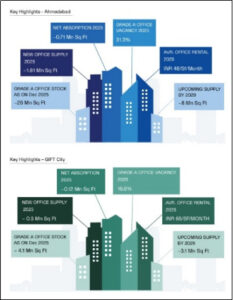
Ahmedabad has around 26 million sq ft of Grade A office stock, while GIFT City adds another 4.1 million sq ft. Average non-CBD office rentals in Ahmedabad are around ₹50 per sq ft per month, while the net effective occupancy cost across the Ahmedabad–GIFT City belt stands at approximately ₹147 per sq ft per month.
That makes the region one of the most cost-efficient major office destinations in India, with occupancy costs estimated to be 30–35% lower than leading Indian office markets.
But the report suggests that the real differentiator could be people rather than property.
Ahmedabad has a technology talent pool of approximately 90,000–95,000 professionals and produces around 55,000–60,000 graduates annually from leading institutions including IIM Ahmedabad, IIT Gandhinagar and several engineering and management institutions.
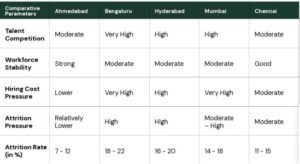
Even more significant for global employers is workforce stability. Attrition levels in Ahmedabad are estimated at just 7–12%, substantially below those seen in several established technology hubs.
For GCC operators, that combination could translate into lower employee-replacement costs, greater continuity and a more predictable platform for long-term expansion.
GIFT City turns the corridor into a global proposition
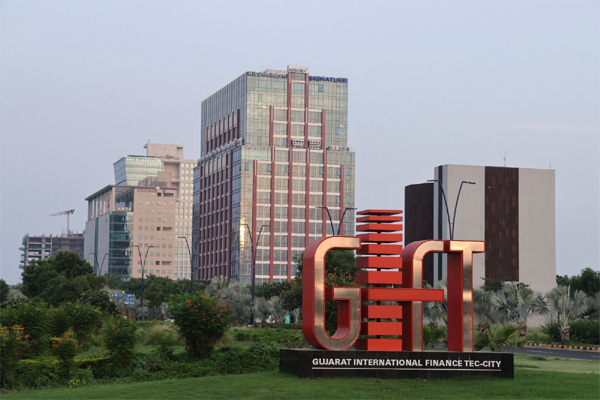
The emergence of GIFT City as India’s first operational International Financial Services Centre (IFSC) adds another dimension to Ahmedabad’s GCC ambitions.
The region is already home to more than 30 GCCs and nearly 3,700 technology firms, according to the report, while its growing Grade A office ecosystem is attracting multinational financial institutions, technology companies and consulting firms.
The report identifies the changing enterprise-location strategy as a major opportunity.
India currently has more than 1,700 GCCs employing nearly 1.9 million professionals, with the number projected to cross 2,400 GCCs by 2030.
As companies increasingly adopt hub-and-spoke models and diversify beyond saturated Tier-I markets, Ahmedabad–GIFT City could emerge as a strategic alternative capable of offering scale without sacrificing cost or talent quality.
Umesh Uttamchandani, Managing Director, Dev Accelerator Limited, said: “India’s GCC story is evolving beyond the traditional metros. Today, global enterprises are making location decisions based not only on cost, but on access to skilled talent, operational resilience and the ability to scale over the long term. This structural shift is creating opportunities for cities that can offer a balanced ecosystem rather than just lower operating costs. Ahmedabad has quietly built that foundation. With a strong talent pipeline, world-class educational institutions, improving infrastructure and the emergence of GIFT City as a global financial hub, the region is increasingly becoming a strategic destination for knowledge-led businesses.”
He added: “At DevX, we’ve witnessed this transition firsthand. Organisations that initially entered Ahmedabad with small teams are now expanding their presence with greater confidence. We believe the city is no longer an emerging alternative, but one of India’s most credible destinations for the next wave of GCC-led growth and enterprise investment.”
ANAROCK: “ONE OF THE COUNTRY’S STRONGEST EMERGING ENTERPRISE CORRIDORS”
Anuj Puri, Chairman, Anarock Group, said: “India’s office market continues to demonstrate remarkable resilience, supported by sustained occupier demand and the rapid expansion of Global Capability Centres. However, what is equally significant is the changing geography of this growth. As enterprises look beyond traditional Tier I markets, cities that combine talent availability, infrastructure readiness, business-friendly policies and cost competitiveness are emerging as the next engines of commercial real estate growth.”
He added: “Ahmedabad and GIFT City stand out as one of the country’s strongest emerging enterprise corridors. While affordability remains an important differentiator, the region’s true strength lies in its ability to offer workforce stability, institutional depth and an ecosystem that enables companies to scale with confidence.”
The report also expects managed and flexible workspaces to become increasingly important, with demand projected to reach 1–1.5 million sq ft across GIFT City, SG Highway and Ahmedabad’s western commercial corridor.
Policy + infrastructure could accelerate the GCC take-off
The state’s policy architecture is another key pillar of the growth story.
Under the Gujarat GCC Policy 2025–30, the state aims to attract more than 250 GCCs and investments exceeding ₹10,000 crore, supported by targeted incentives for technology and infrastructure development.
At the same time, a series of major infrastructure projects is strengthening the physical backbone of the Ahmedabad–GIFT City ecosystem.
These include Metro Phase II, the Sabarmati Multimodal Transport Hub and the Mumbai–Ahmedabad High-Speed Rail corridor—projects that could significantly enhance connectivity, accessibility and the region’s attractiveness to global enterprises.
The report also points to Ahmedabad’s projected role as host city for the 2030 Commonwealth Games, which could further accelerate investment in infrastructure and connectivity.
Taken together, the numbers suggest that Ahmedabad’s GCC story is moving into a new phase: from an affordable alternative to a strategic enterprise destination.
If the projected 40–50 GCC additions materialise, the impact will extend well beyond office leasing. It could reshape commercial real estate, technology employment, talent migration, flexible workspaces, urban infrastructure and the broader knowledge economy of Ahmedabad and GIFT City.
The GCC map is being redrawn — and Ahmedabad–GIFT City is positioning itself at the new frontier.