- Gautam Adani urges CareEdge to create what he calls the world’s first comprehensive Credit Framework for Integrated Platform Infrastructure
- He argues conventional standalone models can miss the economic multiplier, strategic resilience and new demand created around transformational assets
- Mundra, Vizhinjam and Khavda cited as examples of infrastructure that has evolved from individual projects into interconnected economic platforms
- “We do not need lower standards but we need wider lenses,” Adani says, rejecting any suggestion of easier ratings or diluted scrutiny
- The proposed framework could reshape how lenders and investors assess India’s next generation of ports, energy, manufacturing and AI-linked infrastructure
NE BUSINESS BUREAU
AHMEDABAD, AUG 31
What if a port is worth far more than the ships it handles, a renewable-energy project is worth more than the electricity it generates, and an infrastructure asset becomes valuable precisely because it makes dozens of other businesses more viable?
That is the question Gautam Adani, Chairman of the Adani Group, has put before India’s credit-rating industry.
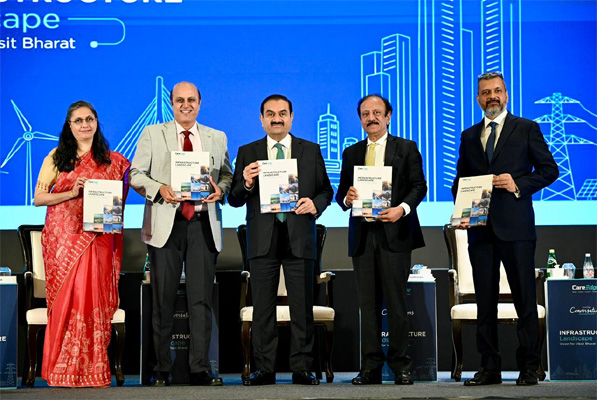
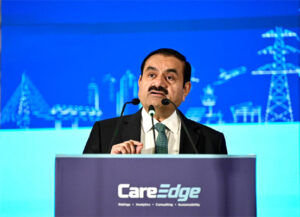
Addressing the CareEdge Group Annual Summit in Mumbai on Monday, Adani urged CareEdge to develop what he described as the world’s first comprehensive Credit Framework for Integrated Platform Infrastructure—a framework capable of assessing not merely the standalone financial strength of an asset, but the wider economic ecosystem, strategic resilience and additional value created around it.
His proposition goes to the heart of a changing Indian infrastructure story.
As projects increasingly combine ports, railways, logistics, power, manufacturing, digital infrastructure, data centres and artificial intelligence, Adani argued that conventional single-asset models may no longer tell the entire economic story.
And he posed the provocative question: “Why should the world’s first truly comprehensive Credit Framework for Integrated Platform Infrastructure not come from India? Why should CareEdge not lead it?”
Not easier ratings—bigger lenses
Adani was careful to draw a line between reforming credit assessment and weakening it.
“We do not need lower standards but we need wider lenses.”
He said transformational infrastructure could be constrained not only by inadequate ambition or capital but also by the frameworks through which risks are assessed.
According to Adani, many analytical models were developed when infrastructure expanded incrementally, demand was relatively visible and the boundaries of an individual asset were easier to define.
India, he argued, has entered a different phase.
“The nature of infrastructure has changed and the sophistication of our rating frameworks must evolve alongside the sophistication of what India is building.”
The distinction is important for lenders and investors.
A rating is ultimately an assessment of risk and repayment capacity. But when one infrastructure project creates demand for, and strengthens, several adjacent assets, the economic value generated may extend well beyond the cash flows of the original project.
The challenge is how to quantify that value without compromising analytical independence.
From port to economic flywheel
Adani used Mundra Port in Gujarat as his most vivid example.
What began as a port on a marshy coastline with limited surrounding infrastructure evolved into an interconnected ecosystem involving rail, logistics centres, power plants, industrial zones, traders and manufacturers.
“Mundra proved that platform infrastructure operates as a multi-layer network where each new layer cross-subsidizes, feeds, and de-risks the other, creating an economic compounding flywheel that linear financial models mostly fail to capture.”
His argument is that the port cannot be viewed simply through the revenue it earns from cargo.
The rail network makes logistics more efficient; logistics strengthens industrial activity; power supports industry; industry generates cargo—and the resulting ecosystem reinforces the original infrastructure.
Adani also cautioned against building only for visible present demand.
“If we build only for the demand we can see today, India will always be late for the opportunities of tomorrow.”
That philosophy lies at the centre of his proposed rating framework.
Vizhinjam: rating risk versus national resilience
The second example was Vizhinjam International Seaport in Kerala, where Adani highlighted the distinction between conventional financial risk and strategic national value.
For decades, India depended heavily on foreign transshipment hubs such as Singapore, Dubai and Colombo for container cargo.
Vizhinjam’s strategic significance, therefore, extends beyond its port revenues to questions of logistics efficiency, maritime autonomy and sovereign resilience.
Adani acknowledged that conventional credit models correctly assess execution risk.
But, he argued:
“In strategic infrastructure, we must also learn to recognise the economic value of sovereign resilience.”
He also pointed to Vizhinjam’s rapid operational performance, noting that the port became the fastest Indian port to handle two million TEUs within 18 months.
The larger message is that some infrastructure projects create value that is partly financial and partly strategic—and the two dimensions need not be treated as mutually exclusive.
Khavda: when energy meets AI
Adani’s third example came from Gujarat’s Khavda renewable-energy development, which he described as a platform rather than simply a large power project.
The 30-GW renewable-energy development brings together energy, artificial intelligence, manufacturing and digital infrastructure.
“Rating frameworks often measure individual assets. But we must realise that the real value in today’s age is being created at the intersection, where ‘energy + data + manufacturing’ converge.”
That intersection becomes increasingly important as India races to build an AI economy.
Artificial intelligence may appear to be a software revolution, but its physical requirements are substantial: land, data centres, cooling, transmission networks and enormous quantities of reliable electricity.
Adani put it succinctly: “AI may look like software. But, ultimately, AI runs on infrastructure.”
The implication for credit assessment is profound.
A renewable-energy project supplying clean power to future data centres and manufacturing facilities could have economic consequences far beyond the electricity it sells today.
Three kinds of infrastructure, three ways to assess risk
Adani broadly divided infrastructure into three categories:
Replacement infrastructure, where traditional assessment models generally work well;
Growth infrastructure, where the analysis needs to capture ecosystem effects and multiplier value; and
Platform infrastructure, where multiple layers interact to create new demand, new ecosystems and new capabilities.
The proposed CareEdge framework would therefore need to examine multi-dimensional infrastructure, ecosystem multipliers, adjacency value and strategic resilience rather than relying exclusively on the economics of a single asset.
That does not mean replacing financial discipline with optimism.
It means developing additional analytical tools to determine whether the wider ecosystem is real, sustainable and capable of generating measurable economic value.
The builder and the analyst
Adani acknowledged the natural tension between infrastructure ambition and credit scrutiny.
“A builder imagines what does not yet exist. An analyst questions whether imagination can survive reality. Both perspectives are necessary.”
That may be the most important principle underlying his proposal.
Infrastructure developers need the freedom to imagine projects whose full economic benefits may take years to emerge.
Rating agencies, meanwhile, have a fiduciary responsibility to question assumptions, test cash flows and identify risks.
The proposed framework seeks to place those two perspectives on the same analytical map.
The ₹3-lakh-crore question
Adani said his association with CareEdge spans nearly two decades, with the relationship now extending to more than ₹3 lakh crore of rated assets across more than 100 entities.
That long association gave his intervention an additional dimension: the question of whether rating frameworks designed to measure India’s risks can also adequately capture India’s possibilities.
The answer, he suggested, should not be a relaxation of standards.
It should be a more sophisticated understanding of value.
“The India of 2047 will not be built by ambition alone. It will be built when ambition earns trust, when trust unlocks capital and when capital builds national capability.”
That proposition places credit rating at the centre of a much bigger economic conversation.
Because if the way infrastructure is rated influences the cost and availability of capital, then the framework used by rating agencies can itself influence which ambitious projects get financed, scaled and replicated.
India’s infrastructure moment—and a rating challenge
India’s infrastructure landscape is moving rapidly towards interconnected systems rather than isolated assets.
Ports are becoming logistics ecosystems. Renewable-energy parks are increasingly linked to manufacturing and digital infrastructure. Data centres are becoming inseparable from power and transmission capacity. AI is creating demand for an entirely new physical infrastructure stack.
The question now is whether the country’s financial architecture can evolve at the same pace.
Adani’s challenge to CareEdge is therefore bigger than a request for a new rating methodology.
It is a call to ask whether the economics of tomorrow can be adequately measured using the models of yesterday.
For CareEdge, the challenge is now on the table.
For India’s rating industry, the debate may be even bigger.
And for investors, lenders and infrastructure builders, the eventual answer could determine one crucial question:
When an asset builds an entire ecosystem around itself, should the ecosystem finally become part of the rating?