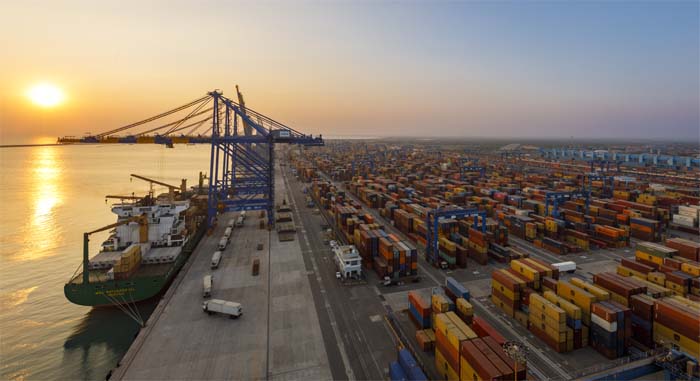
- APSEZ launches Dedicated Empty Container Yard at Mundra to take container logistics into a faster lane
- Integrated facility to cover storage, inspection, maintenance and seamless movement of empty containers
- On-site operations to cut unnecessary container movements, improve safety, security and regulatory compliance
- With Mundra handling nearly 35% of India’s container trade, ECY to optimise turnaround and logistics costs
- Move supports APSEZ’s Ambition 2031 roadmap and strengthens Mundra’s position as a gateway to Viksit Bharat
NE BUSINESS BUREAU
AHMEDABAD, SEPT 4
In global trade, even an empty container carries a cost. At Mundra, APSEZ is now turning that “empty” space into an efficiency opportunity. Adani Ports and Special Economic Zone Ltd (APSEZ) is set to commence operations of a Dedicated Empty Container Yard (ECY) at Mundra Port and SEZ, a move aimed at reducing avoidable container movements, accelerating turnaround and making the logistics chain more seamless for shipping lines, exporters and other stakeholders.
The initiative comes at a strategically significant point for Mundra Port, which has emerged as a critical artery for India’s international trade. APSEZ commanded 45.5% of India’s container market in FY26, while Mundra alone handles nearly 35% of the country’s container trade, making it India’s largest container-handling port.
With around 1.6 million TEUs of empty containers handled at Mundra annually, the dedicated facility is designed to address an often-overlooked but vital component of the import-export ecosystem—the movement, storage, inspection and maintenance of containers when they are not carrying cargo.
When empty containers stop travelling unnecessarily, the supply chain starts moving faster
The ECY will provide integrated warehousing and end-to-end services across the empty-container lifecycle, including storage, maintenance, inspection and seamless movement of containers to exporters and Container Freight Stations (CFSs).
The objective is to bring activities that are currently dispersed into a more coordinated ecosystem, reducing unnecessary movement and improving the utilisation of existing port and logistics infrastructure.
The facility will also be operated by APSEZ and/or its partners, including CFSs and shipping lines, creating scope for closer coordination across the container value chain.
“The dedicated Empty Container Yard at Mundra to be operated by APSEZ and / or partners (including CFS and shipping lines) will enhance efficiency across the container ecosystem by enabling faster turnaround times, reducing unnecessary container movements, and optimizing logistics costs. Strengthening trade-enabling infrastructure remains central to APSEZ’s commitment towards supporting India’s growth and the vision of Viksit Bharat,” said Ashwani Gupta, Whole-time Director and Chief Executive Officer, APSEZ.
Mundra’s next growth story is being built around capacity—and coordination
The ECY forms part of APSEZ’s broader Ambition 2031 roadmap, under which the company is making significant investments to expand capacity across its network, with Mundra at the forefront.
APSEZ plans to add more than 6 million TEUs of container-handling capacity over the next five years, further reinforcing Mundra’s role in India’s international trade architecture.
But capacity alone does not guarantee efficiency. The ability to move containers quickly, safely and economically through the ecosystem is equally critical.
The dedicated yard is intended to address precisely this operational gap by creating a specialised facility for empty containers alongside integrated warehousing capabilities.
From port gate to exporter: fewer detours, tighter logistics
By bringing empty-container operations within the Mundra Port SEZ, APSEZ expects to facilitate closer coordination among Customs authorities, shipping lines, terminal operators and transporters.
The resulting ecosystem is expected to strengthen safety, security and regulatory compliance, while enabling better utilisation of infrastructure and potentially lowering logistics costs through faster turnaround and fewer unnecessary movements.
For shipping lines and customers, the benefit could be particularly tangible: an empty container waiting in the wrong place is not merely idle equipment—it can represent additional handling, transport, time and cost.
The ECY seeks to make that idle leg of the journey shorter and smarter.
A logistics reform with Viksit Bharat in its sights
The initiative also aligns with the Government’s broader emphasis on developing efficient, technology-enabled logistics systems and improving the ease of doing business.
As India seeks to strengthen its position as a global manufacturing and trading hub, the efficiency of its logistics infrastructure will increasingly determine how competitively goods can move from factories and farms to international markets.
Against this backdrop, the Dedicated Empty Container Yard at Mundra is more than another piece of port infrastructure. It represents an attempt to optimise the “in-between” movement that often determines how efficiently the larger trade machine operates.
And for a port handling nearly 35% of India’s container trade, even marginal improvements in turnaround, coordination and cost efficiency can have consequences far beyond the yard gates.