- DSA3 targets thymidine kinase, an underexplored enzyme essential for bacterial DNA survival
- IIT Gandhinagar, Jamia Millia Islamia and partner institutions identify promising molecule from nine laboratory-synthesised candidates
- Crystal-structure mapping, computer modelling and laboratory experiments point to DSA3 as a potential new weapon against Staphylococcus aureus
- Research offers an early proof of concept against one of the notorious ESKAPE pathogens driving the global antimicrobial-resistance crisis
- Scientists stress that DSA3 is not yet a drug—but say it provides a promising starting scaffold for future antibacterial development
NE HEALTH SCIENCE BUREAU
GANDHINAGAR, SEPT 4
What if the next breakthrough against antibiotic-resistant bacteria does not come from hitting the same targets harder—but from attacking a vulnerability bacteria have rarely been forced to defend?
Nearly a century after a stray mould on Alexander Fleming’s laboratory plate helped usher in the antibiotic era, scientists are turning the tables on one of the very bacteria that helped demonstrate the power of penicillin.
A collaborative research team involving the Indian Institute of Technology Gandhinagar (IITGN), Jamia Millia Islamia and partner institutions has identified a potential new molecular route to tackle Staphylococcus aureus (S. aureus)—a major pathogen and the “S” in the notorious ESKAPE group of bacteria known for their ability to evade multiple antibiotics.
At the heart of the study is DSA3, a laboratory-made molecule designed to disable thymidine kinase (TK), an enzyme that S. aureus needs to recycle molecular building blocks essential for DNA replication and repair.
The findings, published in Chemistry & Biodiversity and funded by the Indian Council of Medical Research–Department of Health Research, provide an early proof of concept for targeting this relatively underexplored bacterial vulnerability.
From Fleming’s miracle to the AMR nightmare
In 1928, Alexander Fleming returned to his London laboratory to discover that a stray mould had killed the Staphylococcus growing on one of his culture plates. That chance observation eventually led to penicillin and transformed medicine.
The bacterium that penicillin once humbled, however, has since evolved into a formidable adversary.
Methicillin-resistant Staphylococcus aureus, or MRSA, is now among the pathogens associated with some of the most difficult-to-treat infections, including skin, bloodstream and surgical-implant infections.
As one of the six pathogens represented by the ESKAPE acronym, S. aureus exemplifies the extraordinary ability of bacteria to survive antibiotic assaults.
The threat is no longer confined to individual infections. Antimicrobial resistance (AMR) is increasingly described as a silent pandemic, raising the prospect that routine infections and even common medical procedures could once again become life-threatening.
The 2024 Global Research on Antimicrobial Resistance (GRAM) study published in The Lancet estimated that drug-resistant infections could directly cause more than 39 million deaths between 2025 and 2050, with resistant Staphylococcus infections linked directly to about 130,000 deaths. South Asia, including India, is expected to carry a particularly heavy burden.
It is against this alarming backdrop that the researchers set out to ask a deceptively simple question: Can S. aureus be attacked somewhere antibiotics have largely left untouched?
Looking beyond the usual antibiotic targets
“Most antibiotics attack bacteria through a handful of familiar routes, including puncturing their walls and jamming their protein-making machinery. The trouble is that bacteria have spent decades learning to dodge those blows,” explains Prof Bhaskar Datta, corresponding author of the study and affiliated with IITGN’s Departments of Chemistry and Biological Sciences and Engineering.
“Antibiotic resistance is, in many ways, an evolutionary arms race. That is why researchers hunt for fresh points of attack.”
The IITGN team, working with researchers at Jamia Millia Islamia, Jamia Hamdard, Xi’an Jiaotong-Liverpool University and Ahmedabad-based Sushen Medicamentos, chose precisely such an alternative target.
Every bacterial cell must replicate its genome to survive and multiply. That process depends on a continuous supply of molecular building blocks called pyrimidine nucleotides.
Thymidine kinase is part of the machinery that helps S. aureus recycle these building blocks for DNA replication and repair.
Disable TK, and the bacterium’s genetic machinery begins to run out of fuel.
Earlier research had identified TK as an essential gene. Because conventional antibiotics have not extensively targeted this enzyme, the researchers reasoned that bacteria may not have developed the same breadth of resistance mechanisms against it.
That made TK an intriguing candidate for a new generation of antibacterial research.
A crystal map points to the target
The researchers were helped by an important piece of structural biology.
A team led by Prof Md. Imtaiyaz Hassan, co-corresponding author of the study and affiliated with the Center for Interdisciplinary Research in Basic Sciences at Jamia Millia Islamia, had recently solved the crystal structure of S. aureus thymidine kinase.
That gave the researchers an atomic-level picture of the enzyme—including the molecular pocket they wanted their new compound to occupy.
Rather than simply mimic the enzyme’s natural chemistry, the chemists designed a molecule incorporating two chemical fragments with established histories in antibacterial research: a thiazole ring and a sulfonamide group, the latter belonging to a chemical family descended from some of the earliest antibiotics.
Nine compounds were synthesised and screened.
One candidate stood out.
DSA3, carrying iodo and trifluoromethyl substitutions, emerged as the most promising molecule.
When computer modelling meets the lab
Computer-based molecular docking was first used to predict how the compounds would interact with thymidine kinase.
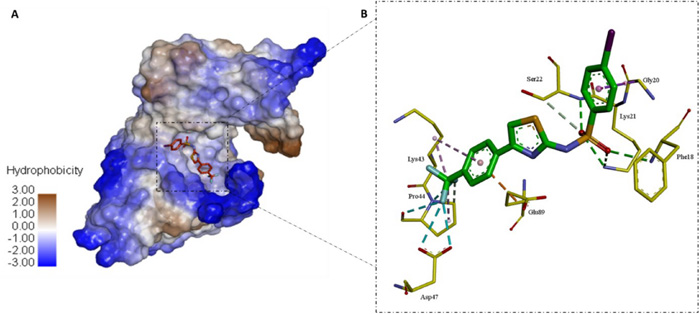
DSA3 displayed the strongest predicted interaction, particularly within the enzyme’s ATP-binding pocket—the critical region where the enzyme captures the chemical fuel required for its function.
By occupying that pocket, DSA3 could effectively interfere with the enzyme’s activity.
The modelling indicated that DSA3 interacted with several key amino acids within the pocket, including one directly involved in the enzyme’s catalytic activity. Longer computer simulations further suggested that the enzyme remained structurally stable while DSA3 stayed within this region.
But a computer prediction alone cannot establish whether a molecule actually works.
So, the researchers took DSA3 into the laboratory.
The experiments showed that DSA3 binds to thymidine kinase and reduces its activity, with a concentration of 6.996 μM reducing the enzyme’s activity by half.
Additional fluorescence measurements showed changes in the enzyme’s natural fluorescence when DSA3 was introduced, providing further evidence of interaction.
Using isothermal titration calorimetry, the researchers also measured the heat changes associated with the interaction between the molecule and the enzyme. The results provided additional evidence that DSA3 forms a stable association with thymidine kinase.
The crucial question, however, was whether disabling the enzyme would actually hurt the bacterium.
From enzyme to bacterium: Does DSA3 work?
Laboratory tests against Staphylococcus aureus provided an encouraging answer.
DSA3 inhibited bacterial growth and, at a higher concentration, killed the bacteria. The researchers also observed a substantial reduction in viable bacterial cells at the concentration that inhibited growth.
For an AMR field desperately searching for fresh targets, the significance lies not in claiming a new antibiotic has already been discovered, but in demonstrating that an underused bacterial vulnerability can potentially be exploited.
And the researchers themselves are careful not to overstate the finding.
“We see DSA3 as a proof of concept and a starting scaffold. It is not a drug,” said Dr Rajesh K Hadiya, co-first author and former PhD scholar at IITGN, who was a recipient of the Science and Engineering Research Board-Confederation of Indian Industry (SERB-CII) Prime Minister’s Fellowship.
“Its potency needs to improve, and the future steps include testing against resistant clinical isolates, checking selectivity over the human enzyme, and moving into animal models. But that is exactly where medicinal chemistry begins.”
A small molecule, a much bigger amr question
The next stage, therefore, is not simply to celebrate DSA3—but to improve it.
The molecule must become more potent, its selectivity must be established, its performance against resistant clinical isolates must be tested and its safety and efficacy must eventually be assessed in animal models before any consideration of human applications.
Yet that is precisely what makes the finding significant.
DSA3 does not represent the finish line. It may represent a new starting line.
The work also fits into the wider national and international effort to confront AMR, where resistant bacteria move across the boundaries separating humans, animals and the environment.
Funded by the Indian Council of Medical Research and conducted largely through Indian institutions, the study adds to India’s growing efforts to strengthen domestic capacity in antibacterial drug discovery and development.
It also resonates with the One Health approach, which recognises the interconnectedness of human, animal and environmental health, and with initiatives including India’s National Action Plan on Antimicrobial Resistance 2.0 (NAP-AMR 2.0) and the National One Health Mission.
Prof Datta places the research within that larger mission.
“We have previously reported on using distinctive strategies and less-explored targets to fulfill the larger goal these frameworks set out. As part of our continuing efforts here we have shown that a particular chemical class can engage an underused antimicrobial target in a specific, measurable way.”
The search for the vulnerability bacteria haven’t learned to hide
There is a striking symmetry to the story.
In 1928, an accident involving mould revealed a vulnerability in Staphylococcus and helped launch the antibiotic age.
Nearly 100 years later, the same organism has become one of the reasons scientists must keep searching for new antibacterial strategies.
The lesson may be that the future of antibiotics will not necessarily belong to ever-more-powerful versions of familiar drugs.
It may belong to finding biological weaknesses bacteria have not yet learned to protect.
DSA3 is only an early laboratory finding, not a finished medicine. But by putting thymidine kinase under the microscope as a potential Achilles’ heel of S. aureus, the researchers have added another question to the global fight against AMR: If bacteria have learned how to escape the antibiotics we know, can we stay one step ahead by attacking targets they have never been taught to defend?