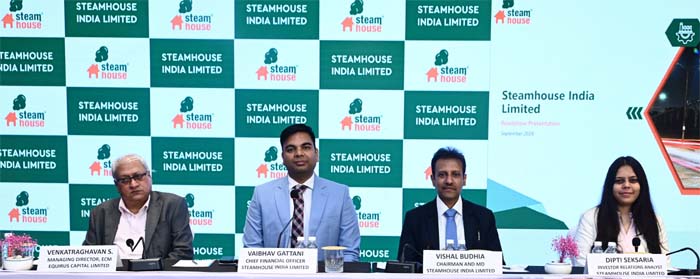
- ₹414-crore IPO opens Wednesday with ₹77–81 price band; fresh issue of ₹353 crore and OFS of ₹61 crore
- CMD Vishal Budhia says technology, engineering, cost efficiency, execution and customer relationships form a difficult-to-replicate competitive moat
- ₹180 crore earmarked for debt repayment, while ₹114.13 crore will fund capacity expansion at Ankleshwar, Panoli and Dahej
- Company positions waste-to-steam solutions as a key partner in India’s energy-efficiency and decarbonisation journey
R MANICKAVASAGAM
AHMEDABAD, SEPT 8
Can industrial steam become the next big efficiency lever for India’s manufacturing economy—and can a community-boiler model turn waste into both energy and opportunity? Steamhouse India Limited is taking that proposition to the capital markets with a ₹414-crore IPO, as the Gujarat-based industrial-energy company seeks to scale its centralised steam and nitrogen distribution model while strengthening its presence across the country’s industrial clusters.
The IPO opens for public subscription on Wednesday, September 9, and closes on Friday, September 11, with the price band fixed at ₹77–81 per equity share of face value ₹2. The anchor bidding took place on Tuesday, September 8. Investors can bid for a minimum of 185 shares, and in multiples thereof.
The issue comprises a fresh issue of ₹353 crore and an Offer for Sale of ₹61 crore by promoter Vishal Sanwarprasad Budhia. The equity shares are proposed to be listed on both BSE and NSE.
Five-pronged competitive moat
At a media interaction in Ahmedabad, Vishal Budhia, Chairman and Managing Director, Steamhouse India, said the company’s competitive advantage is not dependent on a single parameter but on a combination of capabilities built over the years.
He said Steamhouse has strengths across technology, engineering expertise, cost efficiency, execution capability, customer relationships and intellectual property, making its business proposition difficult for competitors to replicate.
The integrated nature of these capabilities, coupled with its established pipeline infrastructure and customer relationships, forms the backbone of Steamhouse’s community industrial-gas model, under which customers can access centrally generated steam rather than maintaining individual generation infrastructure.
Established in 2014, Steamhouse has built a 45-km-plus steam pipeline network across industrial clusters including Sachin, Vapi, Ankleshwar, Sarigam, Panoli and Nandesari, serving more than 167 industrial customers across chemicals, textiles, pharmaceuticals, food processing, paper and manufacturing.
₹180 crore debt pay-down; ₹114 crore for expansion
The IPO proceeds are aimed at simultaneously deleveraging the balance sheet and funding the next phase of capacity expansion.
Of the fresh issue proceeds, ₹180 crore is earmarked for repayment or prepayment of outstanding borrowings. Another ₹75.96 crore will be invested in infrastructure expansion—₹37.98 crore each for the Ankleshwar Facility Phase 3 and Panoli Facility Phase 2. A further ₹38.17 crore is earmarked for establishing a new steam-generation manufacturing facility at Dahej GIDC Phase 2. The balance will go towards general corporate purposes.
The allocation effectively puts about ₹294 crore of the fresh issue towards debt reduction and identified growth/capital expenditure, with debt repayment alone accounting for ₹180 crore.
Steamhouse had also completed a pre-IPO placement of nearly ₹50 crore, while it has now raised ₹124.2 crore from anchor investors at ₹81 per share ahead of the public issue.
Turning waste into steam—and sustainability into business
Budhia said Steamhouse has been a partner in India’s transition towards more efficient and sustainable thermal-energy solutions, particularly through its ability to convert waste into steam for industrial use.
A notable example is the Pirana waste dump-yard project, under which, pursuant to an agreement with the Ahmedabad Municipal Corporation, steam generated from waste is supplied through a pipeline to industries in Narol.
The model, he indicated, demonstrates how waste management and industrial energy requirements can be brought together in a commercially useful and environmentally conscious ecosystem.
With the Gujarat Government planning 25 more GIDCs, Budhia said the expansion of industrial clusters could create further opportunities for Steamhouse by increasing demand for centralised utility solutions.
The company is also diversifying into nitrogen compression and distribution, waste-to-energy solutions and aviation logistics, while its nitrogen business began commercial operations through a distributed pipeline network at Ankleshwar in February 2025.
Community boiler model seeks to rewrite industrial-energy economics
Steamhouse and its promoters pioneered the community boiler system in India, replacing the need for individual industrial customers to invest in separate steam-generation infrastructure with a centralised generation-and-distribution model.
The company’s expanding footprint across Gujarat’s industrial belt gives it proximity to major manufacturing clusters, while its plug-and-play utility model enables customers to consume steam based on their requirements.
The larger opportunity, however, lies in how industrial India manages the twin imperatives of cost efficiency and decarbonisation. By centralising generation and exploring waste-to-steam applications, Steamhouse is seeking to position its business at the intersection of industrial productivity, energy efficiency and cleaner thermal solutions.
With the IPO now heading to the public market, the company’s next challenge will be to convert its existing Gujarat-led operating model into a broader growth story—while delivering the promised capacity expansion and continuing to build a defensible technology and execution moat.