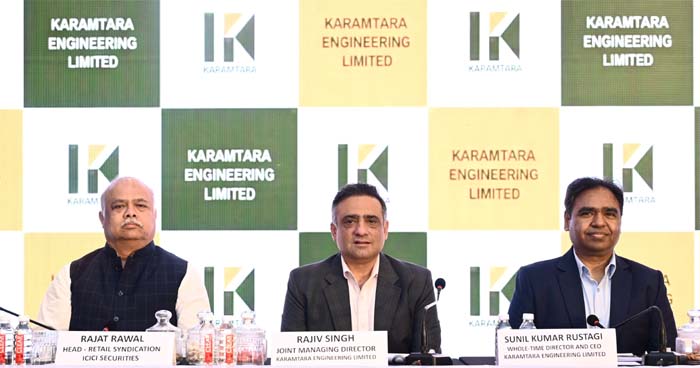
- ₹875-crore IPO opens today at ₹241-254 a share, with ₹600 crore earmarked for debt reduction
- Company valued at up to ₹8,174 crore; FY26 revenue rises 36.5% to ₹4,312 crore
- ₹262.5 crore anchor book signals institutional appetite ahead of public issue
- Gujarat emerges as a key growth hub with Bhachau facilities for renewable-energy manufacturing
- Solar remains the core engine as Karamtara expands into wind towers, telecom and transmission infrastructure
- Fresh capital to strengthen balance sheet while supporting the next phase of capacity expansion
R MANICKAVASAGAM
AHMEDABAD, SEPT 9
The steel structures that quietly hold up India’s solar panels, transmission networks, wind turbines and telecom infrastructure are now stepping into the public-market spotlight, with Karamtara Engineering Ltd opening its ₹875-crore initial public offering (IPO) on Wednesday, positioning itself as a diversified engineering play on India’s accelerating energy and infrastructure transition.
The Mumbai-based company, which describes itself as a backward-integrated manufacturer serving the renewable-energy and transmission sectors, has fixed the IPO price band at ₹241-254 per equity share. The issue will remain open till September 11, with shares proposed to be listed on both the BSE and NSE on September 17.
The offer comprises a fresh issue of ₹675 crore and an offer for sale (OFS) of ₹200 crore, with the OFS being undertaken equally by promoters Tanveer Singh and Rajiv Singh. At the upper end of the price band, the company is valued at around ₹8,174 crore, giving investors an opportunity to participate in a business increasingly aligned with India’s renewable-energy, power-transmission and infrastructure expansion.
Anchor book gets ₹262.5 crore head start
Ahead of the public issue, Karamtara mobilised ₹262.5 crore from anchor investors, allocating 1.03 crore equity shares at ₹254 apiece to institutional investors. The anchor book included 15 investors, while five domestic mutual fund houses — HDFC AMC, Motilal Oswal AMC, Nippon Life India, Mirae Asset and Trust MF — together received 46.85 lakh shares worth about ₹119 crore through six schemes.
For retail investors, the minimum bid is 59 shares, translating into a minimum investment of ₹14,986 at the upper end of the price band. Bids can thereafter be made in multiples of 59 shares.
The issue has already attracted considerable institutional and private-market attention. Before the IPO, Karamtara had raised around ₹546 crore through a combination of pre-IPO and secondary transactions, including investment from Amara Partners and other institutional and individual investors.
Debt reduction at the heart of fresh issue
A substantial portion of the fresh capital is intended to strengthen the company’s balance sheet. Karamtara plans to utilise ₹600 crore of the net fresh issue proceeds towards repayment/prepayment of borrowings and related obligations, with the remaining amount earmarked for general corporate purposes.
The balance-sheet focus is significant given the scale of the company’s manufacturing operations and expansion programme. As of July 2026, its standalone outstanding borrowings stood at around ₹1,344.4 crore, while outstanding acceptances pursuant to letters of credit were about ₹735.1 crore.
The IPO, therefore, is not merely a fund-raising exercise for expansion; it also represents an attempt to create greater financial headroom as the company scales its renewable-energy and transmission businesses.
Gujarat turns into a critical growth engine
For Gujarat, the IPO carries particular significance as Bhachau in Kutch is emerging as an important manufacturing hub in Karamtara’s expansion map.
The company has four manufacturing facilities in Gujarat and is developing its wind-tower manufacturing facility at Bhachau, with plans for a state-of-the-art tubular tower plant capable of producing windmill towers with diameters of up to six metres. The facility is designed to use submerged-arc-welding technology.
Karamtara’s Gujarat footprint is therefore moving beyond conventional steel manufacturing towards products supporting the next generation of renewable-energy infrastructure.
The company is simultaneously expanding its manufacturing footprint in Saudi Arabia, including facilities aimed at serving solar and transmission markets, thereby combining domestic manufacturing depth with an international supply-chain strategy. Karamtara says it has cumulatively exported to more than 50 countries across North America, Europe, Asia, Africa, Australia and Latin America.
Solar remains the centrepiece
Solar continues to be the company’s principal growth pillar.
Karamtara manufactures module mounting structures, tracker piles and piers, torque tubes and other tracker components, supported by backward integration into steel processing and galvanising. Its solar module mounting facility has an annual capacity of about 100,500 MT, while tracker piles and piers have a capacity of around 180,600 MT.
The company has positioned itself as one of India’s largest integrated manufacturers of solar mounting structures and tracker components by installed capacity and has also been among the significant Indian exporters of solar products to North America.
That positioning gives Karamtara exposure not merely to solar-module manufacturing but to the physical infrastructure required to install and operate utility-scale renewable-energy projects.
Wind, telecom add new legs to the business
Karamtara’s growth story, however, is no longer confined to solar.
The company has commenced production of angular and tubular towers for wind turbines, while its upcoming Bhachau facility is expected to deepen this vertical. Its fasteners business also caters to solar, wind, transmission and telecom-tower applications.
Telecom is another established diversification rather than a completely new experiment. According to the company’s historical disclosures, Karamtara commenced manufacturing telecom towers in 2006, while its product portfolio today includes transmission and telecom towers.
This creates a broader infrastructure proposition — from the structures supporting renewable generation to the towers carrying electricity and connectivity.
The company has also incorporated Karamtara Green Energy, its wholly owned subsidiary, with plans to enter the battery energy-storage systems segment. Together with planned prefabricated engineered-building structures, these initiatives point towards an attempt to build multiple growth engines around its core steel-engineering capabilities.
Strong FY26 performance adds momentum
Karamtara’s operating performance provides another key plank for the IPO narrative.
For FY26, the company reported a 36.5% rise in revenue to ₹4,312 crore, while profit increased 64.2% to ₹228.8 crore. Its consolidated revenue has expanded sharply over the past few years as the company increased its exposure to renewable-energy products and international markets.
The company says its integrated manufacturing model — encompassing steel processing, structural fabrication, galvanising, fasteners and finished renewable-energy products — gives it greater control over quality, costs and delivery.
Its transmission business can manufacture towers for systems of up to 1,200 kV, and the company says it has supplied more than half a million tonnes of transmission towers and lattice structures.
A one-stop energy-infrastructure play
Founded in 1996, Karamtara began with transmission towers before diversifying into solar and subsequently broadening its product portfolio. The company’s current positioning is built around what it calls a “one-stop solution” model spanning renewable energy and power transmission.
Rajiv Singh, Joint Managing Director, has been associated with Karamtara since its incorporation and is responsible for directing the company’s global growth strategy in the renewable-energy sector. Whole-Time Director and CEO Sunil Kumar Rustagi, who joined the company in 2011, oversees overall management, commercial negotiations, strategic partnerships and finance-related functions.
The company’s leadership is thus taking a business that began with transmission towers into a wider arena encompassing solar structures, wind towers, telecom infrastructure, transmission hardware, fasteners and, potentially, energy storage.
The larger question for public-market investors is whether this diversification can convert India’s massive renewable-energy and grid-expansion opportunity into sustained earnings growth.
With the IPO opening today, Karamtara is effectively asking the market to back its thesis that the energy transition will need not only power generators and technology companies, but also the steel, structures and engineered infrastructure that make the transition physically possible.
- Lead managers: JM Financial, ICICI Securities and IIFL Capital Services
- Registrar: MUFG Intime India
- Proposed listing: BSE and NSE
- Designated stock exchange: NSE