R ARIVANANTHAM
CHENNAI, SEPT 8
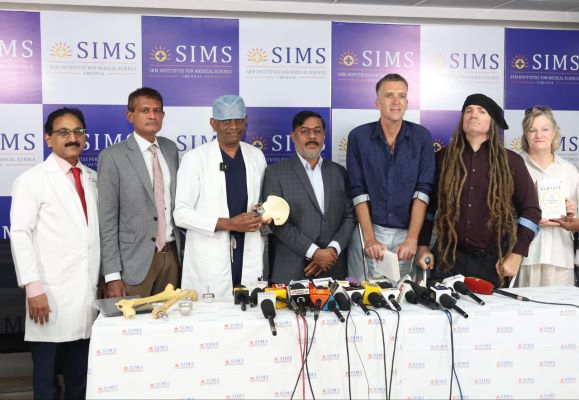
What if the future of hip replacement is not about removing more bone, but saving more of it? SIMS Hospital has turned that proposition into a clinical milestone, performing Asia’s first new-generation, bone-sparing hip procedure on two international patients from the USA and the UK—an achievement that places Chennai firmly in the conversation around the next generation of advanced orthopaedic care.
- SIMS Hospital performs Asia’s first new-generation bone-sparing hip procedure on patients from the USA and UK
- Innovative technique preserves more of the patient’s natural bone while delivering stable, anatomical and highly functional reconstruction
- US-based JointMedica explores India manufacturing prospects; SRM Group open to foreign medical-device joint ventures
- SRM Group mulls air-ambulance service as part of wider push to strengthen emergency and advanced healthcare infrastructure
- International patients hail Chennai’s surgical expertise, technology and patient-care standards after pioneering procedures
- Milestone strengthens Chennai’s credentials as a destination for complex, specialised and innovation-led orthopaedic care
The pioneering procedures were performed on Hurvey Welles Haskins IV, 44, from the USA, and Mark William Maybank, 58, from the United Kingdom, using an innovative approach designed to preserve a substantial portion of the patient’s healthy natural bone while achieving stable and functional hip reconstruction.
Unlike conventional hip procedures that can involve extensive bone removal, the new-generation approach seeks to retain more of the patient’s native bone, respect natural hip anatomy and optimise implant stability. The strategy could be particularly significant for younger and active patients, for whom preserving bone stock may provide greater options for future interventions.
Preserving bone, preserving possibilities
The procedures followed detailed clinical assessments, comprehensive imaging, medical optimisation and meticulous surgical planning. Both patients have reported encouraging early functional recovery during the initial postoperative period.
Dr. Vijay C Bose, Joint Director and Senior Consultant, Orthopedics, who led the surgical team, described the development as a shift in the philosophy of hip reconstruction.
“This procedure represents a significant shift in how we approach hip replacement and reconstructive hip surgery. The goal is not simply to replace a painful joint, but to preserve as much of the patient’s own bone as possible while respecting the natural mechanics of the hip.”
He stressed that the approach is founded on a simple principle: wherever possible, surgery should preserve the patient’s bone and work with the body’s natural anatomy.
“With careful patient selection, meticulous planning, advanced technology and precise surgical execution, we believe this approach can help many patients achieve a stable reconstruction and return to a highly functional and active life.”
Patient selection, he added, remains critical and depends on factors including age, bone quality, diagnosis, anatomy, activity requirements, overall medical condition and the surgeon’s assessment.
US expertise meets India’s manufacturing ambition
The milestone also opened a larger conversation around medical technology, indigenous manufacturing and international collaboration.
Dr. Sharat Kusuma, President of US-based JointMedica, a leading developer of transformative hip arthroplasty solutions, was part of the interaction surrounding the breakthrough. An Indian-origin medical technology entrepreneur, Kusuma told navjeevanexpress.com that the company could consider establishing a manufacturing facility in India after obtaining the necessary statutory approvals.
His response comes against the backdrop of SRM Group’s willingness to work with international medical-equipment companies to establish manufacturing capabilities in India, potentially creating a bridge between advanced orthopaedic technology, Indian healthcare delivery and local production.
Dr. Ravi Pachamuthu, Chairman, SRM Group, told navjeevanexpress.com that the group is open to joint ventures with foreign medical-equipment companies seeking to establish manufacturing facilities in India.
Such collaborations, if realised, could add a new dimension to India’s medical-value proposition—moving beyond importing advanced devices and creating opportunities for technology transfer, local manufacturing, clinical innovation and export-oriented medical-device development.
SRM eyes air ambulance to bridge emergency-care gap
Pachamuthu also revealed that the SRM Group is mulling the launch of an air-ambulance service to address the urgent need for faster emergency medical intervention, particularly in accident cases where every minute can influence outcomes.
He said the group is establishing a 1,200-bed multi-specialty hospital in Tiruchirappalli with a helipad facility and is currently in the process of obtaining the necessary permissions from the Central and State governments as well as the aviation authorities.
The proposed air-ambulance initiative, he indicated, is aimed at bridging a critical gap in emergency healthcare by enabling faster movement of accident victims and critically ill patients to specialised medical facilities.
Together, the planned emergency-care infrastructure and potential medical-device partnerships point to a broader SRM vision that extends from advanced clinical care to emergency response and healthcare manufacturing.
International patients put Chennai in global spotlight
For the two international patients, the decision to travel to Chennai was driven by confidence in the hospital’s expertise, infrastructure and surgical capabilities.
Hurvey Welles Haskins IV and Mark William Maybank said:
“We are very happy with the clinical outcome and feel that our decision to travel to Chennai for this procedure was the right one.”
They said they had options to seek treatment closer to home but chose SIMS Hospital because of the combination of clinical expertise, advanced infrastructure, innovative surgical techniques and confidence in the surgical team.
Their experience, they added, gave them first-hand insight into the capabilities of Indian hospitals and surgeons in delivering highly specialised care to international patients.
“The outcome of our treatment has reinforced that confidence and, in our view, Chennai has the potential to emerge as an important destination for complex and innovative orthopaedic care.”
A Chennai milestone with a global message
Dr. Ravi Pachamuthu said the achievement represents a larger transformation in the way hip surgery is being approached.
“It is about the future of hip surgery, a future that is more bone-preserving, anatomical, functional and focused on the long-term needs of patients.”
He attributed the achievement to continued investment in advanced surgical infrastructure, trained multidisciplinary teams, patient-safety systems and orthopaedic innovation.
The fact that patients from the USA and UK travelled to Chennai for the procedure, he said, was a testament to growing international confidence in India’s medical expertise and high standards of patient care.
The convergence of bone-preserving surgery, global medical technology, potential local manufacturing and next-generation emergency healthcare infrastructure gives the milestone significance beyond a single surgical achievement.
It also strengthens Chennai’s claim as a destination where clinical excellence and healthcare innovation can meet global patient demand—with the latest hip breakthrough potentially marking only the beginning of a much larger healthcare story.