- Hillhouse Capital-backed education-infrastructure platform to open ₹2,100-crore IPO from September 23–25
- Price band fixed at ₹343–₹362; fresh issue of 5.80 crore shares with no offer-for-sale component
- ₹1,100 crore earmarked for promoter-group K–12 acquisitions and ₹750 crore for partial debt repayment
- Company serves 80,255 students across 16 cities in India and the UAE through owned and managed accommodation
- Gujarat emerges as a potential growth market as international universities expand and new education hubs take shape
R MANICKAVASAGAM
AHMEDABAD, SEPT 21
Can a hostel bed become a long-term infrastructure asset—and can the business of housing students evolve into a scalable campus-services platform?
That is the larger proposition entering India’s capital market as Singaporean Hillhouse Capital-backed Elevate Campuses Ltd prepares to open its ₹2,100-crore initial public offering (IPO) on September 23, bringing student accommodation, integrated campus services and K–12 infrastructure into the investor spotlight.
The three-day public issue will close on September 25, with the company’s shares expected to list on September 30. The IPO price band has been fixed at ₹343–₹362 per share.
The issue comprises an entirely fresh issue of 5.80 crore equity shares, with no offer-for-sale component. At the upper end of the price band, the company expects to raise ₹2,100 crore, implying a post-issue market capitalisation of approximately ₹6,100.82 crore.
A hostel platform evolving into campus infrastructure
Elevate Campuses operates student accommodation under its Good Host Spaces and ScholarZ brands, providing universities and colleges with non-academic services covering accommodation, dining, safety and campus operations.
The proposition is designed to allow educational institutions to concentrate on their core academic functions while outsourcing the management of student living and related infrastructure.
The company also owns K–12 school infrastructure leased to third-party school operators. It does not itself operate schools or provide educational services in this segment.
As of March 31, 2026, Elevate Campuses had the capacity to serve 80,255 students across 15 cities in India and one city in the UAE.
Its institutional relationships include O.P. Jindal Global University, Manipal University Jaipur and Shoolini University.
The owned portfolio comprises seven student-accommodation campuses with 20,368 beds across six cities, besides two K–12 assets in Dubai. Its managed portfolio comprises 14 student-accommodation campuses with 55,487 beds under management as of March 31, 2026.
Gujarat: From education hub to potential growth frontier
The company’s Ahmedabad IPO interaction also brought Gujarat’s rapidly evolving higher-education ecosystem into focus, particularly with international universities already operating in the State and more institutions exploring a presence.
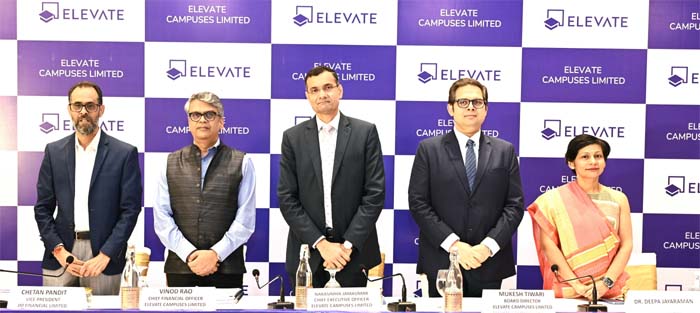
Asked what opportunities Elevate Campuses sees in Gujarat’s expanding higher-education and school ecosystem, and whether it is evaluating new campuses or partnerships in Ahmedabad, Gandhinagar, GIFT City or other emerging education hubs, Board Director Mukesh Tiwari said: “With international universities already functioning and many more coming in Gujarat, we will explore all opportunities on need based one.”
The response indicates that the company is watching the State’s education-infrastructure expansion while linking any future investment or partnership decision to institutional demand and requirements.
For a student-accommodation platform, the emergence of new universities, international institutions, specialised campuses and education-led urban centres could potentially create demand for professionally managed residential and support infrastructure.
Gujarat’s developing education ecosystem, therefore, becomes relevant not merely as a geographic market but as a potential extension of Elevate’s institutional-partnership model.
Long-term contracts anchor the business model
The durability of institutional relationships is another critical element of the company’s business proposition.
Asked about the general contract period with educational institutions, Tiwari said: “All are on longer terms of 15 years and beyond.”
Long-duration institutional arrangements can provide visibility for accommodation infrastructure and campus services, while the company’s growth trajectory will also depend on occupancy, client retention, operating costs and the ability to secure additional institutional partnerships.
₹1,100 crore for K–12 acquisitions
The largest allocation from the IPO proceeds—₹1,100 crore—will be used for acquiring K–12 entities and campuses from fellow subsidiaries of the promoter group.
The proposed acquisitions are expected to expand the company’s school-infrastructure portfolio beyond its existing two Dubai assets, with transactions involving campuses in Hyderabad, Chennai and Pune.
Another ₹750 crore will be utilised to repay part of the outstanding borrowings of the company and certain wholly owned subsidiaries, including GHS Shoolini, GHS Sonipat, Souk HIS UAE, Data Ram Sons and Souk NLCS UAE, through investments in those entities.
The remaining proceeds will support inorganic growth through unidentified acquisitions, other strategic initiatives and general corporate purposes.
The deployment strategy thus combines balance-sheet strengthening with expansion into additional education infrastructure.
CFO: Upfront hostel fees support cash flows
Elevate Campuses CFO Vinod Rao explained that the company operates with negative working capital because hostel fees are collected from students at the beginning of the admission period while services are delivered throughout their stay.
The model enables the company to provide an integrated student-living experience, including facilities such as laundry, dining and other campus amenities.
Rao said universities and colleges are increasingly seeking professional hostel-management services as institutions look to focus on their primary academic responsibilities.
The company generates rental and management fees as well as income from dining, laundry, gyms and other campus facilities.
Its owned assets typically have operating lives of 50–60 years, while its managed model is relatively asset-light, with contracts generally running for up to five years.
The economics of the model, however, remain closely linked to occupancy, institutional relationships, contract terms and operating efficiency.
Revenue up 53.8%; profit jumps 3.5-fold
Elevate Campuses reported a sharp improvement in its financial performance in FY26.
Revenue from operations rose 53.8% to ₹568.6 crore, from ₹369.8 crore in the previous year, while consolidated profit increased 3.5-fold to ₹173.8 crore, compared with ₹49.7 crore earlier.
The company’s scale-up, however, comes with operational metrics that investors will need to track as the platform expands.
Owned-bed occupancy declined from 99.92% in FY24 to 89.37% in FY26.
At the same time, customer concentration has reduced, with the company’s three largest higher-education clients—O.P. Jindal Global University, Manipal University Jaipur and Shoolini University—accounting for 61.46% of FY26 revenue, compared with 89% in FY25.
O.P. Jindal Global University alone contributed approximately 36% of FY26 revenue.
Occupancy trends, client concentration, contract renewals, operating costs and cash generation will consequently remain important parameters as the company seeks to scale.
Hillhouse-backed platform takes the IPO route
Elevate Campuses is ultimately owned and controlled by funds of Hillhouse Investment, a global alternative investment manager.
Hillhouse established Rava Partners in 2020 as its real-assets investment strategy, with commitments exceeding US$3.5 billion since inception across sectors including education, logistics and industrial assets, life sciences and healthcare, and digital infrastructure.
The company is led by a management team with experience spanning real estate, deal financing, operations and facility management.
For retail investors, the minimum application is 41 shares, with bids permitted in multiples thereafter. At the upper price-band limit of ₹362, the minimum application value would be ₹14,842, before applicable charges.
The issue has reserved 75% for qualified institutional buyers, 15% for non-institutional investors and 10% for retail investors. The anchor-investor portion is scheduled to open on September 22.
IIFL Capital Services, Morgan Stanley India Company and JM Financial are the book-running lead managers, while KFin Technologies is the registrar.
The bigger question: can campus infrastructure become a long-duration asset class?
Elevate Campuses’ public issue comes at a time when India’s higher-education landscape is expanding beyond classrooms into a broader ecosystem of accommodation, food, safety, mobility, technology and student services.
Its proposition is consequently broader than conventional hostel operations: build or manage accommodation, integrate ancillary services, establish long-term institutional relationships and increasingly participate in education infrastructure through K–12 assets.
For Gujarat, where Ahmedabad, Gandhinagar and GIFT City are developing as interconnected education, technology and professional-services hubs, the company’s stated willingness to explore opportunities on a need-based basis places institutional demand at the centre of its potential expansion strategy.
The IPO will therefore put a market value not only on beds and buildings, but on a longer-term proposition: whether professionally managed student living and integrated campus infrastructure can emerge as a durable institutional business in India’s expanding education economy.