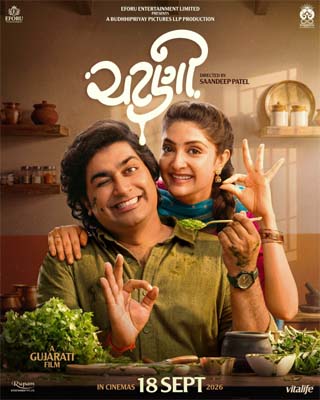
- Malhar Thakar plays an engineer determined to transform his family’s century-old chutney recipe into a contemporary brand.
- Puja Joshi joins Thakar in their first big-screen lead pairing since marriage, adding warmth to the romantic narrative.
- Saandeep Patel explores the clash between culinary heritage, generational expectations and entrepreneurial ambition.
- Jigardan Gadhavi’s soulful Pankhida, composed by Rahul Munjariya, lends a melodious touch to the romance.
- An appealing Gujarati family saga loses some of its flavour to a 2-hour-47-minute runtime, leisurely pacing and an overextended romantic track.
GOWRI MANICKAVASAGAM
When a century-old chutney recipe meets a modern business dream
Can a family’s treasured culinary tradition become the foundation of a modern business without losing its original flavour? And can a romantic family entertainer successfully balance business ambitions, generational conflict and matters of the heart?
Gujarati film Chatni, directed by Saandeep Patel, sets out to explore these questions through the story of Deval, played by Malhar Thakar, and his dream of transforming his family’s traditional farsan business into a contemporary brand. The film has an appealing premise rooted in Gujarati culture, but its execution is a mixed experience, with an engaging central idea competing against an overextended narrative.
A deliciously relatable premise
Deval is an engineer with a stable career, but his heart lies in carrying forward his family’s culinary legacy. He dreams of turning its more than century-old chutney recipe into a modern brand, taking the authentic taste of his mother’s traditionally prepared chutney to urban consumers.
His ambition, however, encounters resistance from his traditionalist father, while the challenges of city life and the difficulties of establishing a business add further complications.
The conflict between preserving a family’s heritage and adapting it to contemporary aspirations gives Chatni its most distinctive flavour. The traditional grinding stone, the family’s culinary inheritance and the prospect of commercial expansion provide a recognisable Gujarati setting, lending the story an emotional and cultural foundation.
The idea of building a business around a cherished family recipe has considerable potential. It connects food with memory, family identity and entrepreneurship, making Deval’s struggle more than a straightforward commercial venture.
Story and screenplay: An appealing idea stretched too far
The film’s central storyline is its principal strength. Deval’s determination to give his family’s traditional business a new identity, creates an opportunity to explore generational differences, entrepreneurial risks and the emotional significance of family heritage.
However, the screenplay does not always make the most of this promising foundation.
At approximately two hours and 47 minutes, Chatni feels longer than its story warrants. Certain portions appear unnecessarily extended, slowing the narrative and diminishing the impact of scenes that could have been more effective with tighter editing.
The romantic track, meanwhile, occupies considerable screen time in relation to the central business struggle. Although romance is a natural component of a family entertainer, its prominence occasionally diverts attention from the more distinctive conflict surrounding Deval’s ambition.
The result is an uneven balance: just when the audience’s interest is drawn towards the family’s culinary legacy and the challenges of transforming it into a modern enterprise, the narrative shifts towards romance, interrupting the momentum of the principal storyline.
A more focused screenplay, with sharper transitions between the family, business and romantic elements, could have made the film considerably more engaging.
Direction: Tradition and modernity in focus
Saandeep Patel, who has written the film with Harsh Shodhan, brings together family emotions, romance and the contrast between traditional values and contemporary thinking.
The director’s choice of a family’s chutney-making heritage as the centrepiece is an appealing departure from more conventional romantic and family-drama premises. It provides a distinctly Gujarati cultural setting while addressing an aspiration that audiences across generations can understand.
Yet, the challenge lies in sustaining the central conflict without allowing the supporting tracks to overshadow it. The film’s leisurely pace and the disproportionate space given to romance leave its business narrative with less sustained attention than its premise promises.
Malhar Thakar and Puja Joshi: A real-life pairing on screen
Malhar Thakar, as Deval, anchors the film’s central ambition: a young man seeking to take his family’s traditional culinary inheritance into a new era.
Puja Joshi shares the lead with Thakar, marking their first big-screen pairing in lead roles since their marriage. Their real-life relationship adds a point of interest to the film’s romantic appeal, and the the song Pankhida highlights their on-screen warmth.
The ensemble also includes experienced performers Prashant Barot, Hetal Modi, Smit Joshi, Premal Yagnik, Manisha Trivedi and Aakash Zala.
The film’s family-oriented premise offers the cast opportunities to contribute to its emotional and cultural setting.
Music: ‘Pankhida’ provides a soulful romantic touch
Music is an important part of the film’s promotional identity, particularly through Pankhida, a romantic song rendered by Jigardan Gadhavi.
Composed by Rahul Munjariya, with lyrics by Milind Gadhavi, the song offers a melodious expression of romance and provides a glimpse of the relationship between the lead pair.
Its gentle, emotional character complements the film’s family-entertainer positioning. The song’s appeal is further enhanced by the audience interest surrounding Thakar and Joshi’s first lead pairing on screen after marriage.
Cinematography and dance: Scope for a fuller assessment
The film’s traditional culinary setting offers opportunities for visual storytelling, particularly through the contrast between an old family enterprise and the modern marketplace Deval hopes to enter.
Production and distribution
Chatni is presented by EForU Entertainment Limited and produced under Buddhipriyay Pictures LLP.
Prashant Modi, Nilesh Modi, Amit Vedawala and Harsh Patel are the producers, while Malhar Thakar and Puja Joshi serve as co-producers. Rupam is handling distribution in India, with OMG Pictures overseeing overseas distribution.
The film brings together an ensemble cast and a creative team led by Patel and Shodhan, with a story rooted in Gujarati family life and entrepreneurial aspiration.
The final verdict: A promising recipe, not quite perfectly balanced
Chatni has an appealing central idea: a young engineer’s determination to transform his family’s traditional chutney business into a contemporary brand, while negotiating the expectations of an older generation.
Its cultural rootedness, family setting and the pairing of Malhar Thakar and Puja Joshi give it an identifiable audience appeal. The soulful Pankhida, sung by Jigardan Gadhavi, adds a romantic dimension to its presentation.
However, the film’s extended runtime, uneven pacing and the amount of attention devoted to the romantic track weaken the impact of its most distinctive storyline. The family’s culinary legacy and Deval’s entrepreneurial struggle could have benefited from a tighter, more consistently focused screenplay.
For viewers who enjoy Gujarati family dramas, cultural settings, romance and stories about generational aspirations, the premise may hold interest. Those looking for a briskly paced business-oriented narrative, however, may find the journey more leisurely than expected.
Ultimately, Chatni has the ingredients for a relatable Gujarati family entertainer, but the balance between tradition, business ambition and romance could have been more carefully measured.