- IIT Gandhinagar signs MoUs with Taipei Tech, Taiwan Tech and National Central University
- Partnerships target joint research, academic exchanges and talent development in semiconductors, AI and emerging technologies
- IITGN delegation’s Taiwan visit opens fresh avenues for high-end technology and innovation collaboration
- Taiwan’s higher-education ecosystem and IITGN’s SAMARTH hub create a platform for research-to-workforce linkages
- 974 Indian doctoral students in Taiwan in 2026 underline the growing India–Taiwan academic connect, says Taiwan’s Deputy Education Minister
NE SCIENCE & TECHNOLOGY BUREAU
GANDHINAGAR, SEPT 24
Can India’s semiconductor ambitions gain a stronger academic edge by tapping Taiwan’s deep technology expertise?
The Indian Institute of Technology Gandhinagar (IITGN) is seeking to answer that question by building a new academic and research bridge with Taiwan—one that connects semiconductor expertise, cutting-edge research, student talent and technology development.
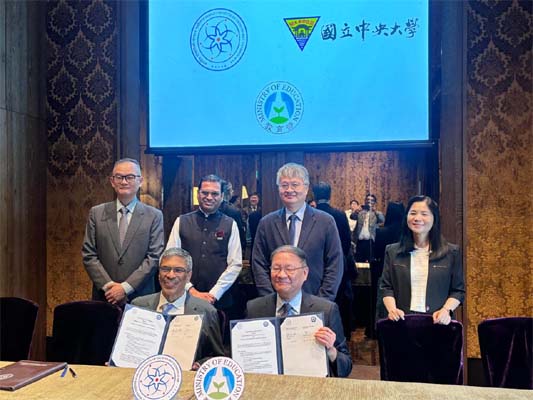
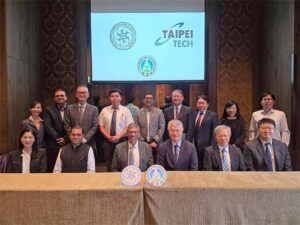
During an IITGN delegation’s visit to Taiwan from September 20–25, the institute signed Memoranda of Understanding with three leading Taiwanese universities—the National Taipei University of Technology (Taipei Tech), National Taiwan University of Science and Technology (Taiwan Tech), and National Central University (NCU).
The agreements are aimed at promoting joint research, academic exchanges and talent-development programmes in semiconductors, artificial intelligence and other emerging technologies.
The delegation was led by Prof Rajat Moona, Director, IIT Gandhinagar, while Minand Deshpande, Director General, India Taipei Association (ITA), and the Presidents of Taipei Tech, Taiwan Tech and NCU attended the MoU signing ceremony.
Building the talent bridge
For IITGN, the collaboration goes beyond institutional exchange. It seeks to expose students and faculty to different approaches to semiconductor research, engineering, technology development and specialised talent training, while creating opportunities for sustained academic cooperation.
“Our visit to Taiwan has provided an opportunity to engage directly with institutions that have developed strong capabilities in semiconductor technology and advanced engineering. Our discussions with Taipei Tech, Taiwan Tech and National Central University have opened new possibilities for our students and faculty to experience different approaches to research, technology development and talent training. We look forward to translating these conversations into meaningful and sustained academic and research collaborations,” said Prof Rajat Moona.
The timing is significant as India seeks to build not merely semiconductor manufacturing capacity but also the researchers, engineers and specialised workforce required to sustain the ecosystem.
Taiwan sees IITGN as a strategic academic partner
The emerging India–Taiwan education link was highlighted by Dr Kuo-Wei Liu, Deputy Minister, Ministry of Education, Taiwan.
“Taiwan–India collaboration in higher education and research has grown significantly over the past decade. In 2026, 974 Indian students pursued doctoral degrees in Taiwan—the second-highest number from any country, after Indonesia with 1,081 students. IIT Gandhinagar and its recently established Silicon and Advanced Semiconductor Manufacturing Research and Training Hub (SAMARTH) are poised to play a major role in deepening bilateral collaboration in semiconductor education, research and technology development,” he said.
His remarks underline the growing importance of educational partnerships in developing the human capital required for advanced technology sectors.
SAMARTH becomes the crucial link
A key component of IITGN’s semiconductor push is its Silicon and Advanced Semiconductor Manufacturing Research and Training Hub (SAMARTH), established to promote semiconductor workforce development, applied research, technology innovation and industry collaboration.
The new university partnerships could provide SAMARTH and IITGN’s academic programmes with deeper access to Taiwan’s semiconductor education, research and manufacturing expertise.
IITGN’s location in Gujarat, which is emerging as an important semiconductor manufacturing hub, further strengthens the potential connection between academic research, industrial requirements and workforce development.
Beyond the three MoUs
The Taiwan visit is also opening discussions beyond the three newly signed agreements.
The IITGN delegation is engaging with institutions including National Cheng Kung University, National Yang Ming Chiao Tung University, Taiwan Tech, Taipei Tech and National Central University, besides organisations such as the Taiwan Semiconductor Research Institute (TSRI) and Powerchip Semiconductor Manufacturing Corporation (PSMC).
These interactions are expected to explore opportunities for joint research, institutional exchanges, specialised training and longer-term technology collaboration.
For IITGN, the emerging network could help create a continuum from classroom learning and fundamental research to specialised training, applied innovation and industry needs.
And for India’s semiconductor journey, that continuum may prove increasingly important: chips may power the technology revolution, but people with the right knowledge and skills will power the chip ecosystem.