NE NEWS SERVICE
NEW DELHI/AHMEDABAD, SEPT 27
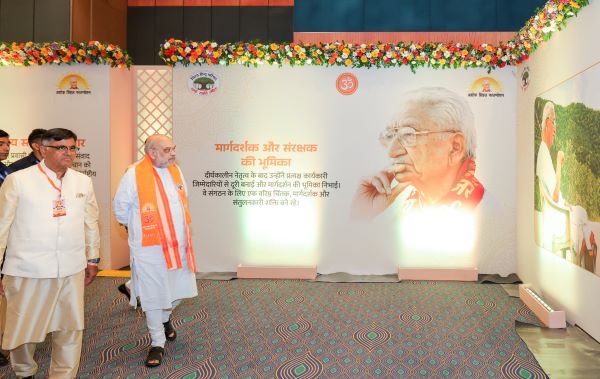
What does a century-long remembrance of a controversial and consequential public figure tell a new generation about conviction, sacrifice, organisation and the making of a movement? That question took centre stage on Sunday as the birth centenary year of former Vishwa Hindu Parishad (VHP) president Ashok Singhal was formally inaugurated in New Delhi, while Gujarat simultaneously marked the occasion in Ahmedabad.
- Amit Shah inaugurates birth-centenary year of former VHP president, recalls Singhal’s simplicity, sacrifice and lifelong commitment to his causes
- From a modest VHP room to the centre of the Ram Janmabhoomi movement, Singhal’s life is being remembered as one of organisational dedication
- Gujarat marks the centenary in Ahmedabad as Chief Minister Bhupendra Patel pays tribute to the former VHP leader
- Eleven Ram Stambhs digitally inaugurated to carry the message of the Ram Van Gaman Path to future generations
- Birth-centenary programmes planned across India and overseas, with service, social initiatives and cultural outreach forming part of the year-long observance
- The commemoration also revives a larger question: how should a society preserve the memory of figures who shaped major chapters of its public life?
Union Home Minister and Minister of Cooperation Amit Shah, addressing the inaugural ceremony, described Singhal’s life as a combination of “sacrifice, simplicity, exemplary patriotism, devotion to Dharma” and a spirit of struggle. He said Singhal remained dedicated to his organisational and ideological commitments from his student years through his roles as a volunteer, Pracharak and VHP leader.
The centenary comes a decade after Singhal’s death in 2015 and 100 years after his birth in Agra on September 27, 1926. Prime Minister Narendra Modi also recalled Singhal’s contribution to the Ram Janmabhoomi movement during the 138th episode of Mann Ki Baat on Sunday.
A life measured in commitment
Shah said Singhal came from a prosperous family but chose a deliberately austere lifestyle, including spending about two decades in a room at the VHP office.
“Ashok Singhal was an institution in himself,” Shah said, adding that his simplicity, sacrifice and dedication could inspire young people during the centenary year.
He recalled that even at an advanced age, Singhal worked for long hours, describing his motivation as rooted in his commitment to his causes.
Shah also referred to Singhal’s reverence for Hindu Dharma, the Vedas, Upanishads, Sanskrit, Indian culture and the traditions of saints. According to Shah, Singhal believed that Hindu philosophical traditions should be taken to the world not merely because they were Hindu, but because they articulated a wider concern for the welfare of humanity.
Ram Janmabhoomi at the heart of his public life
The Ram Janmabhoomi movement remained central to Singhal’s public role.
Shah recalled Singhal’s participation in the movement and his presence during confrontations surrounding the campaign. He said the image of Singhal injured during a lathi charge represented the determination with which he pursued the cause.
Shah also linked Singhal’s long campaign for a Ram Temple with the eventual construction of the temple in Ayodhya, saying the obstacles to its construction were removed after the change in government in 2014 and that the temple was built without bloodshed.
These are Shah’s political and historical characterisations of Singhal’s role and legacy; the Ram Janmabhoomi movement itself remains one of the most consequential and contested chapters of modern Indian public life.
11 Ram Stambhs take the message forward
A significant feature of Sunday’s programme was the digital inauguration of 11 Ram Stambhs, conceived as markers of the Ram Van Gaman Path—the traditional route associated with Lord Ram’s exile.
Shah said the pillars would carry the message of the Ram Van Gaman Path and the life and values associated with Lord Ram to future generations.
He acknowledged that Singhal did not live to see either the Bhoomi Pujan or completion of the Ayodhya temple, but said Singhal had regarded the struggle as one extending across generations.
Gujarat joins the centenary observance
રાષ્ટ્રહિત સાધક અને સાંસ્કૃતિક ચેતનાના પ્રખર સંવાહક શ્રદ્ધેય અશોક સિંઘલજીના જન્મ શતાબ્દી વર્ષ નિમિત્તે અમદાવાદ ખાતે આયોજિત વિશેષ સંગોષ્ઠી કાર્યક્રમમાં ઉપસ્થિત રહી તેમને ભાવપૂર્ણ શ્રદ્ધાંજલિ અર્પણ કરી.
તેમનું સમગ્ર જીવન રાષ્ટ્ર, સનાતન સંસ્કૃતિ અને આધ્યાત્મિક પરંપરાના જતન માટે… pic.twitter.com/bo9qBBkvWb
— Bhupendra Patel (@Bhupendrapbjp) September 27, 2026
The centenary celebrations also resonated strongly in Gujarat.
In Ahmedabad, Chief Minister Bhupendra Patel paid floral tributes to Ashok Singhal at a programme organised to mark his 100th birth anniversary. The Gujarat event was part of the wider centenary-year observance, with speakers recalling Singhal’s contribution to the Ram Temple movement and his organisational work.
The Gujarat programme assumes particular significance because the state has historically been an important centre of activity for organisations and campaigns associated with the wider Ram Janmabhoomi movement.
The Ahmedabad programme was also planned as a platform for reflecting on Singhal’s contribution, with senior VHP representatives and other dignitaries participating.
From memory to service
The centenary is not being confined to commemorative ceremonies.
The VHP has announced programmes at 47 major locations between September 27 and October 4, followed by year-long activities in India and abroad involving service initiatives, social outreach, seminars, exhibitions and public-awareness programmes.
A disability-assistance camp at Ayodhya’s Karsewakpuram from September 27 to October 1 is among the initiatives announced as part of the centenary observance.
The stated objective, according to the organisers, is to take Singhal’s life and message to a wider audience while giving fresh impetus to activities relating to service, social engagement, cultural awareness and organisational work.
The legacy question
Singhal’s legacy cannot be separated from the major ideological and political developments in which he was involved.
For his supporters and associates, he represented uncompromising dedication to Hindu cultural causes and the Ram Janmabhoomi movement. For others, his legacy is inseparable from the contentious history and social consequences of that movement.
The centenary therefore provides an opportunity not only for remembrance but also for examining how movements, institutions and individuals leave their imprint on India’s public life.
Shah framed that issue in terms of the importance of remembering national figures and transmitting their values to younger generations.
“When society forgets its heroes, an ideological vacuum emerges,” he said, arguing that young people need identifiable sources of inspiration and direction.
A century after Singhal’s birth, Delhi and Ahmedabad have begun a year-long exercise in remembrance. The larger test will be how that memory is interpreted by a new generation—and what lessons it chooses to draw from a life that became deeply intertwined with one of the defining movements of contemporary India.