- Over 1,000 delegates and 180 national and international faculty to converge in Ahmedabad for 22nd Indian Arthroplasty Association conference
- Robotics and AI-assisted surgery, kinematics and innovation to dominate three-day scientific programme
- First large-scale IAA cadaveric workshop to train surgeons in advanced hip, knee and shoulder replacement techniques
- Experts flag rising arthroplasty demand among both senior citizens and younger patients
- PM-JAY and government health schemes widen access, but insurance coverage for robotic surgery and implants remains a key question
- 25 scientific sessions, surgical videos, live demonstrations and consensus document to drive practical learning
R MANICKAVASAGAM
AHMEDABAD, SEPT 29
Can artificial intelligence, robotics and advanced navigation transform joint replacement while keeping the procedure accessible to the patients who need it most? And as younger patients increasingly enter the arthroplasty pipeline, when does a damaged joint warrant partial replacement rather than a total replacement?
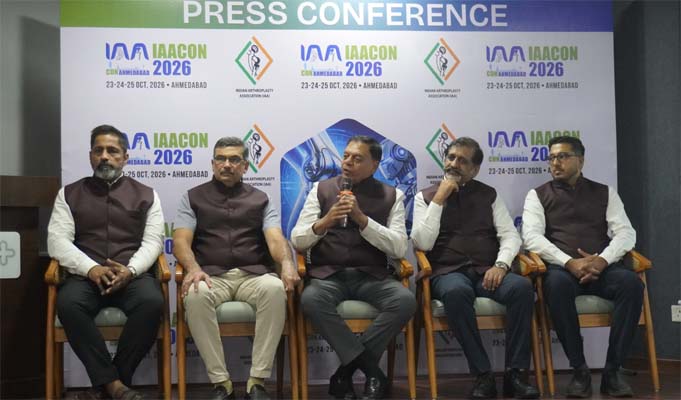
These questions will form an important backdrop to IAACON 2026, the 22nd Annual Conference of the Indian Arthroplasty Association (IAA), which will bring more than 1,000 delegates and 180 national and international faculty to Ahmedabad from October 23 to 25 at Club O7.
Themed “Evolving Arthroplasty – Robotics, Kinematics and Innovation”, the conference was announced at a media interaction at EPIC Multispecialty Hospital on Tuesday.
‘Over 10% of senior citizens face arthritis’
Putting the technological advances in the context of patient demand, Dr. H.P. Bhalodia, Organising Chairman, IAACON 2026, said: “Over 10 per cent of the senior citizens face arthritis issue. The deployment of AI and robotics have increased the cost of arthroplasty by nearly 10-15 percent.”
He said access to treatment had also expanded as patients requiring knee or hip replacement became eligible under Ayushman Bharat PM-JAY and other government health schemes.
“Ever since the patients requiring knee or hip replacements have been covered under Ayushman Bharat PM-JAY and other government health schemes, the number of patients seeking arthroplasty has gone up considerably in the last two years.”
With demand rising, he said the profession would need more trained specialists.
“To meet the needs of the patients, we are gearing up to train more experts in this meet.”
At the same time, Dr. Bhalodia urged patients to look carefully at the terms of private health insurance policies.
“However, one has to read the fine print of private insurers whether they cover the robotic surgery, implants and hospitalisation.”
The issue is particularly significant as robotic and AI-assisted procedures can involve additional technology and equipment costs.
Younger patients change the replacement equation
The traditional image of arthroplasty as predominantly an elderly patient’s procedure is also changing.
Responding to a question on what criteria should determine when joint replacement is genuinely warranted, particularly among younger patients, Dr. Bhalodia said the number of younger patients requiring arthroplasty had increased.
“Nowadays, the number of youth requiring arthroplasty have gone up among 4-45 age group.”
He explained that advances in the field had created alternatives to replacing an entire joint in selected cases.
“With the advancement in this special field, they need not go for total replacement. Only the damaged parts can be replaced.”
He added that the longevity of implants and the possibility of subsequent procedures remained considerations in younger patients.
“However, after 70-75 years of age they have to undergo this surgery again. By that time only less cement will be applied.”
The comments highlight an increasingly important clinical dilemma: balancing the immediate restoration of mobility against the patient’s age, extent of joint damage, expected longevity and the possibility of future revision surgery.
Cadaver lab to turn theory into surgical skill
A major attraction of IAACON 2026 will be the IAA’s first large-scale cadaveric surgical workshop, scheduled for October 22 at B.J. Medical College and Civil Hospital, Ahmedabad.
Dr. Bhalodia described it as: “the biggest one of its kind.”
The workshop will use 12 cadaveric specimens to demonstrate Direct Anterior Approach hip replacement, Unicondylar Knee Arthroplasty, Total Knee Arthroplasty and Reverse Shoulder Arthroplasty.
Ten international faculty—four from Australia, three from Ireland, two from the United States and one from the United Kingdom—will participate.
The emphasis, organisers said, is on giving surgeons an opportunity to understand advanced techniques through hands-on anatomical learning.
From AI-assisted hips to complex knees
The scientific programme will focus on AI-assisted instruments, robotics and 3D camera-assisted surgery, alongside conventional and non-robotic approaches.
Dr. Bhalodia will conduct a dedicated session on AI-assisted total hip replacement using Intellijoint technology, focusing on the role of advanced surgical navigation in improving precision.
The programme will also feature Unicondylar Knee Arthroplasty and Total Hip Replacement demonstrations, around 30 surgical videos, and expert discussions on complex cases, rare periprosthetic fractures and challenging joint infections.
“With more than 1,000 delegates and 180 national and international faculty, IAACON 2026 is designed as a comprehensive academic forum with a strong focus on practical learning. The first large-scale cadaveric workshop in IAA’s history will further strengthen the hands-on dimension of the programme,” said Dr. Dhiraj Marothi Jain, Organising Secretary.
Consensus document targets the next generation
The IAA will also unveil its consensus document, designed as a practical reference for younger surgeons covering established surgical approaches and supporting consistent clinical decision-making.
Senior specialists will discuss the recommendations during a dedicated two-hour session.
Dr. Dimple Parekh, Organising Co-Chairman, said: “IAACON 2026 provides a valuable platform for arthroplasty specialists to exchange experience, discuss evolving clinical practices and learn from diverse perspectives. Participation from experts across India and overseas will encourage meaningful academic dialogue and collaborative learning.”
Each of the 25 scientific sessions will conclude with remarks from senior specialists, practical take-home messages and open questions from students and faculty. Five halls will simultaneously host workshops using anatomical bone models.
Science, surgery and the affordability question
Dr. Deepak Dave, Scientific Committee Chairman, said the programme had been structured around contemporary challenges and evolving arthroplasty techniques.
“The scientific programme focuses on contemporary challenges and evolving techniques in arthroplasty, covering robotic and non-robotic approaches, Relive and InBox surgical sessions and focused workshops to support practical understanding of complex surgical decision-making.”
The conference will also introduce the C.S. Ranawat Gold Medal Competition, which has received around 140 submissions, with two papers to be selected. Dr. Parag Sancheti will deliver the inaugural C.S. Ranawat Memorial Lecture.
With AI and robotics rapidly changing the operating theatre, IAACON 2026 will therefore confront a question extending beyond surgical precision: how can India expand access to increasingly sophisticated joint replacement while ensuring that technology, training, insurance and patient affordability evolve together?