NE DEFENCE BUREAU
NEW DELHI, SEPT 29
With India’s maritime responsibilities stretching from the Indian Ocean to the South China Sea, Mediterranean and Atlantic, Defence Minister Rajnath Singh has called for a sharper surveillance and response architecture and a future-ready Indian Navy, underlining that the security of the seas is inseparable from India’s economic security and its Viksit Bharat ambition.
Addressed the Indian Navy Commanders' Conference at Nausena Bhawan in New Delhi today.
The ongoing 'Operation Urja Suraksha' has once again demonstrated the Indian Navy's professionalism and operational readiness to protect our energy supply lines and national interests.
The… pic.twitter.com/ds7m5Y8z5x
— Rajnath Singh (@rajnathsingh) September 29, 2026
India stands as a “First Responder” and “Preferred Security Partner” in the Indian Ocean Region, Defence Minister Rajnath Singh said on Tuesday, calling for stronger maritime monitoring and response mechanisms as congestion, deception and gray-zone activities make the maritime domain increasingly complex.
- India’s role as ‘First Responder’ and ‘Preferred Security Partner’ expands across Indian Ocean Region and beyond
- Warship deployments in South China Sea, Mediterranean and Atlantic underscore blue-water capability
- Defence Minister calls for sharper maritime surveillance amid congestion, deception and gray-zone activity
- 2026 set to witness Navy’s biggest single-year force accretion with 18 warships planned for induction or commissioning
- Indigenisation, women in frontline roles and international maritime cooperation feature prominently at commanders’ conference
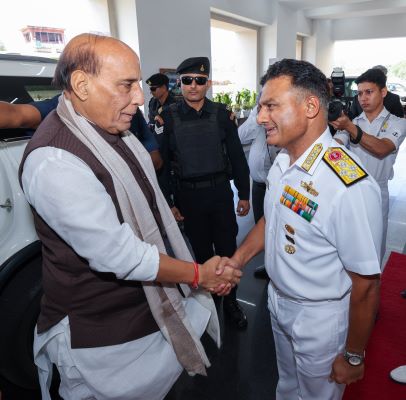
Addressing the second edition of the Indian Navy’s biannual Commanders’ Conference 2026 at Nausena Bhawan, New Delhi, Singh said India’s expanding strategic position in the region was accompanied by greater strategic responsibility.
“India stands firm as the First Responder, Preferred Security Partner and as a symbol of trust and reliability in the Indian Ocean Region and the entire world is witnessing the growth of both our strategic position and our strategic responsibility in the region.”
He added that the changing maritime environment required India to elevate its surveillance and response capabilities.
Blue-water reach, wider maritime responsibilities
Singh highlighted the presence of Indian warships in the South China Sea, Mediterranean and Atlantic Ocean as evidence of the Navy’s blue-water force capability.
The Defence Minister said the Indian Navy had a crucial role in providing strategic depth and regional power projection, while also safeguarding India’s wider maritime interests.
The Navy’s role has increasingly extended beyond traditional territorial defence to securing sea lanes, supporting energy security and contributing to regional stability. Recent government statements have similarly linked the Navy’s operational presence with India’s role as a preferred security partner and first responder in the region.
Energy security takes centre stage
Highlighting the Navy’s role during the West Asia crisis, Singh described the safe transit of Indian-flagged merchant vessels, particularly LPG tankers, through the Strait of Hormuz under Operation Urja Suraksha as an important achievement.
He underlined the direct relationship between maritime security, energy supplies, the economy and defence preparedness, noting that a substantial share of India’s crude oil and natural gas imports moves through maritime routes.
The Defence Minister also called for a significant upgrade of India’s maritime surveillance architecture, pointing to the growing volume and complexity of maritime traffic and the need for stronger analytical capabilities.
‘Warships now meeting global benchmarks’
Singh highlighted the progress of India’s indigenous naval shipbuilding ecosystem and said recently commissioned warships contain more than 75% indigenous content.
“The Indian Navy’s warship production ecosystem is now meeting global benchmarks. The warships commissioned recently contain over 75% indigenous content.”
He added: “In the times ahead, we must not only meet our own requirements but also export our warships to friendly foreign nations.”
Singh described 2026 as a historic year for the Indian Navy, with 18 warships planned for induction or commissioning, which he said would constitute the largest single-year force accretion in the Navy’s history.
The development, he said, reflected the growing maturity of India’s domestic naval shipbuilding ecosystem while also underscoring the need for continued capability enhancement.
Women, global partnerships and a secure maritime future
Defence Minister commended the Navy’s efforts under the “All Ranks, All Roles” approach, including the deployment of women officers on frontline warships and aircraft and their participation in naval navigational expeditions such as Navika Sagar Parikrama.
He also congratulated the Navy on assuming command of Combined Task Force-154 under the Combined Maritime Forces and highlighted Operation Southern Readiness conducted in Kochi during India’s command tenure.
The operation involved personnel from 27 countries, international facilitators and subject-matter experts, besides representatives of international organisations.
Singh also highlighted the deployment of INS Sudarshini for Lokayan-26, describing it as an initiative that strengthened India’s maritime diplomacy and engagement with the Indian diaspora across the United States, Atlantic and Mediterranean regions while showcasing the country’s maritime heritage.
Concluding his address, Singh commended the Navy for maintaining combat readiness and meeting its commitments despite an evolving security environment.
He said India’s maritime power was not merely about displaying the national flag at sea but about ensuring that wherever the Tricolour is seen, it conveys security, trust and confidence.
“If the seas are secure, India will be secure; and if India is secure, the resolve for a Viksit Bharat will be further strengthened.”
Singh also interacted with the Chief of Defence Staff and the Chief of the Army Staff during the conference.
The three-day apex-level conference, being held from September 29 to October 1, brings together the senior leadership of the Indian Navy to review operational preparedness, maritime security and future capability development. The 2026 conference is part of the Navy’s continuing apex-level review of operational posture, capability development, technology, jointness and maritime security.