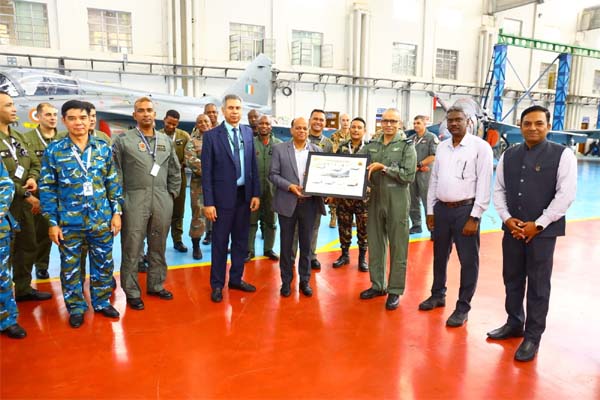
- Foreign observers from 32 nations get a first-hand look at India’s indigenous aerospace and defence capabilities in Bengaluru
- HAL, BEL and National Aerospace Laboratories showcase the continuum from design and research to advanced manufacturing and systems
- IAF’s multinational exercise moves beyond aerial operations to create space for professional exchange, technology exposure and mutual learning
- Air Marshal Ashutosh Dixit: “The stronger our indigenous capability, the more meaningful our engagement with the world becomes”
- Industrial outreach underlines Tarang Shakti 2026 theme, “Power in Partnership”, and India’s expanding defence-industrial ecosystem
NE DEFENCE BUREAU
NEW DELHI, SEPT 30
What happens when the world’s air forces stop looking at India merely from the cockpit—and step inside the laboratories and factories building its next generation of defence capability?
That question found an answer in Bengaluru, where observers from participating countries in Exercise Tarang Shakti 2026 undertook an industrial tour of Hindustan Aeronautics Limited (HAL), Bharat Electronics Limited (BEL) and the National Aerospace Laboratories (NAL), getting a close-up view of India’s indigenous aerospace, defence and advanced-technology ecosystem.
The visit added a powerful industrial dimension to India’s second edition of the multinational air exercise, taking the engagement beyond aircraft, sorties and operational missions to the laboratories, production lines and technology institutions that underpin modern air power.
The Indian Air Force has described Tarang Shakti 2026 as an opportunity for participating forces to exchange operational expertise, build interoperability and gain a better understanding of each other’s capabilities and operating philosophies. The exercise is being conducted at Air Force Station Jodhpur, with its operational phase scheduled from late September into October.
From aerospace design to defence electronics
The Bengaluru tour gave foreign observers an opportunity to see different components of India’s defence-industrial chain.
At HAL, the visitors were exposed to India’s aerospace manufacturing capabilities, while BEL provided a window into the country’s defence-electronics and systems ecosystem. The National Aerospace Laboratories, a premier aerospace research institution, added the research and technology-development dimension to the tour.
Together, the three institutions offered a snapshot of an ecosystem stretching from research and indigenous design to manufacturing, electronics, systems and advanced aerospace technologies.
The engagement therefore served a purpose beyond showcasing hardware. It enabled professional interaction and created opportunities for participants to exchange experiences and understand how different nations approach aerospace, defence production and technological innovation.
‘We can develop, manufacture and offer to the world’
The industrial outreach comes against the backdrop of India’s growing emphasis on indigenous defence production and international defence cooperation.
Vice Chief of the Air Staff Air Marshal Ashutosh Dixit has framed the exercise as an opportunity for partner countries to see the evolution of India’s defence-industrial capabilities.
“India is no longer only looking at what it can acquire from the world. We are increasingly looking at what we can develop, manufacture and offer to the world,” Dixit said.
He added: “Tarang Shakti provides an opportunity for our partners to see the growing capabilities of the Indian aerospace and defence industry—our indigenous platforms, sensors, weapons, unmanned systems and technologies. For us, Atmanirbharta and international cooperation are not contradictory. They complement each other. The stronger our indigenous capability, the more meaningful our engagement with the world becomes.”
That formulation captures the larger significance of the Bengaluru engagement: self-reliance is being positioned not as isolation, but as a foundation for deeper international cooperation.
‘Power in Partnership’ takes shape on the ground
Tarang Shakti 2026 is being conducted under the theme “Power in Partnership”. The exercise brings together seven Friendly Foreign Countries with air assets, while 32 other nations are participating as observers, according to the Ministry of Defence’s public information.
The exercise has deliberately been designed with a wider canvas beyond flying operations. The IAF has listed a professional seminar, industrial tour, heritage activities, marathon and yoga sessions among the engagements intended to promote professional interaction and camaraderie.
The industrial tour is consequently part of a larger effort to combine operational experience with institutional exposure.
For participating observers, the Bengaluru visit provided an opportunity to understand the industrial foundations behind the aircraft, sensors, weapons, unmanned systems and other technologies that increasingly shape modern warfare.
India’s defence story moves beyond the runway
The timing is significant as India seeks to expand both indigenous defence capability and its engagement with international partners.
The Ministry of Defence has said Tarang Shakti 2026 will provide the IAF an opportunity to demonstrate its operational capabilities and professional standards while highlighting India’s growing indigenous aerospace and defence capabilities.
Recent reporting has also highlighted India’s expanding defence-export ambitions. India recorded defence exports of ₹38,424 crore in 2025-26, while the government has set a target of ₹50,000 crore by 2029-30, according to Hindustan Times.
Against this backdrop, the Bengaluru industrial tour becomes more than a visit by foreign observers. It is a demonstration of the ecosystem behind India’s ambition—from research laboratory to production floor, from indigenous technology to international partnership.
And that may be Tarang Shakti’s most important message beyond the skies: modern air power is not built only in the air; it is built in laboratories, factories, institutions and partnerships long before an aircraft ever takes off.