- Global Horticulture Hub and Indian School of Agriculture launched at Madanapalle in a major push to transform Rayalaseema’s farm economy
- ₹40,000 crore government support to anchor a project expected to draw another ₹60,000 crore in private investment
- Reliance Executive Director Anant Ambani announces ₹1 lakh crore CBG investment plan for Andhra Pradesh
- More than 3 lakh jobs and nearly ₹60,000 crore state revenue projected from Reliance’s compressed-biogas initiative
- Jio Krishi, AI, drones, robotics, virtual classrooms and hi-tech animal husbandry to connect farmers with the next generation of agriculture
NE AGRICULTURE BUREAU
AMARAVATI, OCT 3
Can a drought-prone region become one of India’s next great horticulture engines? Andhra Pradesh has placed a ₹1-lakh-crore bet on precisely that transformation—with the Global Horticulture Hub and Indian School of Agriculture at Madanapalle seeking to move Rayalaseema’s farmers from farm-gate production to technology-led cultivation, processing, value addition and global markets.
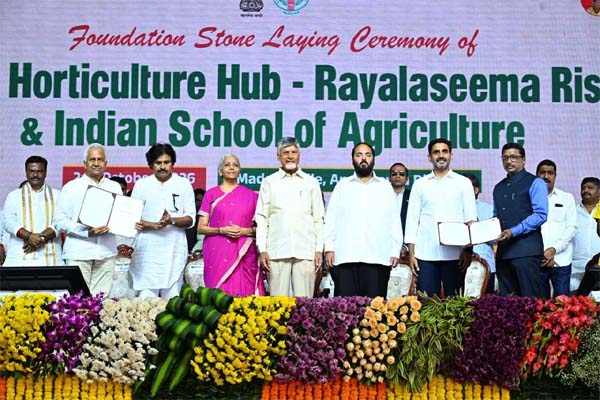
The foundation stones for the Global Horticulture Hub and Indian School of Agriculture (ISA) were laid at Madanapalle on October 2 by Union Finance Minister Nirmala Sitharaman and Andhra Pradesh Chief Minister N Chandrababu Naidu, in the presence of Deputy Chief Minister Pawan Kalyan, Minister Nara Lokesh and Reliance Industries Executive Director Anant M Ambani.
The horticulture hub is planned as a ₹1-lakh-crore initiative, with about ₹40,000 crore in government support and around ₹60,000 crore expected through private investment. The project is to be implemented in three phases across 10 districts, 201 clusters and nearly 5,860 villages, with horticulture cultivation targeted to expand by about six lakh acres.
The ambition is larger than increasing acreage: it is to build an integrated agricultural ecosystem encompassing production, technology, processing, logistics, marketing and exports.
From farmer to ‘CEO of his own farm’
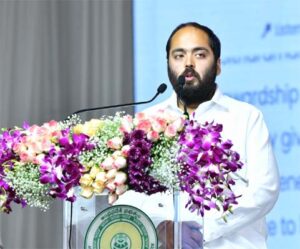
Addressing the gathering, Anant Ambani positioned the Indian School of Agriculture as a technology-and-enterprise bridge between traditional agricultural knowledge and emerging technologies.
“A quarter-century ago, you brought the Indian School of Business to Hyderabad. Today, you are giving the Indian farmer his own ISB,” he said, adding:
“Bharat ne duniya ko bohot CEO diye. ISA Bharat ke kisaan ko apne khet ka CEO banayega.”
Ambani said the institution could bring artificial intelligence together with the traditional intelligence of Indian farmers, with applications ranging from early pest alerts and crop-health mapping to precision irrigation, robotics, cloud-based agricultural advice and market intelligence.
The concept is significant for Rayalaseema, where horticulture is increasingly being viewed as a route to diversification, value addition and higher farm incomes.
Union Finance Minister Sitharaman said the Centre and Andhra Pradesh were working together to develop the state as a major horticulture centre, while stressing water management, modern technology and infrastructure. She also highlighted measures including PM-KISAN, crop insurance, PM-KUSUM and climate-resilient crop varieties.
₹1-lakh-crore agri-ecosystem takes shape
The project is designed to cover major horticultural crops and create a more integrated value chain.
Naidu has said the initiative aims to expand Andhra Pradesh’s horticultural cultivation area from around 8.4 lakh hectares to 14.4 lakh hectares and increase horticultural output from approximately 222 lakh metric tonnes to 435 lakh metric tonnes, according to reports.
The proposed ecosystem will bring together farmers, processors, agri-tech companies, logistics providers and exporters, potentially allowing produce to move from seed to shipment through a more coordinated value chain.
For farmers, the critical question will ultimately be whether the infrastructure can translate into better productivity, reduced post-harvest losses, predictable market access and more stable incomes.
Reliance’s ₹1-lakh-crore energy play
The agricultural announcement was accompanied by another major investment proposition.
Ambani said Reliance Industries plans to invest ₹1 lakh crore in Andhra Pradesh to establish compressed biogas (CBG) plants, with the projects expected to create more than three lakh jobs and generate nearly ₹60,000 crore in revenue for the state over the coming decades.
The proposal creates a potentially important connection between agriculture and the clean-energy economy.
Ambani described farmers who guarantee India’s food supply as potential contributors to the country’s energy security as well.
“Through Reliance’s green energy businesses, I see an opportunity to help our Anna Daatas become Urja Daatas.”
He added:
“Our kisans, who ensure India’s FOOD SECURITY, will now strengthen India’s ENERGY SECURITY too – making India self-reliant in energy.”
CBG can be produced from organic waste, agricultural residues, animal dung and other biomass. Beyond renewable fuel production, such an ecosystem can create additional markets for agricultural and livestock waste and potentially support rural employment and circular-economy models.
Four-Point Reliance–agriculture partnership
Ambani outlined four areas in which Reliance could work with the Indian School of Agriculture.
First, digital farmer education. Jio would collaborate with ISA to take training modules to millions of farmers in Indian languages through virtual classrooms in villages. Educated rural youth could become “digitally enabled extension workers”, helping farmers adopt new technologies.
Second, Jio Krishi. Ambani said the platform has developed products aimed at helping farmers, while Reliance’s Jamnagar R&D centre for bio-energy development could also become a knowledge-sharing partner.
Third, hi-tech animal husbandry. Ambani linked agricultural prosperity with livestock and veterinary care, saying he regarded “Pashu Seva” as “Prabhu Seva.” He also proposed a relationship between ISA and the proposed Global University for Wildlife and Veterinary Sciences at Vantara in Jamnagar.
Fourth, agriculture as a career. Ambani argued that technology and enterprise could make farming a profession that young Indians choose with pride rather than one they leave because of uncertain incomes.
“Let us give them the skills, technology and enterprise to build successful futures in THEIR OWN VILLAGES.”
AI meets the anna data
The proposed Indian School of Agriculture is being conceived at a moment when agricultural technology is rapidly moving beyond mechanisation towards data-driven decision-making.
Imagine a farmer receiving an early warning about a pest outbreak before an entire crop is affected.
A drone maps crop health and identifies areas requiring irrigation or nutrients.
Cloud-based systems deliver weather and agronomic advice in local languages.
Price-intelligence tools help farmers assess where and when to sell.
Greenhouse technologies enable controlled cultivation beyond traditional seasonal limitations.
The larger proposition is therefore not simply “technology for agriculture”, but technology that helps farmers make better decisions at each stage of the value chain.
‘Treat me as a son of Andhra’
Ambani struck an emotional note while addressing Naidu.
“Today I request you: Treat me as a son of Andhra.”
He followed it with the Telugu appeal:
“నన్ను ఆంధ్ర బిడ్డగా భావించండి.”
Ambani said Reliance would support the institution through “strategic investment, digital capabilities, technical expertise, and industry partnerships.”
He also referred to the Andhra Pradesh government’s investment pipeline, saying the state had approved 388 mega projects since June 2024, involving investment commitments of more than ₹14 lakh crore and potential employment of nearly 11 lakh people, with about a third of the investment headed towards Rayalaseema. These figures were also reported in coverage of his address.
The Real Test: From foundation stones to farm incomes
The symbolism of the October 2 event was unmistakable: Gandhi Jayanti and Lal Bahadur Shastri’s birth anniversary provided the backdrop for an institution seeking to combine “Jai Jawan, Jai Kisan, Jai Vigyaan and Jai Anusandhan.”
But the true measure of the initiative will lie beyond foundation ceremonies and investment announcements.
Can technology reduce input costs? Can farmers secure better prices? Can processing absorb more of the harvest? Can cold chains reduce wastage? Can young rural Indians build profitable enterprises without leaving their villages? And can Rayalaseema turn horticultural produce into globally competitive brands?
Those are the questions that will determine whether the ₹1-lakh-crore horticulture vision becomes an infrastructure project—or a genuine transformation of the farm economy.
As Ambani put it: “Today, we are not just laying foundation stones. We are laying the foundations for – rural enterprise, stronger villages, a more sustainable India, and most importantly, for improving lives of our farmers.”