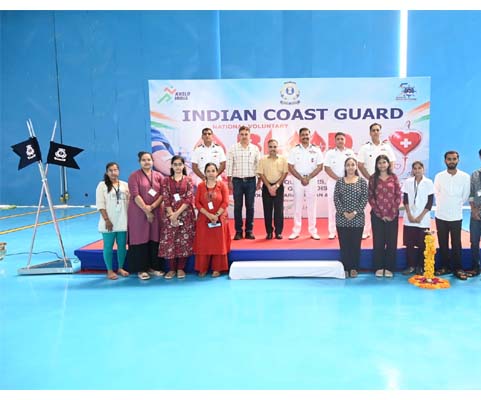
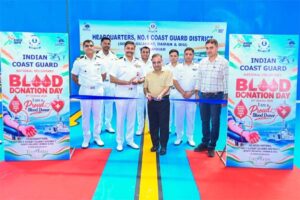
- Indian Coast Guard joins hands with 18 government, educational, community and corporate organisations for National Voluntary Blood Donation Day
- Around 200 volunteers and Coast Guard personnel donate blood in a powerful demonstration of community solidarity
- Safe blood remains critical for trauma victims, surgical patients, people with severe anaemia and women facing childbirth complications
- Donors too gain a pre-donation health check, including assessment of pulse, blood pressure and haemoglobin
- ‘Vayam Rakshamah – We Protect’ extends beyond the sea to a life-saving humanitarian mission
SEO KEYWORDS:
NE DEFENCE BUREAU
PORBANDAR, OCT 3
A unit of blood can be more than a medical resource—it can be the difference between a patient waiting for help and a patient receiving it in time. That life-saving message resonated strongly in Porbandar as around 200 volunteers, including Indian Coast Guard personnel, rolled up their sleeves to donate blood at a special camp organised to mark National Voluntary Blood Donation Day.
The camp, organised by the Indian Coast Guard in coordination with the local administration and a wide cross-section of government departments, educational institutions, community organisations and local establishments, sought to turn voluntary blood donation into a sustained culture of public service.
Dr Sushil Kumar, Dean, GMERS Medical College, Porbandar, inaugurated the camp.
A community comes together for a common cause
The initiative brought together the Lions Club, NCC, Sandipani School, CISF, Shri Ram Sea Swimming Club, Saurashtra Chemicals, Agriculture College, SSB, Airports Authority of India (AAI), Medical College, Mehar Samaj, Mehar Shakti Sena, Kharwa Samaj, Brahma Kumaris, Gujarat Maritime Board, Forest Department and Fern Hotels, besides Coast Guard personnel.
The participation of such diverse organisations transformed the camp into more than a blood-collection exercise—it became a visible demonstration of community partnership and shared responsibility for public health.
For patients, the importance of such voluntary donations is immediate. Blood and its components are routinely required in major surgeries, trauma and accidents, severe anaemia, cancer treatment and complications during pregnancy and childbirth. WHO stresses that regular voluntary, unpaid donors are essential to maintaining reliable supplies because donated blood has a limited shelf life.
When a donor’s few minutes become a patient’s lifeline
The impact can extend beyond a single recipient. India’s official e-RaktKosh platform notes that donated blood can be separated into components such as red blood cells, plasma and platelets, allowing one donation to serve different clinical needs.
That makes regular voluntary donation particularly important for maintaining stocks before emergencies occur—not merely after a crisis strikes.
India’s Directorate General of Health Services describes voluntary, non-remunerated blood donors as the backbone of blood-transfusion services and places emphasis on increasing regular voluntary donations to ensure adequate, accessible and safe blood supplies.
Donors also get a health check
While the greatest benefit of blood donation goes to the person receiving the blood, the donor also undergoes a basic health assessment before donation.
The screening process typically includes checks such as pulse, blood pressure and haemoglobin, helping determine whether it is safe for the individual to donate that day. India’s e-RaktKosh describes donation as a process involving registration, health screening, donation and post-donation refreshments.
International blood-service guidance similarly emphasises haemoglobin screening and donor safety, particularly because blood donation removes iron from the body and frequent donors may need to pay attention to iron intake.
The important message, therefore, is not that blood donation is a substitute for medical care, but that eligible, healthy donors can contribute to others while receiving an appropriate pre-donation health check as part of a professionally managed donation process.
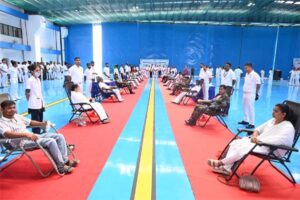
From Porbandar to a culture of voluntary donation
The Indian Coast Guard expressed its appreciation to all participating organisations, volunteers, medical teams and supporting agencies for their wholehearted cooperation in making the camp a success.
The enthusiastic response also reinforced the broader humanitarian role of the Coast Guard, demonstrating that its service to society extends beyond maritime security and rescue operations.
The event reaffirmed the Indian Coast Guard’s commitment to community welfare, humanitarian assistance and service to society, in keeping with its ethos:
“Vayam Rakshamah – We Protect.”
And on a day dedicated to voluntary blood donation, that motto acquired an especially poignant meaning: sometimes protecting a life begins not with a rescue at sea, but with an arm extended and a few minutes given freely.