NE AGRICULTURE BUREAU
DINDIGUL, OCT 4
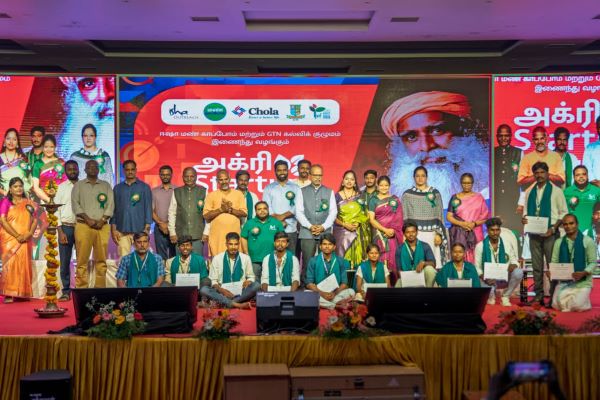
Agriculture is increasingly moving beyond the traditional farm-to-market model, with technology, value addition, digital platforms and innovative food products opening a new entrepreneurial frontier for farmers and young agri-entrepreneurs. This was the central message at “Agri Startup Thiruvizha 3.0”, organised by Sadhguru’s Save Soil movement at G.T.N. Arts College here on Sunday, drawing more than 3,000 farmers, youth, women and agri- and food entrepreneurs.
More than 100 agricultural exhibition stalls showcased modern farming technologies and value-added products, underlining the growing scope for businesses that can bridge the gap between agricultural production, technology, processing and consumers.
- Technology, value addition and marketing emerge as the new engines of farm entrepreneurship
- Save Soil calls for farmers to move beyond production and capture a larger share of the value chain
- TN Agricultural University flags soil degradation, water scarcity, labour shortage and climate risks
- Agri innovators showcase precision farming, sensors, digital tools, traditional foods and export opportunities
- 100+ exhibition stalls put agricultural technologies and value-added products in the spotlight
Speaking at the conference, Swami Srimukha, Programme Coordinator, Save Soil Movement, said agriculture remained largely confined to production, preventing farmers from capturing the full economic value of their produce.
“Agriculture is largely confined to being a production-oriented activity. As a result, farmers are unable to receive the full profit that they deserve. To change this situation, farmers need to become entrepreneurs by adding value to their produce and selling it.”
The conference sought to turn this message into practical opportunities by showcasing business models spanning precision agriculture, machinery, value addition, healthy foods, digital technology, marketing and export-oriented agriculture.
Awards spotlight agri-entrepreneurs and innovators
The Best Agri Entrepreneur Award was presented to Kalaichelvi, Founder, Aruvi Eco Ventures, for her success in value addition and marketing.
The Agri Innovator Awards recognised Dr. Rahul Paramasivam, Founder, Kymer Tech; Padmini Sampath, Founder, Green Collar Agritech Solutions; Dr. Selvavinayagam, Founder, Crop Engine; and Gautham Das, Founder, Myco Matrix, for their innovative practices and application of modern technologies in agriculture.
The awards highlighted a broader transformation underway in agriculture, where innovation is increasingly being used not merely to improve farm productivity but also to create new businesses and revenue streams.
Technology can tackle agriculture’s toughest challenges
Dr. Ravindran, Vice-Chancellor-in-Charge, Tamil Nadu Agricultural University, pointed to the multiple pressures confronting agriculture, including declining soil fertility, water scarcity, labour shortages and climate-related risks.
He stressed the need for innovative practices, modern technologies and machinery to make agriculture more resilient and commercially viable.
“Businesses manufacturing agricultural machinery should grow across all regions, much like cottage industries.”
He also identified opportunities for startups to develop precision agriculture tools, including mobile applications that can deliver climate-related information to farmers, sensors to measure micronutrient depletion in soil caused by continuous fertiliser application and irrigation-related sensors.
According to Dr. Ravindran, another largely untapped opportunity lies in the value addition and marketing of spices, fruits and vegetables. Startups, he said, could also play a role in tackling pesticide residues and helping farmers gain better access to export markets.
Traditional grains meet modern consumer demand
The growing consumer appetite for healthier food products is also creating an emerging entrepreneurial ecosystem around traditional crops.
Ajayraja, Founder, Agaveli Organics, spoke about the business potential of traditional rice varieties and millets and the growing demand for nutrient-rich food products.
“The use of chemical crop varieties and fertilisers has resulted in a 42% decline in nutritional value in agricultural produce. So we started producing food products using pesticide-free traditional rice varieties and millets.”
He said the venture initially distributed its products among acquaintances before expanding through word-of-mouth.
“Through them, our products spread, and today we have 6,000 customers. There is a strong desire among people to have good-quality snacks and healthy food. This offers a huge business opportunity.”
From millet chocolate spread to traditional foods
Entrepreneurs at the conference demonstrated how niche agricultural products can be converted into viable businesses.
Sindhuja Vetriselvan, Founder, Perishgo Foods, shared her experience of earning a monthly income of ₹3 lakh through the production of foxtail millet chocolate spread.
Deepa, Founder, Oormanam Foods, spoke about generating a monthly income of ₹2 lakh through a traditional food business.
Dr. Somasundaram, Director, Agri-Business Development Division, Tamil Nadu Agricultural University, highlighted market opportunities for organic agricultural products and the government incentives available to entrepreneurs in the sector.
Panels focus on disease prevention and digital growth
A special panel discussion, “To Prevent Disease… Protect the Crop… Know the Quality… Increase the Profit!”, was moderated by Vasanthan Selvam, CEO, EDII-Periyakulam Horti-Business Incubation Forum.
Agri-innovators Dr. Rahul Paramasivam, Padmini Sampath, Dr. Selvavinayagam and Gautham Das participated in the discussion, focusing on crop protection, quality and technologies that can improve farm profitability.
This was followed by a panel titled “Digital Technology to Grow Your Business at Low Cost… with Confidence!”, moderated by Archana Stalin, Founder, My Harvest Farms.
Kamala Kannan, Co-Founder, Zhar Tech and Raji’s Kitchen, and Vivek Paramasivam, Head of Digital Media, Save Soil Movement, shared insights into the use of digital technology to build and expand agricultural businesses at relatively low cost.
The message emerging from Agri Startup Thiruvizha 3.0 was clear: the future of agriculture may not be determined by production alone, but by who can innovate, add value, build brands, use technology and reach consumers. For farmers and young entrepreneurs, the farm could increasingly become not just a place of cultivation, but the starting point of a business.