
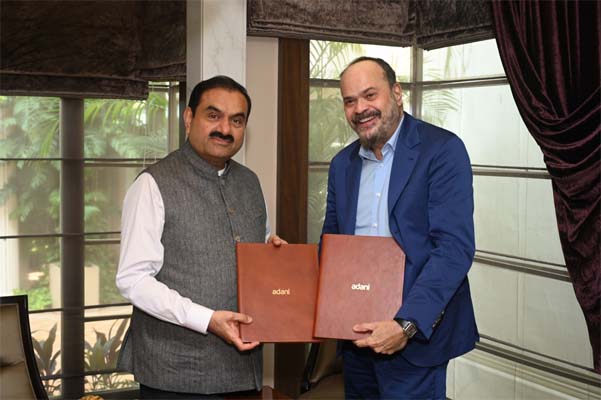
- 50:50 joint venture: Non-binding MoU envisages manufacturing AI racks, servers, storage, networking and critical power-and-cooling systems in India
- Multi-gigawatt ambition: Proposed platform targets the fast-expanding AI infrastructure market, with India’s data centre capacity projected to reach 5–8 GW by 2030
- $3-trillion global opportunity: Adani and Jabil see a massive market opening as hyperscalers, cloud companies and enterprises race to expand AI computing
- From energy to intelligence: Venture would complement Adani Group’s $100-billion commitment to develop 5 GW of green-powered, AI-ready data centres by 2035
- Manufacture in India, serve the world: Proposed partnership combines Jabil’s six decades of engineering expertise with Adani’s strengths in energy, infrastructure and data centres
NE BUSINESS BUREAU
NEW DELHI/ST. PETERSBURG (USA), OCT 13
The global artificial intelligence race is entering a new industrial phase—one in which computing supremacy will depend not merely on smarter algorithms, but on who can manufacture the racks, servers, networking equipment and sophisticated power-and-cooling systems that make AI work at scale. Moving to strengthen India’s position in this emerging supply chain, Adani Enterprises Ltd (AEL) and US-based Jabil Inc have signed a non-binding Memorandum of Understanding (MoU) for a proposed 50:50 joint venture to manufacture and assemble AI and data centre equipment in India.
The proposed venture seeks to establish a multi-gigawatt AI infrastructure manufacturing platform, serving India’s rapidly expanding digital economy while positioning the country as a potential production and export hub for global AI infrastructure. The companies estimate the worldwide market opportunity at more than $3 trillion over the next seven years, reflecting the accelerating investment in AI computing capacity.
The MoU establishes the framework for the proposed partnership, which remains subject to definitive agreements, applicable approvals and customary conditions. It follows the Adani Group and Jabil’s June 2026 announcement of their intention to develop a strategic alliance for AI and data centre infrastructure manufacturing in India.
From powering AI to manufacturing its backbone
Gautam Adani, Chairman of the Adani Group, described the partnership as a strategic move to expand the conglomerate’s role across the AI value chain, from supplying energy and hosting infrastructure to manufacturing the hardware that will underpin next-generation computing.
“The AI revolution will demand far more than just breakthroughs in algorithms. It will require an entire new industrial architecture where energy, hyperscale infrastructure, advanced computing and precision manufacturing converge to power the intelligence economy,” Adani said.
“At Adani, our vision is to expand up the AI value chain evolving from powering and hosting AI infrastructure to engineering and manufacturing the critical systems that will define the next generation of computing.”
He added: “Our proposed joint venture with Jabil marks a strategic step towards this future, combining Jabil’s world-class engineering and manufacturing capabilities with Adani’s integrated strengths in energy, infrastructure and data centres to help build the physical backbone of the global AI economy.”
The proposed arrangement would bring together Jabil’s global engineering, supply-chain and manufacturing capabilities and the Adani Group’s presence across energy, infrastructure, logistics and data centres. The combination is intended to address a growing strategic imperative: building the physical infrastructure required to support increasingly compute-intensive AI applications.
AI racks, servers and critical infrastructure in focus
The proposed joint venture would manufacture and assemble AI racks, servers, storage systems and networking equipment used in data centres. AI racks house high-performance computing systems that process the enormous volumes of data required for artificial intelligence and other advanced digital services.
Its proposed product portfolio would extend beyond computing hardware to include power distribution units, liquid-cooling systems and transformers—essential components for operating high-density computing infrastructure reliably and efficiently.
The venture envisages multi-gigawatt AI rack manufacturing capacity, supporting computing systems with a combined power capacity of several gigawatts. Installation and commissioning services would also form part of its proposed offering.
This integrated approach could help address the complex requirements of hyperscalers, neocloud companies, data centre operators and enterprises seeking scalable AI infrastructure. The companies envisage a manufacturing platform capable of serving both Indian customers and international markets.
India’s data centre capacity set for a major leap
India’s data centre capacity is projected to reach 5–8 gigawatts by 2030, driven by growing AI adoption, cloud computing, digital services and data-localisation requirements. The expansion is creating demand not only for data centre buildings and electricity, but also for the specialised equipment needed to power, cool and operate increasingly sophisticated computing systems.
The proposed venture would provide a domestic manufacturing base to serve this expanding market and support exports. Its strategic significance lies in the opportunity to move beyond building and hosting data centres towards manufacturing more of the critical hardware that powers them.
The Digital Personal Data Protection Act, 2023, provides a legal framework for personal data protection, while the Union Budget 2026’s announced tax holiday for data centres until 2047 is expected to support investment in domestic data infrastructure. Together with the broader expansion of digital and AI services, these developments form part of the investment landscape underpinning the sector’s growth.
Adani’s green-energy ambitions meet Jabil’s manufacturing expertise
The proposed venture complements the Adani Group’s commitment to invest $100 billion in developing 5 GW of green-energy-powered, hyperscale AI-ready data centres by 2035. By adding equipment manufacturing to its existing infrastructure and energy capabilities, the group is seeking a broader presence in the physical foundations of the AI economy.
For Jabil, the partnership represents an opportunity to deepen its manufacturing and engineering footprint in India’s growing data centre market. The company reported revenue of $36 billion in fiscal year 2026 and has expanded its data centre capabilities through the acquisition of Hanley Energy Group, which provides critical power and energy-management solutions, and Mikros Technologies, which specialises in liquid-cooling solutions for high-performance computing systems.
Mike Dastoor, Chief Executive Officer of Jabil Inc, said the partnership would combine the two companies’ complementary strengths to serve the growing requirements of domestic and international AI infrastructure customers.
“The signing of this MoU is the next step forward in our shared efforts to establish a scaled AI infrastructure manufacturing platform in India, a market we believe will become increasingly important for both domestic and global AI infrastructure demand,” Dastoor said.
“Integrating Jabil’s 60 years of engineering and manufacturing expertise with Adani’s significant infrastructure and energy capabilities, we can bring our rack-level data centre solutions to more hyperscalers in India and around the world. We look forward to building on the work we started together in June.”
The larger strategic bet
The proposed Adani-Jabil partnership reflects a broader shift in the AI economy: countries and companies are competing not only to develop AI models and applications, but also to secure the industrial capacity, energy systems and specialised manufacturing needed to sustain them.
For India, the opportunity is to translate its expanding digital demand into domestic manufacturing capabilities and export potential. The proposed joint venture’s eventual scale, however, will depend on the execution of definitive agreements, the necessary approvals and the partners’ ability to translate their manufacturing ambitions into operational capacity.
If realised as envisaged, the partnership could strengthen India’s position in the increasingly strategic business of building the hardware backbone of artificial intelligence—where energy, engineering and computing are converging to shape the next phase of industrial growth.