
NE FOREIGN NEWS SERVICE
SAN FRANCISCO, CA, USA, OCT 31
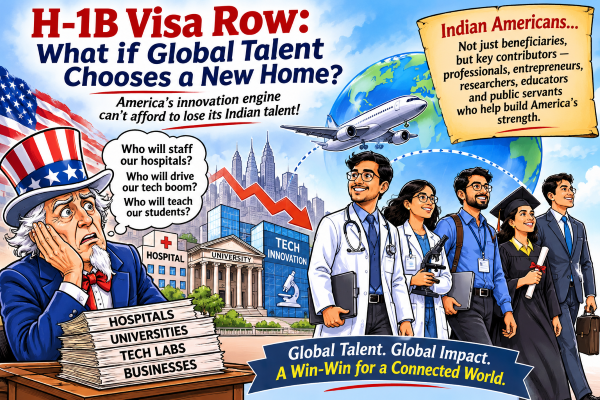
What would happen to America’s hospitals, universities, technology laboratories and businesses if the global talent that helps power them increasingly chose to build its future elsewhere? That is the economic and social question at the heart of a growing debate over H-1B visas and anti-Indian rhetoric in the United States. Indian Americans are not simply beneficiaries of the American opportunity; they are among the professionals, entrepreneurs, researchers, educators and public servants who have helped create it.
- Indiaspora warns that anti-Indian rhetoric and restrictive visa measures could undermine US innovation, healthcare and education
- Indian-origin professionals contribute across technology, medicine, research, teaching, business, public service and philanthropy
- George W. Bush and Donald Trump have publicly acknowledged the community’s contributions to American prosperity
- Microsoft’s Satya Nadella and Google’s Sundar Pichai underline the value of immigration in sustaining US competitiveness
- H-1B restrictions raise questions about America’s ability to attract and retain global talent
- Indiaspora urges Democrats and Republicans to reject prejudice and protect the India-US people-to-people partnership
Indiaspora, a nonpartisan organisation representing the global Indian diaspora, has expressed deep concern over the rise in anti-Indian rhetoric during the US election season, warning that political attacks and restrictive immigration measures could damage the country’s economic interests while unfairly targeting a community that has made substantial contributions to American society.
In its statement, Indiaspora argues that Indian Americans and people of Indian origin should be recognised for their contributions rather than made scapegoats in political debates. It points to a worrying trend: fewer Indian students choosing American universities and skilled professionals recruited by US companies facing increasingly hostile public commentary.
“H-1B workers from India have helped make America the world’s innovation leader, generating billions for the American economy. Driving them away could have very serious consequences for communities nationwide, from major cities to small towns,” said Sanjeev Joshipura, Executive Director, Indiaspora.
A contribution that crosses professions and political divides
The Indian-American story extends far beyond Silicon Valley. It encompasses physicians serving patients in underserved communities, teachers working in schools facing recruitment shortages, scientists advancing research, entrepreneurs creating jobs, academics shaping universities and public representatives participating in American democracy.
The scale of this contribution is reflected in Indiaspora’s US Impact Report 2024. Its published data indicate that approximately one in 10 physicians in the United States is Indian American. The report also identifies 22,000 Indian-origin faculty members in the US and notes that Indian-origin academics hold dean or chancellor positions at 70% of the top 50 American universities.
These figures underline why the debate cannot be confined to technology companies or immigration paperwork. When skilled professionals are unable to enter, remain or work in the country, the consequences can extend to hospitals, schools, research institutions, local businesses and communities.
The community’s political participation is equally significant. Indiaspora takes pride in Indian Americans active in both major political parties, citing the accomplishments of former Vice-President Kamala Harris and the Indian-American Democrats popularly associated with the ‘Samosa Caucus’, alongside Republican leaders such as Bobby Jindal and Nikki Haley.
The organisation emphasises that its appeal is nonpartisan: Indian Americans should not be reduced to political targets because of their ancestry, immigration history or professional background.
American presidents have acknowledged the Indian-American advantage
The community’s contribution has been recognised at the highest levels of American political leadership, including by presidents from different administrations.
In July 2005, then President George W. Bush, welcoming Prime Minister Manmohan Singh to the White House, observed that Americans of Indian origin were leaders in business, science, space exploration and technology. He said: “These citizens contribute a lot to America’s vitality.”
During the same address, Bush also acknowledged the contribution of Indian students to American universities, describing the people-to-people connection as an important source of strength in the relationship between the two countries.
At the 2019 ‘Howdy, Modi’ event in Houston, then President Donald Trump offered another public recognition of the community’s role. “Every day, the Indian American community is helping to strengthen our country and build our future,” he said.
Trump specifically praised Indian Americans for pioneering medicines, developing transformative technologies and founding businesses that provide employment to thousands of Americans.
These remarks are particularly relevant to the present debate. They demonstrate that the value of Indian-American talent has been recognised across political administrations, even as immigration policy remains a subject of intense domestic disagreement.
Technology leaders make the case for global talent
The business community has also repeatedly highlighted the importance of attracting skilled professionals from around the world.
Microsoft CEO Satya Nadella, whose own professional journey was shaped by his immigrant experience, has described America’s immigration policy as a major competitive advantage.
In a 2018 statement, Nadella said: “The immigration policy of this country is one of our greatest competitive advantages, and this is something we must preserve and promote.”
His argument was not that immigration policy should remain untouched, but that America’s ability to attract people from around the world contributes to its economy, communities and companies.
Google and Alphabet CEO Sundar Pichai has made a similar case. Responding to restrictions on immigration in 2020, he said: “Immigration has contributed immensely to America’s economic success, making it a global leader in tech, and also Google the company it is today.”
Pichai’s observation carries particular weight in an era when artificial intelligence, advanced computing, biotechnology and other emerging technologies depend on international research collaboration and highly specialised expertise.
The message from these corporate leaders is that innovation does not thrive in isolation. Companies need access to talent, ideas and research networks that cross national boundaries.
Visa restrictions: The economic consequences
Indiaspora has raised concerns over several policy measures affecting skilled foreign professionals, particularly those from India, who constitute a significant share of the H-1B workforce.
Among the issues highlighted are the $100,000 payment requirement introduced through a presidential proclamation for certain new H-1B petitions involving workers outside the United States, the replacement of the random selection process with a wage-weighted system, and the potential hardship faced by professionals navigating employment disruptions and work authorisation procedures.
The $100,000 measure, introduced in September 2025, was extended by the White House in September 2026 for another year. However, its legal enforceability has been challenged in court. It is therefore important to distinguish the administration’s announced policy from its current legal status and the categories of petitions to which it applies.
The wage-weighted selection system, meanwhile, became effective on February 27, 2026, and generally gives greater weight to applicants whose offered salaries correspond to higher occupational wage levels. While the administration says the change is intended to protect American workers and encourage higher-skilled recruitment, critics argue that it could reduce opportunities for early-career graduates and emerging professionals.
Indiaspora contends that driving away international talent will not automatically create equivalent opportunities for American workers. Companies could shift recruitment and investment overseas, potentially weakening domestic economic activity and reducing the tax revenue and local spending associated with skilled professionals living in the country.
The organisation also warns that the impact would be felt beyond major technology hubs. In rural and underserved areas, hospitals have relied on international medical professionals to fill difficult-to-recruit positions. Schools in regions such as the Mississippi Delta have also turned to teachers from India to address staffing shortages.
If such professionals are forced out or deterred from accepting positions, American patients and students could face the consequences.
A diaspora that gives back
Indian Americans’ contribution is not measured only in salaries, corporate leadership or professional achievements. Philanthropy, volunteering, university support and community development are also important parts of their American story.
A 2025 study by Dalberg, developed with the India Philanthropy Alliance, estimated that Indian-American charitable giving reached $4–5 billion in 2024, up from an estimated $1–2 billion in 2018. The study also found that Indian Americans contribute volunteer hours at nearly three times the US average.
Such contributions strengthen educational institutions, healthcare initiatives, social organisations and local communities. They demonstrate that the relationship between Indian-origin Americans and their adopted country is rooted not merely in employment but also in civic participation and public service.
A living bridge between two democracies
Indiaspora describes the Indian diaspora as a living bridge between India and the United States, helping deepen commercial, educational, cultural and strategic connections. Over the past three decades, successive administrations in both countries have invested in a partnership that has become increasingly consequential.
The organisation credits leaders from both political parties, including the first Trump administration, for advancing bilateral ties. It also recalls the personal warmth between President Trump and Prime Minister Narendra Modi, expressing hope that policies targeting Indian Americans will not undermine a relationship that benefits both countries.
Its appeal to Democrats and Republicans is straightforward: immigration policy can and should be debated, legitimate concerns about labour-market protection must be addressed, and employers should be held accountable for any misuse of visa programmes. But such discussions must not become a licence for racial or ethnic stereotyping.
The larger question is whether America can protect its domestic workforce while continuing to attract the scientists, doctors, engineers, teachers, entrepreneurs and researchers it needs to remain globally competitive.
Indian Americans have helped answer that question through decades of service, enterprise and achievement. Their contribution is part of America’s story — and their future should not be reduced to an election-season political argument.