
NE AGRICULTURE BUREAU
COIMBATORE, OCT 31
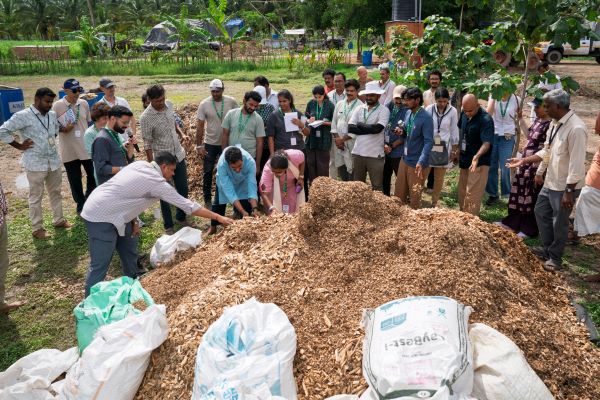
The future of agriculture may depend on something most farmers cannot see with the naked eye—the teeming universe of life beneath their feet. From microscopic organisms that nourish plants to living soil ecosystems that sustain agricultural productivity, the focus is shifting from merely feeding crops to regenerating the soil that feeds them. Bringing this science closer to the farm, the Soil Food Web School (SFW), a global educational and training organisation, has conducted two specialised soil biology programmes at Sadhguru’s Save Soil Regenerative Revolution Model Farm in Coimbatore.
- Soil Food Web School brings international Accelerator Workshop to Isha’s Save Soil Model Farm for the first time
- 46 participants from 10 countries and seven Indian states undergo intensive hands-on soil biology training
- Ten-day programme explores BioComplete™ composting, microbial analysis and biological soil amendments
- Farmers, microbiologists, consultants and soil scientists learn to restore soil ecosystems through practical interventions
- Global collaboration seeks to turn soil health science into sustainable farming practices and stronger agricultural livelihoods
The collaboration brought together farmers, soil scientists, microbiologists, consultants and environmental practitioners from across continents, turning the model farm into an international learning laboratory for regenerative agriculture.
Speaking about the programmes and the collaboration with Save Soil, Evan Buckman, Executive Director, Soil Food Web Foundation, said,
“Bringing our Accelerator Workshop to India for the first time has been a meaningful step for the Soil Food Web School. The scale of Save Soil’s on-ground work with farmers and its strong connections across communities were key reasons we chose this collaboration. Its model farm, already practising natural farming methods aligned with regenerative agriculture, provided an ideal setting for our 46 participants from 10 countries and seven Indian states to put their learning into practice.”
Two programmes, one mission: Bringing soil back to life
The initiative featured two distinct learning programmes designed to deepen understanding of soil biology and translate scientific knowledge into practical agricultural applications.
The first, a two-day Life in the Soil Seminar, was held on October 16 and 17, 2026, attracting 61 participants. This was followed by the intensive ten-day Soil Food Web Accelerator Workshop, conducted from October 19 to 30, which concluded with 46 participants representing 10 countries across six continents.
The international participants came from the Netherlands, Australia, Iran, the United States and Costa Rica, among other countries, alongside participants from Tamil Nadu, Kerala, Karnataka, Maharashtra, Andhra Pradesh, Telangana and Uttar Pradesh.
The diverse group included farmers, agricultural consultants, permaculture designers, microbiologists, agribusiness professionals, NGO leaders and soil scientists, creating opportunities for cross-border knowledge exchange and practical collaboration.
From compost heaps to microbial intelligence
The programmes offered participants an opportunity to explore the diverse biological communities inhabiting soil and understand their fundamental role in sustaining healthy agricultural ecosystems.
While the seminar introduced the fundamentals of soil biology and the contribution of soil organisms to soil health, the Accelerator Workshop took participants deeper into practical applications through intensive, hands-on training spread across two weeks.
A key component was the preparation of BioComplete™ compost. Participants learnt the entire process, from selecting and mixing organic materials to constructing, monitoring and turning compost piles, while managing critical factors such as moisture and aeration.
They also prepared biological liquid amendments, including compost extracts and compost teas, and learnt to assess their quality.
Loida, Director of Advanced Education, SFW, highlighted the importance of practical experimentation in understanding composting processes.
“Working with different compost recipes side by side gave participants something concrete to compare. Why was one pile behaving differently from another? What needed adjusting? Those questions are a valuable part of learning, because making compost involves observing and responding, not simply following a recipe,” she said.
Microscopes reveal the hidden workforce beneath the soil
One of the most significant elements of the training was microscopy, which enabled participants to examine soil, compost and liquid amendment samples under microscopes and identify different microorganisms.
The exercise helped connect microscopic observations with the biological condition of compost and the broader functioning of agricultural ecosystems.
Participants also undertook soil sampling and field assessments, linking laboratory observations with practical decisions on soil management. This combination of laboratory learning and field exposure helped demonstrate how soil biology can inform regenerative farming practices.
The emphasis was not merely on learning techniques but on understanding why different biological processes matter and how farmers can make informed decisions based on the condition of their soil.
Save Soil model farms: Demonstration grounds for agricultural regeneration
The training was conducted at one of the model farms associated with the global Save Soil movement launched by Sadhguru.
These model farms serve as practical demonstration and research centres where regenerative, tree-based and natural farming methods are tested and showcased. Their objective is to restore soil organic content, demonstrate sustainable agricultural approaches and help make farming a more economically viable livelihood.
By providing a live agricultural setting for the training, the Coimbatore model farm enabled participants to connect scientific concepts with real-world farming practices.
The collaboration also reflects the growing importance of international knowledge partnerships in addressing soil degradation and promoting regenerative agriculture.
Taking the soil health movement beyond borders
The international character of the programme brought together participants with different agricultural experiences, professional backgrounds and regional challenges.
The exchange offered an opportunity to examine how soil biology principles could be adapted to varying climatic conditions, farming systems and local requirements.
Participants are expected to carry the knowledge and practical insights gained during the programmes to their respective farms, organisations and communities, potentially extending the impact of the training beyond the model farm.
At a time when agricultural sustainability depends increasingly on restoring natural ecosystems, the initiative underlines an important message: healthy agriculture begins with healthy soil, and regenerating soil requires understanding the living communities that make it productive.
The real test of this international learning exercise will be how effectively its scientific insights translate into healthier farms, resilient farming communities and more sustainable agricultural livelihoods.