
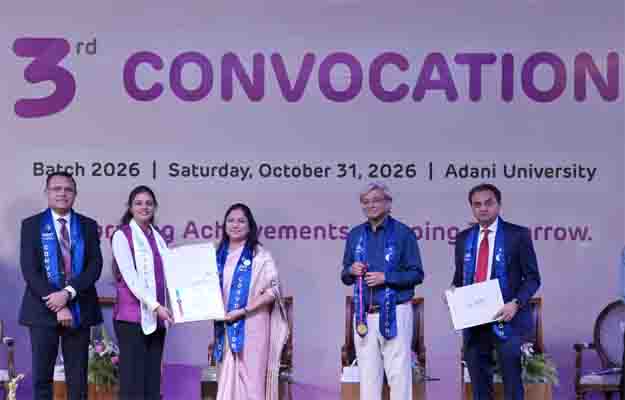
- 374 graduates, 10 medals: Adani University confers degrees on the Class of 2026 at its third convocation in Ahmedabad.
- AI’s promise and perils: IISc Director Prof. Govindan Rangarajan urges graduates to embrace artificial intelligence while questioning its consequences for truth and human relationships.
- India’s next big leap: Dr. Priti Adani calls for innovation and incubation at scale to match the country’s infrastructure achievements.
- Industry meets academia: Dr. Adani highlights how real-world challenges can inspire questions that neither industry nor universities might formulate independently.
- Research-driven ambitions: University Provost Prof. Dhaval Pujara outlines efforts to strengthen research, multidisciplinary learning and industry collaboration.
NE EDUCATION BUREAU
AHMEDABAD, OCT 31
Artificial intelligence may be bringing the world closer through screens, but is it quietly driving people further apart? That was the thought-provoking question at the heart of IISc Director Prof. Govindan Rangarajan’s address to graduating students at Adani University’s third convocation in Ahmedabad on Saturday—a timely reminder that technological progress must not come at the cost of truth, trust and human connection.
Adani University conferred 374 degrees on the Class of 2026, with 10 students earning medals for academic excellence—five gold, three silver and two bronze.
Prof. Rangarajan, Director of the Indian Institute of Science (IISc), Bengaluru, was the Chief Guest. His address explored artificial intelligence’s expanding possibilities in education and scientific research, alongside concerns about misinformation, the erosion of trust and the changing nature of human relationships.
“AI offers tremendous possibilities in education and research. It can help us solve complex problems and accelerate scientific discovery. But we must also be mindful of its consequences,” he said.
“When images, videos and information can be generated so convincingly, how do we know what is true? And while technology is bringing us closer digitally, are we becoming more distant from one another?” he asked.
“We must embrace what AI can do, but also think carefully about what we stand to lose,” Prof. Rangarajan cautioned.
His message offered graduates a perspective beyond the celebration of academic achievement: in an AI-driven world, technological capability must be accompanied by critical thinking, responsible decision-making and a clear understanding of the human consequences of innovation.
From infrastructure scale to innovation at scale
Dr. Priti Adani, President of Adani University, presided over the ceremony and welcomed the Chief Guest, describing his contributions to mathematics, research and academic leadership as an inspiration to the graduating class.
“We are fortunate to have Prof. Rangarajan as our Chief Guest. His distinguished contributions to mathematics, research and academic leadership are a powerful beacon for our graduating class, and for all of us, as we work towards making Adani University a leading research-driven university,” she said.
Turning to India’s development journey, Dr. Adani called on graduates to build on the country’s achievements in infrastructure by strengthening its capacity for innovation and incubation.
“India has built infrastructure on a remarkable scale. Now we must learn to innovate and incubate at scale,” she said.
She urged students to pursue breakthroughs that extend beyond laboratories, classrooms and commercial applications, stressing the need to develop solutions capable of reaching the most marginalised sections of society.
The challenge, in her message, was not merely to generate new ideas but to translate them into meaningful outcomes that broaden access and create wider social value.
Industry and academia must ask new questions together
Dr. Adani also highlighted the potential of closer engagement between industry and academic institutions, arguing that collaboration should go beyond companies prescribing research priorities to universities.
“The promise is not that industry will simply tell a university what to study. It is that exposure to demanding real-world conditions can bring up questions—that neither industry nor academia would have framed alone,” she said.
The approach places real-world challenges at the intersection of academic inquiry and industrial experience, creating opportunities for research questions, solutions and innovations that might otherwise remain unexplored.
For graduates entering a rapidly changing employment and technology landscape, the message underscored the value of combining disciplinary knowledge with curiosity, collaboration and the ability to identify problems that demand fresh thinking.
Building a multidisciplinary research ecosystem
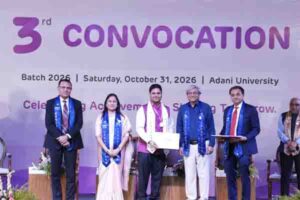
Presenting the university’s annual report, Provost Prof. (Dr.) Dhaval Pujara acknowledged the contributions of faculty members, staff, students and industry partners.
He outlined the institution’s efforts to strengthen its academic foundations, develop its research ecosystem and deepen engagement with industry and society.
Established in 2022, Adani University focuses on industry-relevant education, practical learning and research. Its longer-term ambition is to develop into a multidisciplinary institution that contributes to India’s development and nation-building.
As the Class of 2026 moves from university into professional and research careers, the convocation’s central messages converge on a common challenge: to make technology more responsible, research more relevant and innovation more inclusive.
For the graduates, the real test of education will lie not only in what they know or create, but also in how effectively they use that knowledge to address society’s most pressing challenges.