
R MANICKAVASAGAM
AHMEDABAD, NOV 17
Surviving a life-threatening fungal infection is only half the battle for many victims of COVID-era mucormycosis. For those who lost portions of their upper jaw, the struggle to eat, speak and smile normally often continued long after the infection was defeated. Now, an advanced combination of reconstructive surgery and dental implantology in Ahmedabad is opening a promising new chapter in their rehabilitation, offering hope of restoring not just facial structure but also essential oral functions and self-confidence.
The Asian Head and Neck Cancer Foundation (AHNCF), Ahmedabad, has reported what it believes to be India’s first dental implant placement in a vascularised scapular free flap used for upper-jaw reconstruction following mucormycosis, popularly known as Black Fungus. The reported achievement brings together specialised microvascular reconstructive surgery and implant dentistry to address one of the most challenging consequences of the devastating infection.
Beyond survival: Rebuilding the upper jaw after black fungus
During India’s second COVID-19 wave in 2021, mucormycosis emerged as a serious complication, particularly among vulnerable patients with uncontrolled diabetes and weakened immunity. The aggressive fungal infection could spread from the nasal passages and sinuses into the palate, upper jaw, orbit and surrounding facial structures.
In advanced cases, the destruction of tissue and bone necessitated maxillectomy — surgical removal of the affected portion of the upper jaw — to control the infection and prevent further spread.
Although potentially life-saving, the procedure often left survivors confronting difficulties in chewing, swallowing and speaking, besides facial deformities, missing teeth and compromised confidence.
For such patients, conventional removable dental prostheses may not always provide adequate stability. Advanced microvascular reconstruction using living bone from another part of the body offers a more comprehensive alternative.
Scapular free flap: Bringing living bone back to the upper jaw
In the Ahmedabad case, Dr Shakti Singh Deora and his surgical team undertook the complex reconstruction using a scapular free flap, transferring living bone from the shoulder blade to rebuild the missing upper jaw.
The technique involves connecting the blood vessels supplying the transferred bone to recipient blood vessels through specialised microsurgery, enabling the reconstructed tissue to survive as living bone.
The choice of a scapular flap offers flexibility in reconstructing complex three-dimensional defects and, depending on the patient’s requirements, allows the transfer of additional soft tissue.
However, restoring the missing bone is only one part of the rehabilitation journey. The next challenge is to provide a stable foundation for replacement teeth and recover effective chewing function.
From reconstructed bone to functional teeth: A significant advance
Taking the procedure a step further, Dr Rahul Dhanak performed dental implant placement in the reconstructed scapular bone, marking an important stage in the patient’s oral rehabilitation.
Implants placed in transferred living bone can potentially support fixed dental prostheses following successful osseointegration — the process through which an implant integrates with the surrounding bone.
The approach can improve prosthetic stability, chewing efficiency and comfort, while reducing dependence on conventional removable dentures. The eventual functional outcome, however, depends on successful implant integration, appropriate prosthetic rehabilitation and continued clinical follow-up.
Dr Deora: ‘There is no published medical literature on this in our country’
Explaining the specialised expertise behind the procedure, Dr Shakti Singh Deora said he had undergone advanced training in Germany in dental implant placement in scapular free flaps for upper-jaw reconstruction.
“I have undergone specialised training for dental implant placement in scapular free flap for upper jaw reconstruction treatment procedure in Germany. So far, I have led my team to perform over 100 surgeries successfully. However, there is no published medical literature on this in our country,” he said.
Asked whether the technique could become a reproducible treatment protocol across major cancer and reconstructive surgery centres in India, Dr Deora highlighted his ongoing efforts to develop clinical expertise among younger doctors.
“I have been running 6-month short-term course for junior doctors and have been receiving overwhelming response,” he said.
His training initiative could help widen access to specialised reconstructive expertise, although broader adoption would require clinical documentation, outcome evaluation and appropriate training infrastructure.
Multidisciplinary expertise with a clearer focus on affordability
The achievement also underscores the importance of coordinated intervention by reconstructive surgeons and dental implant specialists, combining anatomical restoration with functional rehabilitation.
Explaining the financial dimension, Dr Rahul Dhanak said: “This procedure costs between Rs 2 lakh and Rs 4 lakh and medical insurance coverage is also available.”
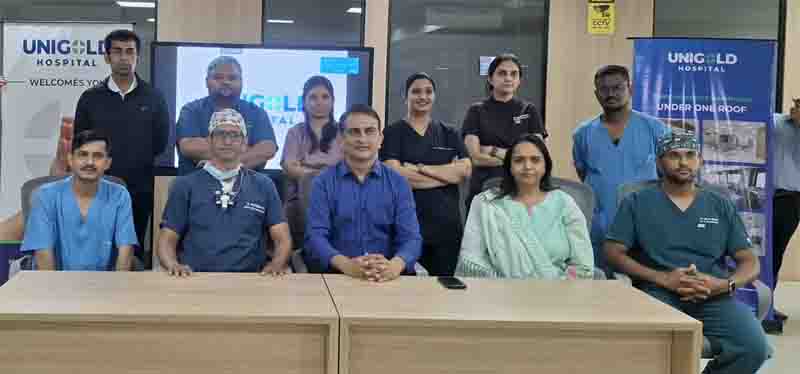
Dr Deepa Agarwal also addressed the media during the interaction.
The bigger victory: Restoring function, dignity and confidence
For survivors of severe mucormycosis, the consequences of Black Fungus do not necessarily end when the infection is controlled. The loss of jawbone and teeth can affect nutrition, communication, appearance and social participation for years.
The reported Ahmedabad achievement represents an important move towards addressing these long-term challenges through integrated reconstructive surgery and implant-supported dental rehabilitation.
Its significance lies in looking beyond the immediate surgical success of removing diseased tissue and rebuilding missing bone to the patient’s ultimate ability to eat, speak and participate confidently in everyday life.
The real measure of reconstructive surgery is not merely how much missing bone can be replaced, but how much of a patient’s normal life can be restored. For Black Fungus survivors, that could be the most meaningful smile of all.