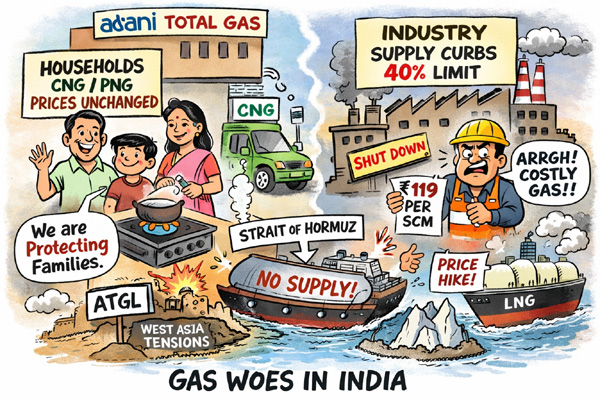
- Adani Total Gas Ltd keeps CNG and domestic PNG prices unchanged despite global supply disruptions
- Industrial and commercial users asked to cut gas consumption to 40% of contracted volumes
- LNG disruptions linked to shipping bottlenecks in the strategic Strait of Hormuz
- Company balances supply security and consumer protection as energy markets face geopolitical shock
NE ENERGY BUREAU
AHMEDABAD, MAR 6
In a move aimed at protecting household consumers amid global energy turbulence, Adani Total Gas Ltd (ATGL) has decided not to increase prices of compressed natural gas (CNG) and domestic piped natural gas (PNG) even as geopolitical tensions in West Asia disrupt global LNG supplies.
However, the city gas distributor has asked certain commercial and industrial consumers to curtail gas consumption to 40 per cent of their contracted volumes, reflecting the impact of supply chain disruptions linked to the escalating regional conflict.
ATGL officials said around 70 per cent of the company’s gas supply is sourced domestically, which is primarily allocated to CNG users and residential PNG customers. Prices for these segments will remain unchanged, ensuring stability for households and transport sectors despite global volatility.
The remaining 30 per cent of gas volumes are imported as liquefied natural gas (LNG) and mainly supplied to commercial establishments and industrial users. It is this segment that has been affected due to disruptions in shipping routes caused by the West Asia crisis.
The situation has intensified after shipping movement through the Strait of Hormuz slowed significantly, a critical maritime corridor through which a large share of the world’s crude oil and LNG shipments pass.
Industrial consumption capped
According to company officials, industrial customers have been asked to limit their gas offtake to 40 per cent of contracted volumes, allowing the company to manage limited LNG availability while ensuring priority supply for essential segments.
Customers consuming gas within this 40 per cent limit will continue to be billed at their contracted rates, which average around ₹40 per standard cubic metre (scm).
“Due to supply chain disruptions linked to the West Asia crisis, commercial and industrial customers have been asked to curtail consumption to 40 per cent of their contracted volumes,” a company official said.
However, consumption beyond this limit will attract spot LNG pricing, reflecting the higher cost of sourcing alternative supplies in the global market.
Spot LNG rates have surged to USD 24–25 per million British thermal unit (mmBtu), more than double the earlier level of around USD 10 per mmBtu during normal market conditions. (Outlook Business)
Industrial customers exceeding the consumption threshold will be charged ₹119 per scm for incremental volumes, a sharp increase compared to standard contracted rates.
Global shock waves reach Indian industry
Energy analysts say the move highlights the growing vulnerability of LNG-dependent sectors to geopolitical shocks, especially disruptions in critical energy corridors such as the Strait of Hormuz.
Nearly one-fifth of global oil and significant LNG shipments pass through this narrow waterway, making any disruption a major concern for global energy markets.
Industrial clusters across western India, including Gujarat, have already started feeling the impact, with several gas-dependent units forced to reduce operations due to limited supplies.
Company prioritises essential consumers
ATGL said it is making all possible efforts to ensure uninterrupted gas supply while managing the supply constraints triggered by the international crisis.
“The company is making all possible efforts to ensure uninterrupted gas supplies while managing supply challenges and protecting consumer interests across segments,” the official added.
Industry observers say the company’s decision to protect household consumers and transport fuel users from price hikes reflects the priority given to essential energy consumption during periods of global supply volatility.
As the West Asia crisis continues to evolve, energy companies and policymakers are closely monitoring supply routes, shipping movements and global LNG pricing trends to mitigate the potential impact on India’s energy security.