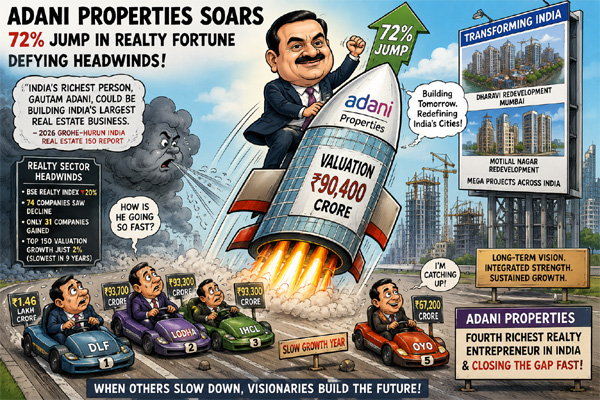
- 72% valuation leap in a sluggish market positions Adani Properties on the brink of becoming India’s most formidable real estate empire
- Hurun-GROHE 2026 report crowns Adani the sector’s fastest-rising force as rivals grapple with declining valuations
- Dharavi, mega urban redevelopment and integrated infrastructure strategy fuel unprecedented wealth creation despite industry slowdown
NE INFRASTRUCTURE BUREAU
MUMBAI, JULY 15
Against the backdrop of one of the weakest years for India’s real estate sector in nearly a decade, Adani Properties has scripted the industry’s biggest success story. While most developers battled shrinking valuations amid a sluggish property market, the Gautam Adani-led conglomerate delivered a staggering 72 per cent jump in real estate wealth, signalling that India’s next real estate giant may well emerge from an infrastructure powerhouse rather than a conventional developer.
The 2026 GROHE-HURUN India Real Estate 150 Report has identified Adani Properties as the country’s most remarkable value creator of the year, with the company’s valuation soaring by Rs 38,000 crore to Rs 90,400 crore.
The report makes a striking observation: “India’s richest person, Gautam Adani, could be building India’s largest real estate business.”
Led by Pranav Adani and Rajesh Adani, Adani Properties now ranks as the fourth-richest real estate entrepreneur in India, rapidly narrowing the gap with long-established industry leaders.
The achievement assumes greater significance because it comes during what industry observers describe as one of the most challenging years for the property sector. The BSE Realty Index declined by 20 per cent, only 31 of the 151 companies tracked managed to improve their valuations, while 74 companies registered a fall. Overall, the combined valuation of India’s top 150 real estate companies increased by a mere 2 per cent—the slowest expansion since the Hurun rankings began nine years ago.
The report credits Adani’s rapid ascent to an expanding portfolio of transformative urban redevelopment and integrated township projects across India.
Among the most ambitious is the Dharavi Redevelopment Project in Mumbai—one of the world’s largest urban renewal programmes—where Adani is executing the redevelopment in partnership with the Maharashtra government. The group is also spearheading the large-scale redevelopment of Motilal Nagar besides several premium residential, commercial and mixed-use developments across multiple cities.
The report suggests these mega projects, combined with the Adani Group’s expertise in infrastructure, logistics, airports, energy and urban utilities, are creating a uniquely integrated real estate model capable of delivering sustained long-term value.
Commenting on this year’s rankings, Anas Rahman Junaid, Founder and Chief Researcher of Hurun India, said:
“The 2 per cent rise in overall valuations is the slowest in the nine-year-old list. The list tells a story of a year that cooled rather than cracked, and the performance of the newcomers, not incumbents, shows where the sector’s momentum has moved.”
Despite market headwinds, the hierarchy at the top has largely remained intact.
DLF retained the No.1 position with a valuation of Rs 1.46 lakh crore, followed by Lodha Developers at Rs 93,700 crore and IHCL at Rs 93,300 crore. Adani Properties climbed to fourth place with Rs 90,400 crore, placing it within striking distance of the industry’s long-established leaders.
Another standout performer was Ritesh Agarwal-founded Prism (OYO), which entered the top five after more than doubling its valuation to Rs 67,200 crore.
The report notes that while the top three positions remained unchanged, the biggest upward momentum came from Adani Properties, OYO and K Raheja Corp. In contrast, established developers such as Oberoi Realty, Prestige Estates Projects and Godrej Properties slipped in the rankings amid softer valuations.
For industry analysts, Adani’s extraordinary rise underscores a structural shift in India’s property landscape—where large-scale urban regeneration, infrastructure-led development and integrated city-building are increasingly becoming the new engines of real estate wealth creation.