
- IIMA invites India’s brightest minds to pursue doctoral and post-doctoral research at its Krishnamurthy Tandon School of AI
- Second batch of two-year Blended MBA in Business Analytics & AI announced; intake yet to be decided
- First cohort comprises 71 professionals, says programme chairperson Anindya S. Chakrabarti
- Curriculum combines management fundamentals, machine learning, Generative AI and Agentic AI
- Applications for 2027–29 batch invited in two rounds, with the first deadline on November 2
R MANICKAVASAGAM
AHMEDABAD, OCT 15
Can artificial intelligence make better business leaders without weakening their capacity for independent judgement—and can India’s brightest minds help ensure that AI benefits humanity as a whole?
These questions underpin IIM Ahmedabad’s push to integrate management education with advanced analytics and artificial intelligence, alongside a wider invitation to researchers to advance AI scholarship at its Krishnamurthy Tandon School of AI.
The Indian Institute of Management Ahmedabad (IIMA) has announced admissions to the second batch of its two-year Blended MBA Programme in Business Analytics & Artificial Intelligence (BPGP: BA & AI), designed for working professionals and entrepreneurs. While the programme combines management fundamentals with emerging technologies, its inaugural 2026–28 cohort is only six months into the journey, and the institute has yet to decide the intake for the second batch.
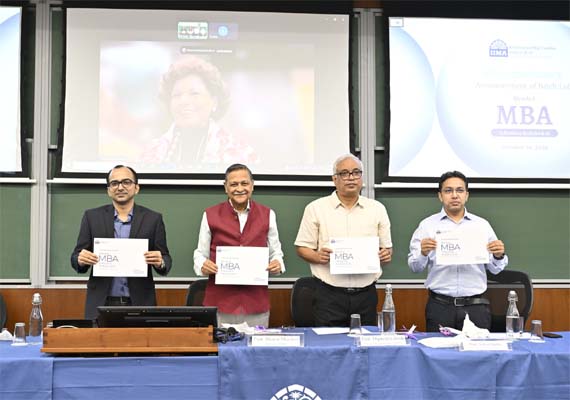
The announcement was made at the IIMA campus in the presence of Director Prof. Bharat Bhasker, Dean (Programmes) Prof. Diptesh Ghosh, Prof. Anindya S. Chakrabarti, Chairperson of BPGP: BA & AI, and Prof. Ankur Sinha, Chairperson of the Krishnamurthy Tandon School of AI. Chandrika Tandon, business leader, humanitarian, Grammy Award-winning musician and alumna of IIMA’s PGP Class of 1975, joined virtually from London.
Tandon established the Krishnamurthy Tandon School of AI at IIMA through a generous endowment, supporting the institute’s ambition to advance research and education in artificial intelligence.
Second cohort: What changes—and what remains undecided?
Asked what major upgrades or refinements IIMA had introduced for the second batch compared with the inaugural 2026–28 cohort, whether student feedback, industry expectations and emerging AI technologies had influenced changes, and how many students would be admitted, Prof. Chakrabarti said it was too early to assess the first batch’s impact.
“The first batch was started only six months ago. It is too early to comment on its impact and the feedbacks. The first batch comprises over 70 students and we are yet to take any decision on the intake for the second batch,” he said.
The response makes clear that the intake for the second cohort has not been finalised and that the institute is not yet ready to draw conclusions about the first batch’s impact. Specific curriculum changes prompted by student feedback or evolving industry requirements were not established in the remarks supplied at the announcement.
‘AI for humanity’: An invitation to India’s brightest minds
Alongside the MBA announcement, Prof. Chakrabarti invited talented candidates from institutions across India to undertake doctoral and post-doctoral studies in artificial intelligence at the Krishnamurthy Tandon School of AI, IIMA.
He said the school’s work could benefit not merely the country but humanity as a whole, underscoring the wider significance of building research capacity in a technology reshaping business, governance, scientific discovery and everyday life.
The invitation places research alongside professional management education in IIMA’s AI ambitions. While the blended MBA is intended to equip practitioners to apply analytical tools to business decisions, doctoral and post-doctoral research can help expand the knowledge base on which future AI applications depend.
Chandrika Tandon’s vision: Beyond powerful tools
Addressing the event virtually, Chandrika Tandon emphasised that technology alone cannot determine which problems deserve attention or how solutions should serve society.
“We have powerful tools, but tools alone will not tell us which problems truly deserve attention. When we envisioned the Krishnamurthy Tandon School of AI, we wanted the emphasis to remain on people, institutions, and purpose. I hope this programme encourages managers to think critically and create solutions that drive value for the economy and society. The programme will allow IIMA to stay ahead of the management curve to help create forward-thinking, relevant managers, leaders, and institution builders.”
Her remarks offer a broader lens through which to view the programme: AI proficiency must be accompanied by critical thinking, a clear sense of purpose and an understanding of the institutional and societal consequences of technology.
For businesses, this distinction matters. The ability to deploy an algorithm or generate an AI-assisted recommendation is not the same as determining whether its assumptions are sound, its results reliable or its implications acceptable.
Management judgement meets machine intelligence
IIMA Director Prof. Bharat Bhasker highlighted the importance of scrutinising evidence and understanding the limitations of analytical tools before making decisions.
“One of the most important things we teach at IIM Ahmedabad is how to examine a problem carefully before arriving at a decision. Today, managers have access to increasingly sophisticated analytical tools, but they must still understand the assumptions and limitations behind the answers those tools produce. Through the second batch of this programme, we intend to strengthen that combination of technical competence, independent thinking, and managerial responsibility in aspiring business leaders,” he said.
Prof. Chakrabarti said the curriculum integrates mathematical modelling, programming and machine learning with core management disciplines such as finance and strategy.
“We have designed the curriculum to integrate mathematical modelling, programming, and machine learning with core management disciplines such as finance and strategy. Through case discussions, capstone assignments, and action-learning projects, participants will learn to critically examine analytical recommendations, understand their practical implications, and apply these insights to complex business decisions,” he said.
The programme is intended to address a growing business requirement: professionals who can evaluate data, identify opportunities and risks, and translate analytical insights into workable strategies across functions such as finance, marketing, operations, supply chains, logistics, information technology, legal services and human resources.
Six terms, blended learning and emerging AI applications
Spread across six terms over two years, the programme combines live, direct-to-device classes with three on-campus modules, allowing working professionals to continue their careers while pursuing the degree.
Its learning framework covers management, statistics, analytical modelling, machine learning and advanced AI through case discussions, simulations, capstone assignments and action-learning projects. Electives include predictive and prescriptive analytics, product management, finance and risk management, human–AI collaboration and change management, AI ethics, policy and regulation, supply-chain digitisation, Generative AI and Agentic AI.
The case-method approach is intended to connect technical learning with commercial, organisational and ethical questions. Participants will also have remote access to IIMA’s academic and research resources, including the Vikram Sarabhai Library, computing infrastructure and databases.
The programme offers an exit pathway after the first year, leading to a Postgraduate Diploma in Business Analytics and AI. Participants who complete the full two-year programme will receive the MBA and become part of IIMA’s global alumni network.
Applications for 2027–29: Two admission rounds
IIMA’s admissions schedule provides two opportunities for prospective participants to apply for the 2027–29 batch.
Round 1
- Application deadline: November 2, 2026
- IIMA Admission Test: November 22, 2026
- Shortlist announcement: November 30, 2026
- Faculty interviews: December 5–13, 2026
- Final selection announcement: December 21, 2026
Round 2
- Application deadline: December 20, 2026
- IIMA Admission Test: January 10, 2027
- Shortlist announcement: January 18, 2027
- Faculty interviews: January 22–31, 2027
- Final selection announcement: February 10, 2027
Applicants must hold a bachelor’s degree, CA, CS, ICWA, CMA or an equivalent qualification in any discipline, with at least 50% aggregate marks or an equivalent CGPA from a recognised university.
Working professionals and entrepreneurs must have at least three years of full-time work experience following a three-year undergraduate degree (10+2+3+3), or two years following a four-year undergraduate degree (10+2+4+2), calculated as of March 31, 2027.
Candidates may submit a valid CAT, GMAT or GRE score obtained within the preceding five years, with test dates no earlier than January 1, 2022. Both GMAT Classic and GMAT Focus Edition scores are accepted. Alternatively, applicants may appear for the IIMA Admission Test for BPGP: BA & AI.
The application fee is ₹2,000 for candidates applying through CAT, GMAT or GRE scores and ₹5,000 for those opting for the IIMA Admission Test.
The one-year exit option leads to a Postgraduate Diploma in Business Analytics and AI, while participants completing the full programme earn the MBA.
Applicants should consult IIMA’s official admissions page for the complete admission requirements, payment conditions and latest schedule.
As AI moves from experimentation to practical deployment across industries, the programme’s central challenge will be to prepare managers not simply to use increasingly powerful tools, but to question their outputs, understand their limitations and make responsible decisions.
That ambition echoes Tandon’s emphasis on people, institutions and purpose—and Prof. Chakrabarti’s invitation to India’s research talent to help advance AI for the benefit of humanity.