NE NEWS BUREAU
AHMEDABAD, MAY 27
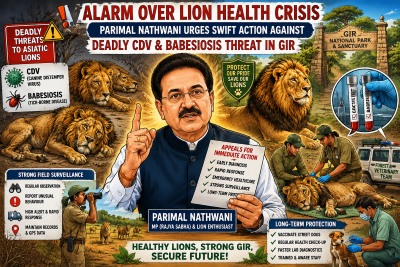
Amid growing concerns over the reported deaths of several Asiatic Lions due to Canine Distemper Virus (CDV) and Babesiosis in Gujarat’s Gir landscape, Parimal Nathwani has called for urgent medical intervention, stronger disease surveillance and long-term wildlife healthcare reforms to protect the endangered big cats.
In letters addressed to Bhupender Yadav, Union Minister for Environment, Forest and Climate Change, and Arjun Modhwadia, Gujarat’s Forests, Environment and Climate Change Minister, Nathwani expressed deep concern over the health threat facing the iconic Asiatic Lions of Gir.
- Parimal Nathwani raises concern over reported lion deaths linked to CDV and Babesiosis in Gir
- Appeals to Gujarat and Central governments for urgent medical intervention and stronger field surveillance
- Recommends high-alert disease reporting protocol, GPS-based monitoring and rapid veterinary response
- Calls for street dog vaccination and joint assessment of CDV-Babesiosis risks to protect Asiatic Lions
“Very Disturbing”: Nathwani Voices Concern Over Lion Deaths
Describing the reported deaths as “very disturbing,” Nathwani urged authorities to immediately provide emergency healthcare support to affected lions and intensify efforts to prevent the spread of infectious diseases within the lion population.
“However, I have full confidence in the capabilities of the management of Gir National Park and Forest Department of the state government and I am sure that they must be taking all required precautionary measures, taking proper care and working round the clock for controlling further deaths, treating the lions affected by virus and taking measures to check the spread of this contagious virus,” Nathwani stated.
Rising Lion Population Bringing New Health Challenges
Nathwani pointed out that the growing population of Asiatic Lions across Gir and Greater Gir regions has simultaneously increased the risk of contagious diseases.
He warned that illnesses such as Canine Distemper Virus and Babesiosis could pose a major threat to the long-term survival of the species if not detected early.
“It is imperative to make observation and reporting systems more effective and robust at the field level for early diagnosis and faster response,” he added.
Call for High-Alert Monitoring System
In his recommendations, Nathwani appealed for the implementation of a comprehensive “Field Observation Protocol” involving trackers, beat guards, round staff and veterinary teams working in the forest ecosystem.
He suggested that field staff should immediately report unusual lion behaviour, respiratory distress, physical fatigue, unstable walking patterns and severe tick infestations.
The Rajya Sabha MP also recommended that cases where multiple lions exhibit similar symptoms should automatically trigger a “High Alert” response involving senior forest officials and rapid veterinary response teams.
He further stressed the need for maintaining detailed records in every suspicious case, including:
- Date and time
- GPS location
- Number and age of lions
- Behavioural symptoms
- Photographic documentation
Nathwani also cautioned against unauthorised handling of diseased or dead lions and emphasised strict adherence to standard operating procedures (SOPs).
Street Dogs, Tick Menace and Disease Linkages
Highlighting the possibility of Canine Distemper Virus transmission through dogs, Nathwani called for vaccination drives targeting stray dog populations around lion habitats.
He also advocated:
- Regular health check-ups
- Faster laboratory diagnostic systems
- Training programmes for frontline forest staff
Importantly, Nathwani noted that diseases like Babesiosis weaken lions’ immunity, potentially increasing vulnerability to CDV infections.
He urged authorities to jointly assess the risks posed by both diseases rather than treating them separately.