R ARIVANANTHAM
CHENNAI, MAR 21
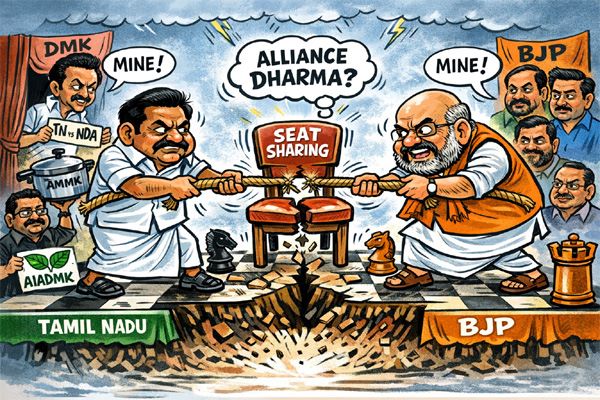
With barely weeks to go for the Tamil Nadu Assembly elections, the principle of “Alliance Dharma”—often invoked as the moral glue of coalition politics—is being tested like never before, as the opposition bloc led by Edappadi K. Palaniswami and the Bharatiya Janata Party grapples with a prolonged and uneasy seat-sharing deadlock.
- AIADMK–BJP seat-sharing deadlock exposes fault lines in NDA’s Tamil Nadu strategy
- DMK sharpens “Tamil Nadu vs NDA” narrative as perception battle intensifies
- Smaller allies turn kingmakers, pushing hard bargains ahead of April 23 polls
- EPS asserts leadership, BJP pushes expansion—tug of war over who leads the alliance
- ‘Alliance Dharma’ under stress as ideology meets arithmetic in high-stakes election
Nearly 11 months after the alliance was sealed with much fanfare—marked by Amit Shah’s high-profile Chennai visit and a symbolic dinner diplomacy—the bonhomie appears to have given way to hard negotiations and silent friction.
Alliance Dharma vs Ground Reality
At the heart of the impasse lies a fundamental question: Who leads the alliance in Tamil Nadu?
While Palaniswami has consistently asserted AIADMK’s primacy, stating:
“AIADMK leads the alliance, and we will form the government,” the BJP, emboldened by its national footprint, is pushing for a larger share of seats and a more decisive role in shaping the coalition arithmetic.
A senior AIADMK leader, reflecting internal discontent, remarked:
“This has never been part of our party culture. When Amma was our leader, national leaders waited. AIADMK is the larger partner and should lead the alliance.”
Despite being projected as the NDA’s chief ministerial face, EPS’s multiple visits to Delhi—his third in three months—have sparked murmurs within party ranks and raised questions over negotiating leverage.
BJP’s Expansion Play
The BJP’s strategy appears clear—expand its footprint while consolidating anti-DMK votes.
Prime Minister Narendra Modi, during recent visits, reinforced this ambition:
“NDA will form the government.”
Sources indicate the BJP has sought around 50+ seats, aiming to contest at least 35 seats on its own symbol, while also playing a central role in accommodating allies like:
- T. T. V. Dhinakaran (AMMK)
- Anbumani Ramadoss faction
- G. K. Vasan
Dhinakaran, in particular, is negotiating aggressively:
Sources suggest he is seeking 12–15 constituencies, primarily in South Tamil Nadu, to retain his core base and symbolic identity.
DMK’s Narrative Offensive
Sensing an opportunity, Chief Minister M. K. Stalin has sharpened the ideological pitch, framing poll as:
“A contest between Tamil Nadu and the NDA.”
This narrative is resonating among sections of voters, while also putting the AIADMK on the defensive in the perception battle.
The ‘Alliance Dharma’ Test
Traditionally, Alliance Dharma implies mutual respect, clarity of roles and collective decision-making. But in Tamil Nadu’s current context, it is being redefined by:
- Electoral arithmetic over ideology
- Central vs regional power equations
- Leadership assertion vs coalition compulsions
EPS has sought to downplay concerns, stating:
“Discussions are ongoing. Decisions will be made in the interest of the alliance.”
Yet, the delay in finalising seat-sharing has already fuelled speculation and unease among cadres across parties.
What Lies Ahead
With smaller allies turning pivotal and negotiations entering a crucial phase, the coming days will determine whether:
- The alliance can strike a balanced formula, or
- Internal contradictions weaken its electoral prospects
For now, Tamil Nadu’s political stage presents a classic coalition dilemma—can “Alliance Dharma” survive the pressures of power politics, or will strategy override sentiment?