
- India retains its position as the world’s largest milk producer, with output soaring 69.41% to 247.87 million tonnes in 2024-25
- Dairy sector sustains 8.5 crore rural households, with women accounting for nearly 70% of the workforce
- Cooperative network connects 1.65 crore dairy farmers across 2.45 lakh villages through 22 milk federations and 241 district milk unions
- White Revolution 2.0 targets 75,000 new dairy cooperative societies and strengthening of 46,422 existing societies by 2028-29
- Scientific breeding, digital livestock identification, doorstep veterinary care and modern infrastructure drive productivity
- National Milk Day honours Dr Verghese Kurien’s legacy as India explores sustainability, circular bioeconomy and expanding global dairy markets
NE AGRICULTURE BUREAU
NEW DELHI, NOV 25
Every glass of milk carries a story far bigger than nutrition. Behind India’s daily supply of milk lies the collective enterprise of 8.5 crore rural households, millions of women managing livestock and village-level cooperative institutions that have transformed dairying into a powerful engine of rural prosperity. As India celebrates National Milk Day on November 26, the country’s remarkable journey to becoming the world’s largest milk producer offers an opportunity to examine how the White Revolution has evolved from a dairy-production movement into a wider mission encompassing farmer incomes, women’s empowerment, scientific livestock management, digital innovation and sustainable development.
India contributes nearly one-fourth of global milk production, making dairying a vital pillar of its nutritional security and rural economy. Milk supplies high-quality animal protein and essential nutrients, including calcium, magnesium and potassium, in easily absorbable forms. Often regarded as a near-complete food, it supports growth, bone health and vitality across age groups.
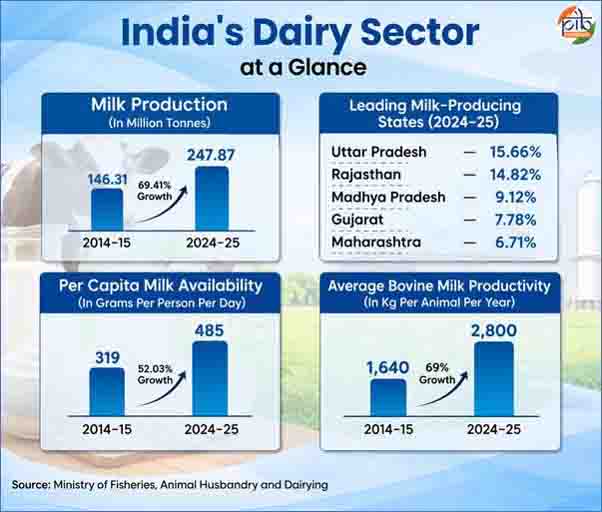
The scale of India’s dairy transformation is reflected in production figures. Between 2014-15 and 2024-25, milk output increased by 69.41%, from 146.31 million tonnes to 247.87 million tonnes, registering a compound annual growth rate of 5.41%.
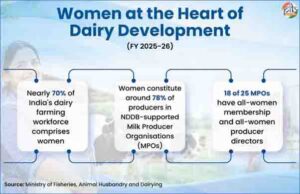
Yet the real significance of this growth extends beyond production statistics. Dairying provides livelihoods to approximately 8.5 crore rural households, while women account for nearly 70% of the dairy farming workforce, making the sector an important instrument of inclusive rural development.
Observed annually on November 26, National Milk Day commemorates the birth anniversary of Dr Verghese Kurien, widely remembered as the Father of India’s White Revolution. The occasion recognises his transformative contribution to the cooperative dairy movement and honours the millions of farmers whose collective efforts sustain India’s global leadership in milk production.
A decade of remarkable dairy growth
India’s dairy sector has recorded substantial progress in production, availability and animal productivity.
Between 2014-15 and 2024-25:
- Milk production: Increased by 69.41%, from 146.31 million tonnes to 247.87 million tonnes.
- Per capita availability: Rose by 52.03%, from 319 grams per person per day to 485 grams.
- Bovine milk productivity: Increased from 1,640 kg per animal per year to 2,800 kg, registering growth of 69%.
The five leading milk-producing States are Uttar Pradesh (15.66%), Rajasthan (14.82%), Madhya Pradesh (9.12%), Gujarat (7.78%) and Maharashtra (6.71%). Together, they account for 54.09% of the country’s total milk production.
These figures underline the growing contribution of dairy farming to India’s agricultural economy and the importance of improving animal productivity alongside expanding milk procurement and processing infrastructure.
Cooperatives: The backbone of India’s dairy revolution
The cooperative model remains central to India’s dairy success, providing an organised institutional framework connecting village-level milk producers with district milk unions and State federations.
The network supports milk procurement, processing, marketing and access to dairy services, enabling farmers to participate in organised markets and benefit from collective bargaining and marketing arrangements.
The country’s dairy cooperative ecosystem comprises:
- 22 milk federations.
- 241 district cooperative milk unions.
- 28 marketing dairies.
- 25 Milk Producer Organisations.
- Approximately 2.45 lakh villages covered.
- Around 1.65 crore dairy farmers as members.
The National Dairy Development Board (NDDB) has played a significant role in developing farmer-owned dairy institutions. Its wholly owned, not-for-profit subsidiary, NDDB Dairy Services (NDDB-DS), facilitates the establishment and operationalisation of Milk Producer Organisations (MPOs).
These farmer-owned Producer Companies bring milk producers together under professionally managed structures, facilitating collective procurement, stronger market linkages, transparent pricing and direct bank payments.
As of October 31, 2026, NDDB Dairy Services had established 25 MPOs. Significantly, 18 of these have entirely women members, with women also serving as all the producer directors on their respective boards.
The MPO network covers more than 13 lakh milk producers across 175 districts in 12 States. Women constitute around 78% of the producers in these organisations, which collectively procure approximately 70 lakh litres of milk daily.
This growing institutional participation by women demonstrates how organised dairying can translate grassroots economic participation into leadership and enterprise ownership.
White Revolution 2.0: Taking cooperatives to the next level
The next phase of India’s dairy transformation is being driven by White Revolution 2.0, a cooperative-led initiative formally launched on December 25, 2024, with its Standard Operating Procedure (SOP) launched on September 19, 2024.
The initiative aims to expand dairy cooperative coverage in villages and Panchayats that remain outside the organised network and increase milk procurement by dairy cooperatives by 50% over five years.
Its broader objectives include strengthening cooperative institutions, improving market access, generating rural employment and promoting women’s empowerment.
Funded under the National Programme for Dairy Development (NPDD), White Revolution 2.0 has set two major targets for 2028-29:
- Establishment of 75,000 new Dairy Cooperative Societies in uncovered villages and Panchayats.
- Strengthening of 46,422 existing Dairy Cooperative Societies.
Progress as of October 31, 2026, includes the formation of 24,097 new Dairy Cooperative Societies and the strengthening of 31,394 existing societies.
The scale of this expansion reflects the effort to take organised milk procurement closer to farmers and extend the benefits of cooperative participation to previously underserved areas.
As of October 31, 2026, dairy cooperatives recorded daily milk procurement of 690.90 lakh kg and liquid milk sales of 462.95 lakh litres.
Procurement prices are determined by cooperatives and other dairies based on production costs and market conditions. Automated milk collection and payment systems are increasingly being used, with payments credited directly to farmers’ bank accounts.
Turning cattle waste into rural wealth
The dairy sector’s future is also being shaped by sustainability and circular resource utilisation.
White Revolution 2.0 promotes climate-smart practices, efficient resource utilisation and renewable, low-emission solutions across the dairy value chain.
A key element is the vision of ‘Gold out of Garbage’ — converting cattle dung and agricultural residues into biogas, organic manure and value-added bio-fertilisers.
Two Multi-State Cooperative Societies support this approach:
- Cooperative Inputs and Services Delivery Multi-State Limited: Seeks to provide quality inputs and services, including animal feed, disease control and artificial insemination.
- Gomay Sahkari Samiti Multi-State Limited: Focuses on scientific management and utilisation of cattle dung.
Complementing these efforts is GOBARdhan, the National Circular Bioenergy Scheme, launched on October 1, 2026.
With an outlay of ₹23,731 crore, the scheme will be implemented from FY 2026-27 to FY 2035-36. It aims to scale up domestic Compressed Biogas (CBG) production nearly ten-fold through assured offtake, stable pricing, capital assistance, pipeline connectivity and credit support.
The initiative seeks to strengthen energy security, mobilise private investment and promote a circular bioeconomy.
GOBARdhan builds on the original initiative launched in 2018 under the Swachh Bharat Mission (Grameen), which promotes converting organic waste, including cattle dung and agricultural residues, into biogas and bio-slurry.
The underlying objective is to turn agricultural and livestock waste into economic resources while supporting village cleanliness, waste management and additional rural livelihoods.
Building a stronger dairy ecosystem through infrastructure
Sustained dairy growth requires more than increasing the number of animals or expanding milk procurement. It depends on scientific breeding, quality feed, reliable veterinary care, cold-chain infrastructure and modern processing facilities.
The National Programme for Dairy Development (NPDD) seeks to strengthen these critical links through two components.
Component A: Strengthening milk procurement and quality infrastructure
This component supports the expansion of organised milk procurement networks, milk processing and value-addition infrastructure, particularly in the North Eastern Region, hilly areas and Union Territories.
It also promotes village-level cold chains, milk-testing facilities and training in quality and clean milk production.
Component B: Dairying through cooperatives
This component seeks to increase milk and dairy-product sales by improving farmers’ access to organised markets. It supports dairy processing and marketing infrastructure and strengthens producer-owned institutions to improve farmers’ returns.
It is being implemented in nine States: Andhra Pradesh, Bihar, Madhya Pradesh, Punjab, Rajasthan, Telangana, Uttar Pradesh, Uttarakhand and West Bengal.
The programme’s physical achievements as of October 31, 2026, include:
- 40,800 new Dairy Cooperative Societies organised or revived.
- 25.82 lakh additional farmers enrolled, with the source also reporting 161.17 lakh in additional milk procurement.
- 168 lakh litres per day of milk-chilling capacity created.
- 94,000 milk-quality testing devices distributed.
These interventions are aimed at improving the quality of milk, reducing post-procurement losses and strengthening the link between producers and organised markets.
Scientific breeding: Improving productivity and indigenous breeds
The Rashtriya Gokul Mission (RGM), initiated in December 2014, focuses on the scientific development and conservation of indigenous bovine breeds.
The programme seeks to enhance milk production and productivity, meet growing domestic demand and make dairying more remunerative for rural farmers.
Revised in March 2025, the mission places greater emphasis on breeding infrastructure and access to advanced reproductive technologies, including sex-sorted semen and in-vitro fertilisation (IVF).
Its progress includes:
- 50,023 Multi-Purpose Artificial Insemination Technicians in Rural India (MAITRIs) trained and equipped.
- 24 IVF laboratories established.
- 48 semen stations being strengthened.
- 32 heifer-rearing centres sanctioned.
The Nationwide Artificial Insemination Programme (NAIP) complements these efforts by providing quality artificial insemination services at farmers’ doorsteps using semen from high-genetic-merit bulls, including indigenous breeds.
More than 18.71 crore artificial inseminations have been performed, covering nearly 11.17 crore animals.
Together, these initiatives seek to improve genetic quality, expand breeding services and strengthen the productivity of India’s bovine population.
Private investment and modern dairy processing
The Animal Husbandry Infrastructure Development Fund (AHIDF) supports the development of modern dairy processing, value-addition and cold-chain infrastructure in the private sector and cooperatives.
Eligible beneficiaries receive a 3% interest subvention for eight years.
Since 2020-21, 258 dairy-processing plants in the private sector and cooperatives have been supported under the fund. This has leveraged investments of approximately ₹21,797 crore.
Projects approved under the initiative represent 500.58 lakh litres per day of milk-processing and value-addition capacity.
The investment is intended to strengthen processing capabilities, encourage value addition and improve the capacity of the dairy industry to serve expanding domestic and international markets.
Doorstep veterinary care and disease control
Animal health remains a critical determinant of dairy productivity and farmer income.
The Livestock Health and Disease Control Programme (LHDCP) supports the prevention and control of economically important livestock diseases, strengthens veterinary infrastructure and provides doorstep veterinary services through Mobile Veterinary Units (MVUs).
As of October 31, 2026:
- 4,019 MVUs were operational across 29 States and Union Territories.
- Around 1.5 crore farmers had received doorstep veterinary services.
- Approximately 3.3 crore animals had been treated.
The National Animal Disease Control Programme (NADCP), a component of LHDCP, focuses on controlling and eventually eradicating Foot and Mouth Disease (FMD), alongside controlling Brucellosis through vaccination and surveillance.
Its reported achievements include:
- More than 152 crore cumulative FMD vaccine doses administered, benefiting around eight crore farmers.
- FMD outbreaks declining from 132 in 2019 to 40 in 2025.
- Brucellosis outbreaks declining from 22 in 2019 to 15 in 2025.
These interventions are crucial to safeguarding livestock health, reducing disease-related economic losses and protecting the livelihoods of dairy-dependent households.
Pashu Aadhaar: Bringing livestock management into the digital age
Digital technology is increasingly becoming an important component of India’s livestock management system.
The Department of Animal Husbandry and Dairying, in collaboration with NDDB, has developed the Bharat Pashudhan database to create digital records of identified animals.
Each registered animal receives a unique 12-digit ear-tag identification number known as ‘Pashu Aadhaar’. This serves as the primary identifier for recording transactions relating to vaccination, breeding, treatment and other livestock-management activities.
As of October 31, 2026:
- 9,98,55,955 livestock owners had been registered.
- More than 39.42 crore Pashu Aadhaar numbers had been issued.
The digital database is designed to strengthen livestock identification, improve the tracking of animal-health interventions and support more informed management of the country’s bovine resources.
Indian dairy products make their mark overseas
India’s dairy industry continues to serve an enormous domestic market while expanding its international presence.
During 2025-26, India exported 97,524.82 metric tonnes of dairy products, earning USD 407.12 million.
Major export destinations included the United Arab Emirates, Saudi Arabia, the United States, Bhutan and Bahrain.
These exports reflect the growing international reach of Indian dairy products and the industry’s efforts to extend its market presence beyond domestic consumption.
The strength behind every drop
National Milk Day is not merely a celebration of India’s position at the top of the global milk-production table. It is also a tribute to the millions of farmers, particularly women, whose daily efforts sustain this vast rural enterprise.
Dr Verghese Kurien’s cooperative vision demonstrated how collective organisation could transform milk production into a nationwide economic movement. Today, that legacy is being extended through new cooperatives, scientific breeding, digital livestock records, veterinary services, infrastructure investment and sustainable resource management.
The challenge ahead is to ensure that rising production translates into better and more dependable returns for farmers, greater participation by women, healthier livestock and a more sustainable dairy value chain.
Ultimately, India’s White Revolution will be measured not only by the millions of tonnes of milk it produces, but also by the prosperity it creates in the villages and households behind every drop.