
R ARIVANANTHAM
CHENNAI, NOV 7
A laptop for every learner, a fairer chance at the future?
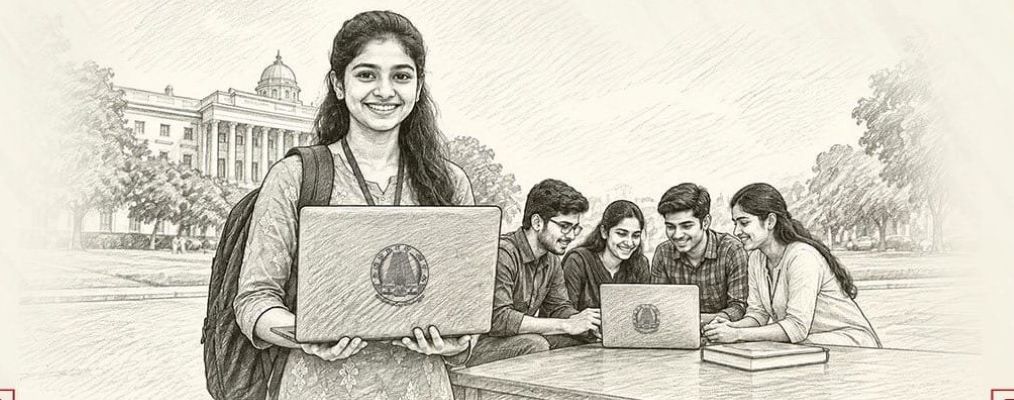
When access to technology increasingly determines who gets to learn, compete and secure tomorrow’s jobs, should a laptop remain a privilege enjoyed by financially comfortable students or become an essential educational resource available to all? Tamil Nadu has put a substantial ₹2,000-crore public investment behind the latter proposition. The state’s Vetri Laptop Scheme, now cleared for implementation by Chief Minister C Joseph Vijay, seeks to bridge the digital divide among college students and equip a wider generation of young learners for an increasingly technology-driven economy.
- Vetri Scheme gets administrative clearance: Chief Minister C Joseph Vijay sanctions ₹2,000 crore to equip students in government and government-aided institutions with free laptops.
- A wider educational canvas: First- and second-year undergraduate and diploma students across arts, science, engineering, medicine, agriculture, law and other disciplines will benefit.
- Engineering gets a technological edge: Students pursuing engineering will receive laptops powered by Intel Core i5 processors or equivalent specifications.
- Other states offer precedents: Madhya Pradesh’s laptop-purchase assistance and Goa’s targeted free-laptop initiatives demonstrate growing recognition of digital access as an educational necessity.
- Beyond the freebies-versus-welfare debate: Experts argue that education and healthcare are public goods; should essential digital learning tools also be considered an investment in equal opportunity?
- The bigger question of universal access: Device quality, internet connectivity, digital literacy, maintenance and measurable learning outcomes will determine whether the initiative delivers lasting value.
The government has issued an order granting administrative approval and prescribing detailed implementation guidelines for the initiative, which was announced in the 2026-27 State Budget.
Under the scheme, first- and second-year undergraduate and diploma students enrolled in government and government-aided institutions during the 2026-27 academic year will receive free laptops.
The beneficiary spectrum is extensive, covering students pursuing arts and science, engineering, polytechnic, industrial training, medicine, veterinary science, fisheries, agriculture and law. The government has also extended the benefit to third- and fourth-year students pursuing professional courses who missed out on laptop distribution during 2025-26.
Recognising the specialised computing requirements of engineering education, the government has prescribed laptops equipped with Intel Core i5 processors or equivalent technology for engineering students.
The initiative is intended to strengthen digital literacy, facilitate skill-development training, expand access to online learning resources and improve students’ preparedness for future employment opportunities.
From Tamil Nadu to other states: A growing recognition
Tamil Nadu is not alone in recognising the importance of equipping students with digital devices. Other states have experimented with different models of laptop assistance, although their coverage and eligibility conditions vary.
Madhya Pradesh operates a Laptop Supply Scheme under which eligible meritorious Class XII students receive ₹25,000 towards purchasing a laptop. The initiative is designed to encourage academic achievement while facilitating access to digital learning and modern technology.
Goa has pursued a more targeted approach through its Laptop-e Scheme for Class XI students and a separate initiative providing free laptops to meritorious Scheduled Caste and Scheduled Tribe students. The latter seeks to encourage educational advancement and digital empowerment among deserving students.
These initiatives demonstrate that digital access is increasingly being recognised as an important component of educational support. However, Tamil Nadu’s Vetri initiative has a distinctly wider higher-education focus, extending across multiple disciplines and academic years.
The question now is whether other states will consider similarly comprehensive programmes, particularly for students from economically weaker and middle-income households who cannot easily afford quality computing devices.
Why should education and health alone be free?
The larger debate goes beyond laptops and government allocations. It raises an important question about the meaning of welfare itself: Why should education and healthcare be regarded as essential public responsibilities, while the technological resources required to access modern education are sometimes treated as optional luxuries?
Education and healthcare are widely recognised as foundational public goods because their benefits extend beyond individual recipients to society at large. Digital access increasingly deserves consideration within the same framework of equal opportunity.
Economist Jayati Ghosh has argued that basic needs such as nutrition, healthcare, housing and education are responsibilities of the government and should not be dismissed as freebies.
“Basic needs” like nutrition, healthcare, housing and education, which the government should provide for its citizens, are not freebies, she has said.
Former Prime Minister and economist Manmohan Singh had also underlined the importance of equitable access to basic public goods, particularly education and healthcare, in strengthening India’s productive capacity.
The 2023 UNESCO Global Education Monitoring Report, Technology in Education: A Tool on Whose Terms?, offers an important caution against assuming that technology alone can transform learning.
It observes: “No screen can ever replace the humanity of a teacher.” The report advocates a complementary relationship between teachers and technology and stresses that digital interventions must be equitable, evidence-based and sustainable.
The report also cautions that technology can actually widen educational inequalities when disadvantaged learners are denied access to devices, connectivity and adequate support.
These expert perspectives make a compelling case for looking beyond the immediate distribution of laptops. A device without affordable internet connectivity, relevant educational content, technical support and digital skills cannot deliver its full promise.
From distribution to measurable educational impact
For effective implementation, the government has decided to constitute a high-level steering committee headed by the Chief Minister to supervise the programme, monitor progress and coordinate the departments concerned.
The Electronics Corporation of Tamil Nadu (ELCOT) has been granted administrative approval to procure laptops meeting prescribed quality standards and technical specifications.
The procurement process will be crucial in ensuring that the devices are durable, suitable for academic requirements and backed by adequate after-sales support.
The government expects the programme to particularly benefit students from economically disadvantaged and middle-income families who may otherwise struggle to purchase computers required for higher education.
However, the real measure of success should extend beyond the number of laptops distributed or the amount spent. Regular assessment of usage, digital skills acquired, academic performance, access to online resources and improved employability would help establish the programme’s long-term impact.
Equally important is ensuring that students in rural and underserved areas receive reliable internet connectivity and the necessary guidance to use technology productively.
A public investment in human potential
Tamil Nadu’s Vetri Laptop Scheme brings an important dimension to the continuing debate over public expenditure, welfare priorities and investment in human capital.
If quality education and accessible healthcare are essential to building an equitable society, digital infrastructure that enables students to participate in contemporary learning cannot remain outside the conversation.
The larger policy challenge is not simply to provide a free laptop, but to ensure that no deserving student is left behind because of the inability to afford the tools required to learn, innovate and compete.
Ultimately, the return on this ₹2,000-crore investment should not be measured merely in laptops purchased, but in opportunities unlocked, skills developed and futures transformed.
A laptop may not guarantee success. But denying a student access to technology could close a door before the journey even begins.