
- Union Home Minister calls for tighter surveillance along Gujarat’s 2,340-km coastline and stronger coordination among BSF, State Police, Coast Guard and central agencies
- With a drug-free India target of 2029, Shah wants investigators to dismantle entire narcotics networks and pursue their kingpins and illicit financial assets
- Gujarat earns praise for new criminal laws, with 92% of chargesheets filed within 60 days and 86% within 90 days
- More than 25,000 pending forensic cases flagged for a special clearance drive as the Centre pushes technology-led criminal investigations
- Cybercrime response, counter-terrorism preparedness and identification of illegal foreign nationals figure prominently in the high-level review
- Disaster management, Ahmedabad’s urban flood mitigation, fire safety and enemy-property disposal also come under the Home Minister’s scrutiny
NE NEWS SERVICE
AHMEDABAD, NOV 7
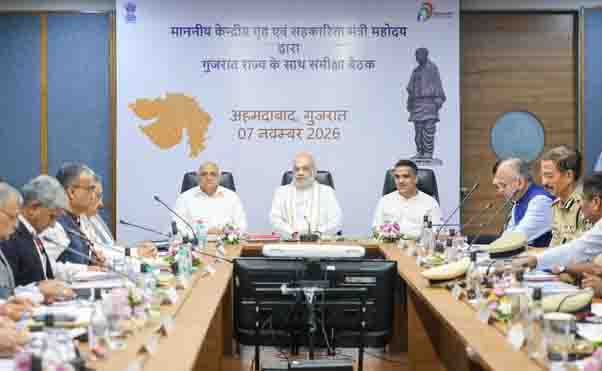
From the vulnerability of a 2,340-km coastline to the growing menace of cyber fraud and narcotics networks, Gujarat’s security preparedness came under an extensive Centre-State review on Saturday, with Union Home Minister Amit Shah calling for sharper surveillance, stronger inter-agency coordination and action that targets the masterminds behind organised crime—not merely its foot soldiers.
Chairing a high-level meeting in Ahmedabad to review the State’s law and order and internal security situation, Shah stressed that border and coastal security must remain a priority, given Gujarat’s strategic location along the international border with Pakistan and its extensive maritime frontier.
He called for closer coordination among the Border Security Force (BSF), State Police, Coast Guard and central security agencies, alongside stronger surveillance mechanisms to detect suspicious activities along the coastline and border areas.
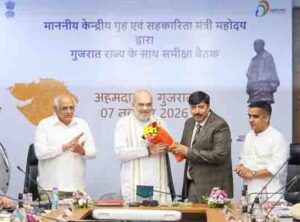
Chief Minister Bhupendra Patel, Deputy Chief Minister Harsh Sanghavi, Union Home Secretary, senior officials of the Ministry of Home Affairs and its subordinate offices, and officials of Gujarat’s Home Department and other departments attended the meeting.
Drug networks in the crosshairs
The Home Minister’s strongest emphasis was on dismantling the entire narcotics supply chain. He made it clear that enforcement action should not stop with small-time peddlers, but must extend to the principal operators, financiers and kingpins who sustain the illegal trade.
He called for financial investigations to be prioritised so that the proceeds of drug trafficking and other illicit assets could be identified and seized. The review also underscored the Centre’s objective of achieving a drug-free India by 2029, with Gujarat expected to intensify enforcement and public-awareness initiatives.
Shah also called for expansion of the 1933 anti-drug control room and coordinated action by all enforcement agencies. The focus, officials indicated, is on combining sustained intelligence-led operations with wider social outreach to tackle drug abuse.
Criminal justice: Gujarat’s performance gets a pat
Gujarat’s implementation of the three new criminal laws drew appreciation from the Union Home Minister. The State reported that 92% of chargesheets were being filed within 60 days and 86% within 90 days.
However, the sizeable backlog of forensic cases remains a challenge. Shah directed the State to launch a special drive to clear more than 25,000 pending forensic cases, underlining the importance of timely scientific examination and technology-backed investigations in strengthening the criminal justice system.
The review also covered the use of digital evidence, e-Sakshya, e-Summons and the Inter-Operable Criminal Justice System, along with measures to improve prosecution, court functioning and the availability of public prosecutors.
Cybercrime and counter-terrorism under watch
With cyber fraud becoming increasingly sophisticated, Shah called for strengthening the capacity of S4C and the 1930 cybercrime helpline to improve response and investigation. The meeting also reviewed initiatives involving Cyber Commandos, the Central Investigation Analytical Repository and Mission Prabodh, Gujarat’s efforts to combat cyber fraud and related offences.
Counter-terrorism agencies were asked to strengthen their capabilities, while the review covered anti-infiltration operations, intelligence-sharing mechanisms and measures to address radicalisation and other security threats.
The identification and deportation of illegal foreign nationals, strictly in accordance with law, also featured in the discussions. Shah appreciated Gujarat’s deportation of 2,412 illegal foreign nationals during special drives. Officials also reviewed foreign-national records, identification mechanisms and related coordination between agencies.
Disaster readiness and urban safety
The meeting went beyond conventional policing to examine Gujarat’s wider preparedness for emergencies and natural disasters. Shah emphasised accelerating work on disaster management, fire safety and the Ahmedabad Urban Flood Management Project.
The review also covered the capacity-building of disaster-response mechanisms, the utilisation of disaster-management funds, mangrove conservation and measures to mitigate urban flooding. The survey and disposal of enemy properties in the State were among the other issues discussed.
At the conclusion, Shah directed Central and State agencies to work in close coordination and regularly assess progress against clearly defined targets. The larger message was unmistakable: Gujarat’s security architecture must be strengthened across land, sea and cyberspace, with effective enforcement, faster investigations and coordinated intelligence-sharing.
He reiterated the commitment to building a secure India through a safe, developed and drug-free Gujarat.