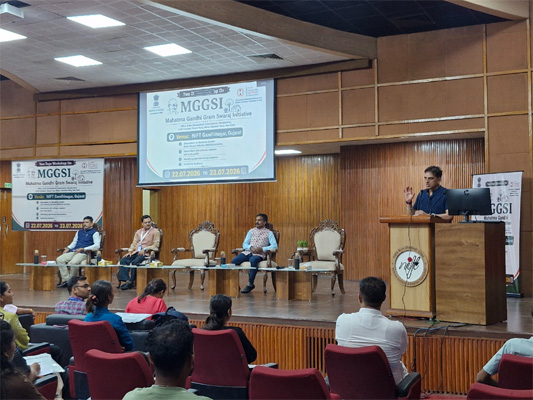
- Two-day Mahatma Gandhi Gram Swaraj Initiative workshop brings together nearly 100 artisans and weavers from five States at NIFT Gandhinagar
- Ministry of Textiles initiative focuses on sustainable livelihoods, entrepreneurship, market access and strengthening grassroots implementation
- Prof. (Dr.) Sameer Sood calls for a “Village Revolution” to transform rural India into self-reliant economic centres
- Fashion forecasting, design innovation, packaging, branding and global market linkages emerge as key tools to make traditional crafts future-ready
- NIFT Gandhinagar offers institutional support to empower artisans to become employment generators and build a Viksit Bharat @2047
NE EDUCATION BUREAU
GANDHINAGAR, JULY 22
What if India’s next economic revolution does not begin in a metropolitan boardroom but in the hands of an artisan, a weaver or a young entrepreneur in a village? This powerful question resonated at NIFT Gandhinagar as nearly 100 artisans, handloom weavers and Khadi weavers from Gujarat, Goa, Maharashtra, Chhattisgarh and Madhya Pradesh came together to explore how traditional skills can be transformed into sustainable, market-driven enterprises.
The Office of the Development Commissioner (Handicrafts), Ministry of Textiles, Government of India, organised a two-day workshop on the Mahatma Gandhi Gram Swaraj Initiative at NIFT Gandhinagar on July 22–23, 2026. The workshop seeks to bridge the gap between policy and the grassroots by facilitating direct interaction with artisans, identifying implementation challenges and evolving strategies to strengthen rural livelihoods.
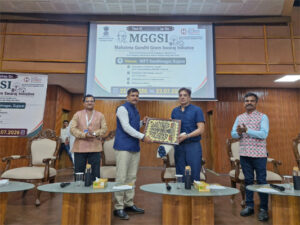
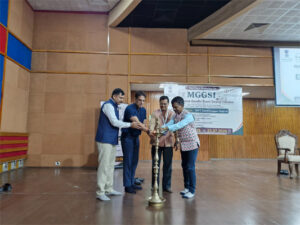
The inaugural ceremony was attended by Prof. (Dr.) Sameer Sood, Director, NIFT Gandhinagar; Deeptansu Haldar, Regional Director (Western Region), Office of the Development Commissioner (Handicrafts); Bidhan Das, Deputy Director, Indian Institute of Packaging; and Dr. Rajendra Prasad Sharma, Professor and Head, Indian Institute of Foreign Trade (IIFT), GIFT City Campus, Gandhinagar.
Addressing the gathering, Prof. (Dr.) Sameer Sood highlighted the crucial role of India’s textile, handloom, handicraft and Khadi sectors in achieving the vision of Viksit Bharat @2047. Referring to the Prime Minister’s vision of the “3 Ts”, he said the textile ecosystem extends far beyond conventional textiles to include handlooms, handicrafts and Khadi—sectors that combine heritage, sustainability, creativity and livelihoods.
He emphasised the enormous potential of the textile ecosystem to generate entrepreneurship, employment and innovation. Citing government estimates, Prof. Sood noted that an investment of ₹1 crore in the textile sector could generate nearly 70 jobs, making it a powerful engine of inclusive growth.
He urged participants to move beyond the traditional mindset of seeking employment and become employment generators, stressing that entrepreneurship would be central to raising per capita income and building a developed India.
Calling for a new “Village Revolution”, Prof. Sood said India’s villages could evolve into self-reliant economic centres rather than merely serving as sources of migration to cities. With nearly 70% of India’s population residing in rural areas, he underlined the need to strengthen local livelihoods through design, technology, market intelligence and management support.
NIFT Gandhinagar, he said, could play a significant role in this transformation by helping artisans remain competitive in rapidly changing markets. He also highlighted VisioNxt, NIFT’s indigenous fashion forecasting platform, developed to reduce dependence on international forecasting tools. He offered to organise a dedicated orientation programme on fashion forecasting and VisioNxt for artisans and entrepreneurs to help them understand emerging consumer preferences and market trends.
Identifying dead inventory as one of the biggest challenges facing the textile, handloom and handicraft sectors, Prof. Sood attributed it largely to the mismatch between production and market demand. He said fashion forecasting, stronger market linkages and sound management practices could help artisans create market-driven products, reduce unsold inventory and build sustainable enterprises.
Deeptansu Haldar highlighted the objectives of the Mahatma Gandhi Gram Swaraj Initiative and reiterated the Ministry of Textiles’ commitment to promoting sustainable livelihoods for artisans and weavers. He urged participants to actively share their experiences and provide constructive feedback to improve the implementation of government schemes.
Bidhan Das spoke on the importance of packaging, branding and value addition in improving the marketability of handicraft products. He stressed that effective packaging could enhance product appeal, strengthen brand identity and open wider domestic and international markets for artisans.
Dr. Rajendra Prasad Sharma said India’s handicrafts and handlooms possess immense potential to strengthen the country’s foreign trade by showcasing its rich cultural heritage and exceptional craftsmanship. He said integrating traditional skills with global market requirements could significantly expand exports, create sustainable rural livelihoods and advance the vision of Atmanirbhar Bharat.
The workshop has been designed as an interactive platform for artisans and weavers to share experiences, identify operational challenges and suggest measures to improve the effectiveness of the Mahatma Gandhi Gram Swaraj Initiative. It also promotes the exchange of best practices among participants from different States.
The two-day initiative underscores the Ministry of Textiles’ commitment to inclusive growth, rural entrepreneurship, preservation of India’s living craft heritage and the socio-economic empowerment of artisans and weavers through participatory and capacity-building interventions.