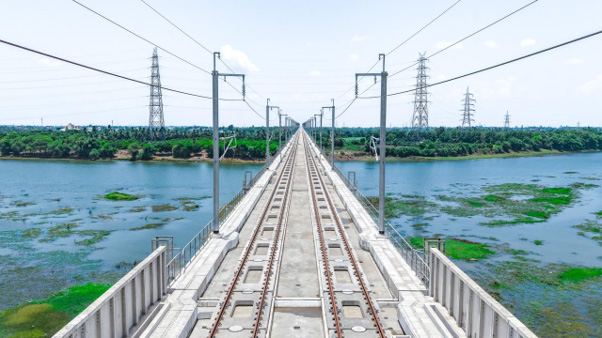
- 2×25 kV high-speed electrification system being deployed in India for the first time
- 14 traction substations, 31 switching posts and 16 distribution substations to power the 508-km corridor
- Nearly 22,000 steel masts and 25,700-plus cantilever assemblies to support the high-speed OHE network
- 320-kmph operations to be backed by precision-tensioned wires and seamless power transitions
- Indigenisation of critical components gives ‘Make in India’ a high-speed rail thrust
NE RAILWAY BUREAU
AHMEDABAD, JULY 22
As Gujarat’s high-speed rail dream hurtles towards reality, the Mumbai–Ahmedabad Bullet Train corridor is quietly building the invisible force that will make the 320-kmph journey possible: a first-of-its-kind electrification network engineered for speed, precision and safety.
While civil construction and track-laying work continue to gather pace along the 508-km Mumbai–Ahmedabad High-Speed Rail (MAHSR) corridor, electrification works are now emerging as a critical pillar of India’s first Bullet Train project. From the power grid to substations, overhead wires and real-time safety systems, every component is being designed to ensure that the train’s high-speed journey remains smooth, uninterrupted and secure.
First 2×25 kV high-speed rail electrification system takes shape
The MAHSR corridor is being equipped with an advanced 2×25 kV Overhead Traction System, one of the most sophisticated electrification technologies used worldwide for high-speed rail. Being introduced in India for the first time, the system is specifically designed to deliver a stable and uninterrupted power supply to trains operating at speeds of up to 320 kmph.
Power will flow from the National Power Grid to specially designed Grid Substations and then to 14 Traction Substations strategically distributed along the corridor. Five are located in Maharashtra—Mumbai, Thane, Virar, Boisar and Thane Depot—while nine are located in Gujarat at Vapi, Bilimora, Surat, Bharuch, Vadodara, Anand, Mahemdabad, Ahmedabad and Sabarmati Depot.
These substations will supply power to different sections of the route. As the Bullet Train moves from one section to another, power transitions will take place seamlessly, ensuring that passengers do not experience any interruption.
The corridor will also have 31 Switching Posts to ensure continuity of supply and facilitate rapid isolation of faults. In addition, 16 Distribution Substations are being constructed to power stations, signalling systems, maintenance facilities and other operational infrastructure.
22,000 steel masts to keep India’s fastest train moving
The Bullet Train will run on a precisely engineered overhead electrical network spread across 1,125 track kilometres, including depots. The system will be supported by nearly 22,000 steel masts and more than 25,700 cantilever assemblies.
Standing between 10.5 and 14.5 metres high, roughly the height of a three- to four-storey building, the masts will support an advanced compound catenary system, another technology being deployed in India for the first time.
At speeds of up to 320 kmph, even the smallest fluctuation can matter. Therefore, every wire is installed under precisely calculated mechanical tension, enabling the train’s pantograph to collect electricity smoothly and continuously without sparks, interruptions or power fluctuations.
Bullet train power network to carry a strong ‘Make In India’ signature
The electrification works are also creating a major opportunity for Indian industry. Several critical components of the high-speed electrification system are now being manufactured domestically.
These include major transformers, cross arms mounted on OHE masts, and the Ground Wire, Protection Wire and Feeder Wire that form part of the overhead electrical network. Several other components of the Traction Power Supply System, Distribution Power System and Electro-Mechanical works are also being produced in India.
The indigenisation drive is expected to strengthen domestic manufacturing capabilities, create specialised employment opportunities, reduce import dependence and build a robust Indian ecosystem for future high-speed rail projects.
Thus, the Mumbai–Ahmedabad Bullet Train is not merely bringing global high-speed rail technology to India—it is helping India learn to manufacture the technology at home.
Earthquake alert system designed to act within seconds
Safety remains at the heart of the electrification architecture. Each of the 14 Traction Substations will be equipped with Early Earthquake Detection Seismometers capable of detecting seismic activity and triggering protective action within seconds.
In the event of an earthquake, the system is designed to facilitate the immediate stopping of trains.
A total of 28 seismometers are being installed—22 along the high-speed corridor at Traction Substations and Switching Posts, and six additional inland seismometers in earthquake-prone areas of Maharashtra and Gujarat.
Of these, 12 will be installed in Maharashtra near Mumbai, Thane, Virar, Boisar, Kheda, Ratnagiri, Latur and Pangri, while 16 will be installed in Gujarat near Vapi, Bilimora, Surat, Bharuch, Vadodara, Anand, Mahemdabad, Ahmedabad, Adesar and Old Bhuj.
A digital nervous system for India’s high-speed rail future
The entire electrical network will be placed under real-time supervision from a centralised control centre. Automated protection systems will be capable of responding within fractions of a second to maintain the safe and reliable operation of high-speed trains.
From Gujarat’s industrial corridors to the Sabarmati Depot and onward to Mumbai, the electrification network is steadily creating the powerful backbone for a new era of Indian mobility—where speed, safety, precision and indigenous engineering converge on a single high-speed track.