
NE HEALTH BUREAU
NEW DELHI, NOV 9
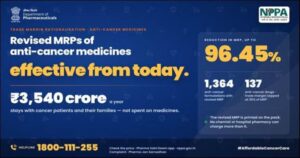
A cancer diagnosis should not become a financial sentence for an entire family. In a landmark intervention aimed at making life-saving treatment more affordable, the Government of India has brought into force revised Maximum Retail Prices (MRPs) of 1,364 anti-cancer formulations from November 9, with consumers expected to save an estimated ₹3,540.38 crore annually.
- NPPA’s landmark trade-margin intervention brings revised prices of 1,364 anti-cancer formulations into force from November 9, with estimated annual consumer savings of ₹3,540.38 crore
- 679 brands report price reductions exceeding 50%, with the steepest cut touching an unprecedented 96.45%
- 85 pharmaceutical companies have revised prices covering 121 drugs, bringing potential relief to patients, caregivers, hospitals and healthcare institutions
- Major public-interest question gains urgency: Can comparable affordability measures be extended to insulin-dependent patients in a country with the world’s second-largest diabetes population?
The National Pharmaceutical Pricing Authority (NPPA), under the Department of Pharmaceuticals, Ministry of Chemicals and Fertilizers, has capped trade margins on the MRPs of 137 anti-cancer drugs, acting on the recommendations of an Expert Committee constituted by the Directorate General of Health Services (DGHS), Ministry of Health and Family Welfare, on October 17, 2026.
The scale of the intervention is significant. As of November 8, 85 pharmaceutical companies had reported revised MRPs for 1,364 anti-cancer formulations covering 121 drugs. Of these, 679 brands recorded price reductions exceeding 50%, while the highest reported reduction stood at 96.45%.
The move offers a potentially substantial financial reprieve to cancer patients and their families, many of whom face prolonged treatment schedules, repeated hospital visits and mounting medicine bills.
Patients, caregivers and hospitals stand to benefit
The intervention addresses excessive trade margins in the pharmaceutical distribution and retail chain, seeking to ensure that the benefits of lower medicine prices reach patients rather than being absorbed by intermediaries.
For patients, lower MRPs can mean reduced out-of-pocket expenditure and improved access to prescribed medicines. Families and caregivers could gain greater financial headroom to manage diagnostics, hospitalisation, supportive care and other treatment-related expenses.
Hospitals, institutional pharmacies, oncologists and healthcare providers also have an important role in ensuring that the revised prices translate into actual savings at the point of purchase.
The initiative is particularly significant because the Government has extended the trade-margin rationalisation framework to non-scheduled anti-cancer medicines, including patented drugs, thereby addressing pricing concerns beyond the conventional scheduled-drug price-control framework.
Transparency and accountability are essential
Consumers can check the revised MRP printed on medicine packs and cross-verify prices through the NPPA’s Pharma Sahi Daam mobile application or its official website, nppa.gov.in.
No chemist or hospital pharmacy can charge more than the applicable revised MRP.
Patients and caregivers who encounter overcharging or other medicine-pricing violations can register complaints through the Pharma Jan Samadhan portal or contact the NPPA helpline at 1800-111-255.
Effective monitoring and enforcement will be crucial to ensure that the announced reductions are reflected consistently across retail pharmacies, hospital pharmacies and institutional supply channels.
The next affordability frontier: India’s insulin-dependent millions
The cancer-drug price intervention also brings into sharp focus another pressing public-health challenge: the recurring cost of diabetes treatment, particularly for people who depend on insulin throughout their lives.
India is not officially classified as the world’s diabetes capital, but the latest International Diabetes Federation (IDF) estimates underline the magnitude of the challenge. The country had approximately 89.8 million adults aged 20–79 living with diabetes in 2024, the second-highest national burden globally. The IDF projects this number could rise to 156.7 million by 2050.
Unlike many short-course treatments, insulin is a continuing necessity for millions of patients. Its affordability, uninterrupted availability and quality are therefore critical to household finances as well as public health.
There are already government measures aimed at improving access. The National Pharmaceutical Pricing Authority regulates the prices of specified scheduled insulin formulations under the Drugs (Prices Control) Order, 2013. The National List of Essential Medicines 2022 also includes insulin glargine in a scheduled formulation subject to price control.
Under the Pradhan Mantri Bhartiya Janaushadhi Pariyojana, affordable generic anti-diabetic medicines, including insulin formulations, are part of the programme’s wider product basket. The Government says Jan Aushadhi medicines are generally priced 50–80% below comparable branded alternatives.
Further, the National Health Mission’s Free Drugs Service Initiative supports States and Union Territories in providing free essential medicines, including insulin, to poor and needy patients through public health facilities.
However, the November 9 anti-cancer price intervention does not announce a comparable new, across-the-board insulin price reduction. That distinction is important. A fresh, transparent review of insulin affordability, coverage, availability and price regulation would be a meaningful next step for the Government.
The wider lesson from the cancer-drug intervention is that regulatory action can address excessive margins and improve access to essential treatment. Extending that commitment to the long-term needs of diabetes patients would bring relief to millions of households.
Ultimately, affordable medicines should not be viewed merely as a pricing exercise, but as an investment in healthier families, financial security, equitable healthcare and a stronger nation.