
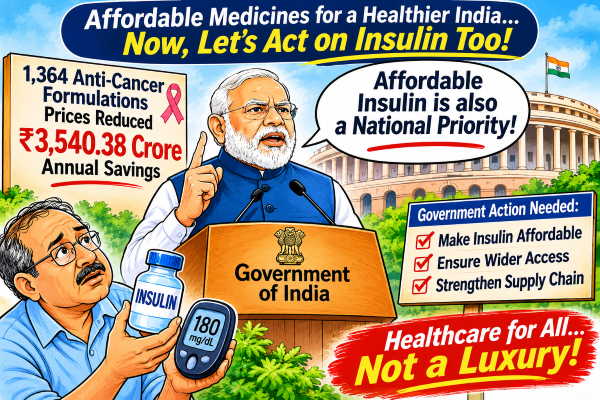
With revised prices of 1,364 anti-cancer formulations expected to save consumers ₹3,540.38 crore annually, the Government has sent an important message: access to essential treatment must not be undermined by unaffordable medicine prices. It is now time to extend the same urgency to another national healthcare challenge that touches millions of households — diabetes and the recurring cost of insulin.

R ARIVANANTHAM
India has demonstrated through its latest intervention in anti-cancer medicine pricing that determined regulatory action can translate into substantial financial relief for patients. With revised prices of 1,364 anti-cancer formulations expected to save consumers ₹3,540.38 crore annually, the Government has sent an important message: access to essential treatment must not be undermined by unaffordable medicine prices. It is now time to extend the same urgency to another national healthcare challenge that touches millions of households — diabetes and the recurring cost of insulin.
The question deserves serious consideration by the Union Government, particularly the Ministries of Health and Family Welfare and Chemicals and Fertilizers, the National Pharmaceutical Pricing Authority (NPPA), State Governments and the pharmaceutical industry.
- With 89.8 million adults living with diabetes, India faces an escalating public-health and household-finance challenge
- NPPA’s existing price-control powers offer scope for a comprehensive review of insulin prices, trade margins and market transparency
- Government hospitals and Jan Aushadhi Kendras must become stronger pillars of affordable, uninterrupted access to quality insulin
- A proposed National Insulin Affordability Mission could bring together the Centre, States, pharmaceutical manufacturers, doctors, hospitals and patient organisations
India is among the countries carrying the heaviest diabetes burden in the world. According to the International Diabetes Federation’s 2025 Diabetes Atlas data for 2024, approximately 89.8 million adults aged 20–79 were living with diabetes in India, the second-highest national burden globally. The number is projected to rise to 156.7 million by 2050. Even more worrying, an estimated 43% of adults with diabetes in India remain undiagnosed.
These figures should prompt policymakers to look beyond awareness campaigns and screening programmes. Affordable, continuous and quality-assured treatment must become an equally important pillar of India’s diabetes strategy.
Insulin is not a luxury; for many, it is a lifeline
For people with Type 1 diabetes, insulin is indispensable for survival. Many people with Type 2 diabetes also require insulin when their clinical condition warrants it. For these patients, treatment is not a short-term expense that can be postponed until household finances improve. It is a continuing medical necessity.
The financial burden does not end with purchasing insulin. Patients may also need syringes or pen needles, glucose-monitoring devices, testing strips, periodic investigations, consultations and appropriate storage facilities.
For economically vulnerable families, the cumulative expenditure can become particularly difficult to sustain.
The consequences of interrupted treatment can be serious. Therefore, insulin affordability must be understood as a matter of patient safety, continuity of care and financial protection, rather than simply a question of pharmaceutical pricing.
Existing government measures offer a foundation
It would be unfair to overlook the initiatives already undertaken by the Government.
The National Pharmaceutical Pricing Authority regulates scheduled essential medicines under the Drugs (Prices Control) Order, 2013. Its price-control framework covers specified anti-diabetic formulations, while its statutory powers also permit intervention in extraordinary circumstances in the public interest.
The National List of Essential Medicines 2022 includes insulin glargine in a specified formulation under the price-control framework.
The Pradhan Mantri Bhartiya Janaushadhi Pariyojana has also expanded access to quality generic medicines at affordable prices, including anti-diabetic medicines and insulin formulations.
Further, the National Health Mission’s Free Drugs Service Initiative supports States and Union Territories in providing essential medicines, including insulin, to poor and needy patients through public healthcare facilities.
These are important foundations. The challenge is to strengthen their implementation, improve availability and ensure that eligible patients do not have to travel long distances or repeatedly return to hospitals because of stock shortages.
Five policy interventions deserve urgent consideration
1. A comprehensive review of insulin prices
The NPPA and Department of Pharmaceuticals should undertake a transparent review of insulin prices, trade margins and affordability across commonly prescribed formulations, including human insulin and insulin analogues.
The review should consider manufacturing costs, distribution margins, market competition, patient affordability and uninterrupted availability. Where justified by evidence, the Government should consider ceiling-price rationalisation and other appropriate interventions under the DPCO framework.
2. Expand free insulin access through public healthcare
State Governments should strengthen the supply of insulin at primary health centres, community health centres, district hospitals and government medical colleges.
A patient diagnosed with diabetes should not be left to navigate a complicated system to obtain essential medicines. Monthly refills, dependable stocks and continuity of treatment should be made practical realities, particularly for low-income households.
3. Strengthen Jan Aushadhi’s diabetes-care basket
The Government should examine the availability, geographical distribution and affordability of essential insulin formulations through Jan Aushadhi Kendras.
Public awareness must improve so that patients and caregivers know where quality-assured, affordable alternatives are available. Medical advice and clinical suitability must remain paramount when choosing or changing insulin formulations.
4. Make the entire treatment package affordable
Insulin affordability cannot be addressed in isolation. Need-based assistance should also cover essential injection supplies, glucose-monitoring equipment and testing strips, particularly for economically weaker patients.
A structured support programme could reduce the risk of patients compromising on monitoring or treatment because of recurring household expenses.
5. Create a transparent national insulin-price monitoring mechanism
The NPPA, pharmaceutical manufacturers, distributors, hospitals and patient organisations should work towards a publicly accessible database of insulin prices, formulations and availability.
Regular monitoring would help identify unusual price variations, supply disruptions and regional disparities. A grievance-redressal mechanism should enable patients to report overcharging and shortages without unnecessary procedural hurdles.
A National Insulin Affordability Mission: The way forward
India should consider establishing a National Insulin Affordability Mission through coordinated action by the Union and State Governments.
Such a mission need not duplicate existing schemes. Instead, it could bring them together under a measurable framework covering affordability, availability, quality assurance, patient assistance and continuity of treatment.
The Union Government could provide policy direction, price regulation and financial support, while States could strengthen procurement, distribution and delivery through public hospitals and primary healthcare networks.
Pharmaceutical manufacturers, including domestic producers, should be encouraged to participate through responsible pricing, quality-assured production, technology development and dependable supplies. Public-private collaboration could also help improve access to newer formulations without compromising patient safety.
Doctors, diabetes specialists, hospitals, pharmacists and patient associations must be part of the consultation process. Their practical experience can help distinguish between the needs of different categories of patients and ensure that price interventions do not inadvertently create shortages or restrict clinical choices.
Importantly, any national initiative must recognise that not every person with diabetes requires insulin. Eligibility and treatment decisions must be guided by qualified medical professionals and individual clinical needs.
A policy opportunity that must not be missed
The anti-cancer medicine price intervention offers an important example of how regulatory action can improve affordability on a substantial scale. Its lessons should encourage a wider discussion on essential medicines for chronic diseases.
India cannot afford a situation in which a patient’s ability to continue prescribed treatment depends primarily on the family’s purchasing power.
The Government has already demonstrated its willingness to intervene when medicine prices become a significant public-interest concern. A similar commitment to insulin affordability would strengthen India’s response to diabetes and bring tangible relief to millions of households.
The ultimate objective should be clear: no patient who medically requires insulin should be forced to interrupt treatment because of financial hardship or inadequate availability.
Affordable insulin is not merely a healthcare benefit. It is an investment in human dignity, productive lives, family financial security and the health of the nation. The time is ripe for India to turn this policy opportunity into a national commitment.
(The author of this article is Executive Editor (Former Senior Correspondent, THE HINDU), navjeevanexpress.com He can be contacted at hindukgi@gmail.com)