
R ARIVANANTHAM
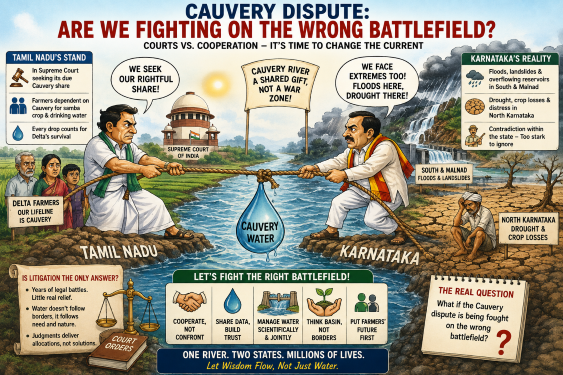
What if the Cauvery dispute is being fought on the wrong battlefield? At a time when Tamil Nadu is in the Supreme Court seeking what it calls its due Cauvery share, Karnataka is simultaneously battling floods, landslides and overflowing reservoirs in its southern and Malnad regions while farmers in North Karnataka stare at drought and crop losses. The contradiction is too stark to ignore.
The latest confrontation is familiar. Tamil Nadu says Karnataka has not released the water due to it and has approached the Supreme Court. The State says that, as of August 3, the combined storage in Karnataka’s KRS, Kabini, Harangi and Hemavathy reservoirs was 77.537 TMC, and argues that the proportionate flow due at Biligundlu should be 26.954 TMC, far above the 4.536 TMC allocated by the Cauvery Water Regulation Committee.
- A river cannot be managed by court orders alone: TN-Karnataka need a joint scientific audit of rainfall, storage, groundwater and crop demand
- From flood-hit Kodagu and Malnad to parched North Karnataka and thirsty Cauvery Delta, the basin is exposing the limits of a litigation-led water policy
- ‘Catch the rain where it falls’ could turn monsoon excess into drought insurance through watershed restoration, tanks, aquifer recharge and farm ponds
- Real-time basin data, climate forecasting and transparent distress-sharing could replace annual political brinkmanship with evidence-based water governance
- Farmers in both States need water security—not another round of courtroom victories and defeats
- A Cauvery Basin Water Security Mission could make every drop count from Kodagu to the Delta
Karnataka, for its part, has consistently maintained that water availability, rainfall and the State’s own requirements must be factored into releases. It has kept its legal options open against the latest CWRC direction.
Tamil Nadu farmers are understandably angry. Farmers’ organisations have recently demanded stronger legal action and have protested the shortfall, with some even staging dramatic demonstrations on the Cauvery banks in Tiruchirappalli.
But there is another question that deserves equal urgency:
Why should Tamil Nadu and Karnataka not jointly commission the most comprehensive scientific study of the Cauvery basin—and then build a water-security system around its findings?
That could be the beginning of the end of the perennial fight.
The Great Cauvery contradiction: Flood here, drought there
Look at Karnataka’s current landscape.
Heavy rains have pushed the Kabini, KRS, Hemavathy and other reservoirs sharply upwards, while parts of Kodagu, Shivamogga, Chikkamagaluru, Hassan and coastal Karnataka have faced flooding, landslides, submerged bridges and disruption.
Yet move towards Bagalkot, Koppal and Raichur, and the picture changes dramatically. Farmers are reporting drying crops, inadequate sowing and mounting debt. Tur dal has reportedly suffered severe damage in Raichur, while drinking-water shortages are affecting people and livestock.
This is not merely a Karnataka paradox.
Tamil Nadu has its own version of the same water tragedy: too much water when the northeast monsoon arrives, too little when the Cauvery is needed for agriculture, rapidly declining groundwater and increasing pressure on reservoirs and aquifers.
The Cauvery Delta itself is no longer the water-secure agricultural landscape it once was.
A peer-reviewed groundwater study of the Cauvery Delta found that groundwater levels and aquifer storage have been declining amid reduced canal flows and increased groundwater abstraction, while salinisation has increased. The study concludes that sustainability requires enhancing groundwater recharge and controlling groundwater abstraction.
That finding should fundamentally change the political conversation.
The question is no longer simply “How much water should Karnataka release?”
It must also be:
“How much water does the entire basin receive, where does it go, how much is stored, how much is lost, how much is extracted and how much can be captured before it reaches the sea?”
A joint scientific Cauvery audit: The way out?
TN and Karnataka should consider commissioning an independent, jointly owned Cauvery Basin Water Security Study, involving hydrologists, climatologists, agricultural scientists, groundwater experts, remote-sensing specialists, reservoir engineers, economists and representatives of farmers from both States.
It should map, in real time and over several decades:
- rainfall and changing monsoon patterns;
- reservoir inflows and storage;
- surface-water and groundwater availability;
- evaporation and transmission losses;
- groundwater extraction and recharge;
- cropping patterns and irrigation demand;
- drinking-water requirements;
- industrial and urban consumption;
- catchment degradation;
- flood flows and drought frequency;
- tank, lake and wetland storage capacity;
- climate-change projections; and
- the amount of water reaching the sea during high-flow periods.
No State should have to take the other State’s word for it. The river itself should provide the data.
Modern satellite imagery, automated rain gauges, reservoir sensors, groundwater monitoring wells and open-data dashboards can make such a system far more transparent than it was when the original dispute mechanisms evolved.
There is already evidence that scientific modelling can illuminate the Cauvery Delta’s groundwater crisis. The next step should be to expand such modelling across the entire basin, from Kodagu to the Delta.
‘Catch the Rain’ before it becomes a flood or a dispute
This is where the principle of “catch the rain where it falls” could become far more than a slogan.
Karnataka’s high-rainfall catchments cannot simply be treated as reservoirs feeding downstream demands. They are also natural water-storage systems.
The two States should jointly invest in:
Watershed restoration → check dams → farm ponds → recharge shafts → revived tanks → desilted lakes → restored wetlands → recharge wells → groundwater monitoring → efficient irrigation.
In Karnataka’s rain-rich Cauvery catchment, every additional drop retained in soil and aquifers can potentially moderate flood peaks and sustain base flows.
In Tamil Nadu, restoring thousands of traditional tanks, irrigation channels and village water bodies can help capture monsoon surpluses and recharge aquifers before excess water escapes into the sea.
There is encouraging evidence from the Cauvery Delta itself. Restoration and desilting of water bodies in villages such as Nadiyam have reportedly helped raise groundwater levels and reduce seawater intrusion.
That is the kind of quiet water diplomacy that rarely makes headlines—but can transform farming.
Farmers should become part of the water equation
Farmers’ bodies in both States have legitimate grievances, but their long-term interests are not necessarily opposed.
A Karnataka farmer wants enough water to protect his crop.
A Tamil Nadu delta farmer wants enough Cauvery water to save his crop.
Both are ultimately asking for the same thing:
predictable water security.
That is why farmers should have a formal seat in a proposed Cauvery Basin Water Security Council, alongside scientists and government officials.
The Council could recommend crop planning according to anticipated water availability, promote less water-intensive crops where scientifically appropriate, expand micro-irrigation and establish seasonal water budgets.
The aim should not be to tell farmers what to grow from Bengaluru or Chennai offices. It should be to provide them with credible advance information about rainfall, reservoir storage, groundwater and likely water availability, allowing them to make informed decisions.
From ‘distress sharing’ to ‘distress prevention’
The existing legal architecture has to remain respected. The Supreme Court’s 2018 Cauvery judgment and subsequent institutional mechanisms cannot simply be wished away.
But legal compliance and scientific water management need not be competing ideas.
The present system largely becomes politically explosive after distress appears.
A better system would attempt to predict and prevent distress.
Imagine a publicly accessible Cauvery dashboard displaying:
Rainfall received → reservoir storage → groundwater levels → inflow forecast → crop demand → drinking-water requirement → ecological flow → projected surplus/deficit.
If every figure is independently verifiable, arguments over whether a State is “hoarding” or “starving” another State could become far harder to sustain.
More importantly, distress-sharing could become formula-driven rather than emotion-driven.
The recent CWMA direction for Karnataka to release 3,500 cusecs daily for 15 days—about 4 TMC—shows once again how quickly the issue can become a matter of regulatory and political confrontation.
What is missing is a permanent scientific mechanism that tells both States what the basin can sustainably provide before the political battle begins.
Can Cauvery become a model of cooperative federalism?
Tamil Nadu need not surrender its legal rights to embrace scientific cooperation.
Karnataka need not surrender its legitimate concerns about its farmers, cities and ecological needs to participate in basin-wide planning.
The two can do both.
Indeed, the greatest victory for either State would be to reach a point where the Supreme Court no longer has to decide every monsoon what two neighbouring States should have already settled through data, science and institutional trust.
The Cauvery is not a political boundary.
It is a living basin.
Its water falls as rain in one place, becomes groundwater in another, fills a reservoir somewhere else, irrigates a farm downstream and eventually flows towards the sea.
Trying to divide such a dynamic system through annual political arithmetic alone is like trying to measure a cloud with a ruler.
The real Cauvery solution may be under our feet
The most provocative lesson from the present crisis is that the Cauvery may not be short of water in absolute terms as much as the basin is short of storage, recharge, efficiency, transparency and trust.
There will always be years of abundance and years of scarcity. Climate variability may make those swings more pronounced. Recent research also points to increasing rainfall variability and changing wet-season patterns over southern peninsular India.
No court can order the monsoon to behave.
But governments can ensure that when the rain comes, it is captured; when it falls heavily, it is stored; when it infiltrates, it recharges aquifers; when crops are planned, water availability is considered; and when scarcity arrives, every stakeholder knows exactly how much water exists and how it must be shared.
That is the real meaning of “catch the rain”.
Perhaps TN and Karnataka should stop asking only “Who gets how much Cauvery water?”
They should jointly ask the more revolutionary question:
“How can we ensure that there is enough water for both?”
If they can answer that scientifically—and act on it politically—the Cauvery could cease to be a perennial legal battlefield and become something far more valuable:
A laboratory for cooperative federalism, climate resilience and farmer-centred water security.
(Author of this article is R Arivanantham, Executive Editor, navjeevanexpress.com He can be contacted – hindukgi@gmail.com, navjeevanexpress@gmail.com Mobile: 9444671601.)