NEW DELHI, CHENNAI, AUG 3
When an ambulance cannot reach a patient, the first few minutes of a medical emergency can become the most expensive minutes of a life. India’s proposed regulatory framework for two-wheeled road ambulances could change that equation in villages, hilly regions, narrow lanes and remote settlements where conventional ambulances can struggle to reach in time.
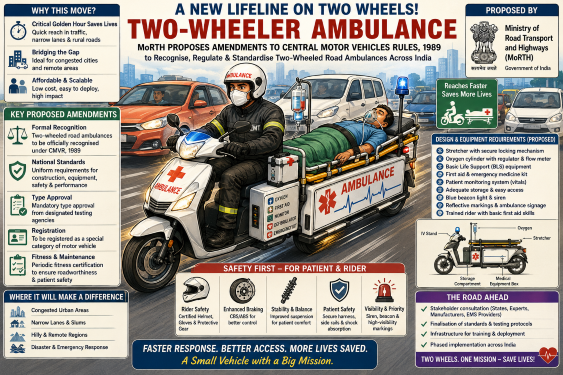
The Ministry of Road Transport and Highways (MoRTH) has proposed amendments to the Central Motor Vehicles Rules, 1989, seeking to formally recognise and regulate two-wheeled road ambulances and establish national requirements for their construction, safety, patient handling, type approval, registration and fitness.
- MoRTH proposes first dedicated national framework for two-wheeled road ambulances to bridge last-mile emergency-care gaps
- New AIS-209 standard seeks to combine speed and accessibility with patient safety, stability and medical protection
- L2 ambulances manufactured from October 2027 proposed to meet prescribed construction and functional requirements
- States to decide operational areas; vehicles proposed to undergo mandatory fitness certification every two years
- Stretcher locking, patient restraints, braking, emergency lights and fire safety brought under dedicated inspection regime
- Doctors and emergency-care experts say the concept could be transformative in difficult terrain—but safety must remain non-negotiable
The proposal is potentially significant for India’s emergency-healthcare architecture because a two-wheeler can negotiate terrain and access routes that may remain difficult or impossible for a conventional ambulance.
But medical experts have long stressed that speed alone does not make an ambulance safe. Patient restraint, vehicle stability, braking performance, protection from weather, equipment security and the ability to transfer a patient safely are equally critical. The proposed framework attempts to put those safeguards into the regulatory system.
A last-mile healthcare breakthrough—if safety leads the way
At present, two-wheeled road ambulances do not constitute a distinct vehicle category under the Central Motor Vehicles Rules. This has left a regulatory gap around their design, functional safety, patient-conveyance systems, type approval and fitness inspections.
The draft seeks to bridge that gap through AIS-209 (Part 1):2026—Construction and Functional Requirements for Life Support Two-Wheeled Road Ambulances.
The proposed standard defines such an ambulance as an L2-category vehicle fitted or attached with an ambulance accessory unit or patient-conveyance system.
That distinction matters.
For a patient in a remote village, a hill settlement or an area accessible only through narrow roads, the question is not simply whether a conventional ambulance exists—it is whether medical assistance can physically reach the patient quickly enough.
Two-wheeled ambulances could potentially become an important first-response and last-mile link between a medical emergency and the larger healthcare system.
From October 2027, a new safety benchmark
Under the draft framework, L2-category two-wheeled road ambulances manufactured on or after October 1, 2027, would be required to comply with AIS-209 (Part 1):2026.
Emergency top lights fitted on such ambulances would also have to comply with the prescribed standard from the same date.
The proposed framework would give State Governments the power to determine the areas in which these ambulances can operate, allowing deployment models to reflect local geography and healthcare requirements.
The vehicles would also be treated as transport vehicles, bringing them under mandatory fitness requirements. Their certificates of fitness would have to be renewed every two years.
This is an important shift from treating the two-wheeler merely as a rapid means of transport to recognising it as a specialised emergency-care vehicle requiring continuing safety oversight.
Stretcher, brakes, restraints: Safety moves to centre stage
The proposed fitness inspection regime is particularly significant.
Authorities would examine the secure mounting of the ambulance accessory or patient-conveyance unit; tyres and rims; emergency warning lights; patient stretcher and its locking mechanism; patient-restraint systems; loading and unloading mechanisms; and the availability, accessibility and validity of the fire extinguisher.
AIS-209 also provides for safeguards covering vehicle stability, braking performance, parking brake, gradeability, rear visibility, coupling integrity, emergency conspicuity and warning devices, besides safe patient loading, restraint and protection from environmental exposure.
The medical community has repeatedly emphasised that an ambulance is not simply a vehicle that transports a sick person. Existing Indian ambulance standards have also stressed the importance of occupant safety, patient-care ergonomics, medical-equipment selection and placement, vehicle engineering and integration.
That makes the proposed two-wheeler framework particularly relevant: the faster the vehicle, the greater the need to ensure that speed never compromises the patient’s safety.
Doctors’ message: Reach fast, but arrive safely
Emergency-medicine specialists say the biggest potential advantage of two-wheeled ambulances is their ability to reach patients before conventional ambulances can penetrate difficult terrain.
From accident victims awaiting first response to patients experiencing acute medical emergencies in inaccessible areas, early intervention can be crucial. The concept could also be valuable in congested urban pockets, disaster-hit areas and locations where roads are too narrow for larger emergency vehicles.
However, medical experts would caution against viewing these ambulances as substitutes for fully equipped conventional ambulances. Their strongest role could be as rapid first responders and last-mile medical links, enabling early assessment, basic stabilisation and safe transfer to a higher-level ambulance or healthcare facility when required.
The proposed national standards are therefore timely because they can help answer the most important question: How do we make an ambulance small enough to reach the patient without making the patient’s safety smaller?
States, health systems and emergency services now have a role
The proposal has implications for a broad stakeholder group—State transport departments, health departments, ambulance operators, hospitals, emergency physicians, paramedics, vehicle manufacturers, medical-equipment suppliers, rural healthcare providers and local administrations.
State Governments will have a particularly important role in identifying where such ambulances can deliver the greatest impact.
A carefully designed deployment strategy could connect difficult-to-reach communities with primary health centres, district hospitals, trauma centres and larger emergency-care networks.
Manufacturers, meanwhile, will need to treat compliance with AIS-209 not as a box-ticking exercise but as a patient-safety obligation.
For healthcare providers, training will be equally crucial. A technically compliant vehicle still needs trained responders, appropriate equipment, clear dispatch protocols and reliable referral networks to deliver meaningful emergency-care outcomes.
30-day window: India can help shape the rules
The draft notification is now open to stakeholder scrutiny, with comments to be examined after the expiry of 30 days from the date of the draft notification, following which the Central Motor Vehicles Rules, 1989, are proposed to be finalised.
That consultation period provides an important opportunity for doctors, emergency-care experts, State health authorities, patient groups, ambulance operators, manufacturers and road-safety specialists to examine the framework and suggest improvements.
The larger promise is compelling: a medical emergency should not become a medical tragedy simply because an ambulance cannot negotiate the final kilometre.
If implemented with rigorous standards, trained personnel, strong State-level deployment plans and uncompromising patient-safety checks, two-wheeled road ambulances could become a powerful new spoke in India’s emergency-healthcare network.
The real measure of this reform will not be how many ambulances take to the road, but how many precious minutes—and potentially lives—they save.